Table of Contents
Key takeaways
A collections policy is a written set of rules covering which accounts get chased, on what schedule, through which channel, by whom, and what happens at each level of escalation.
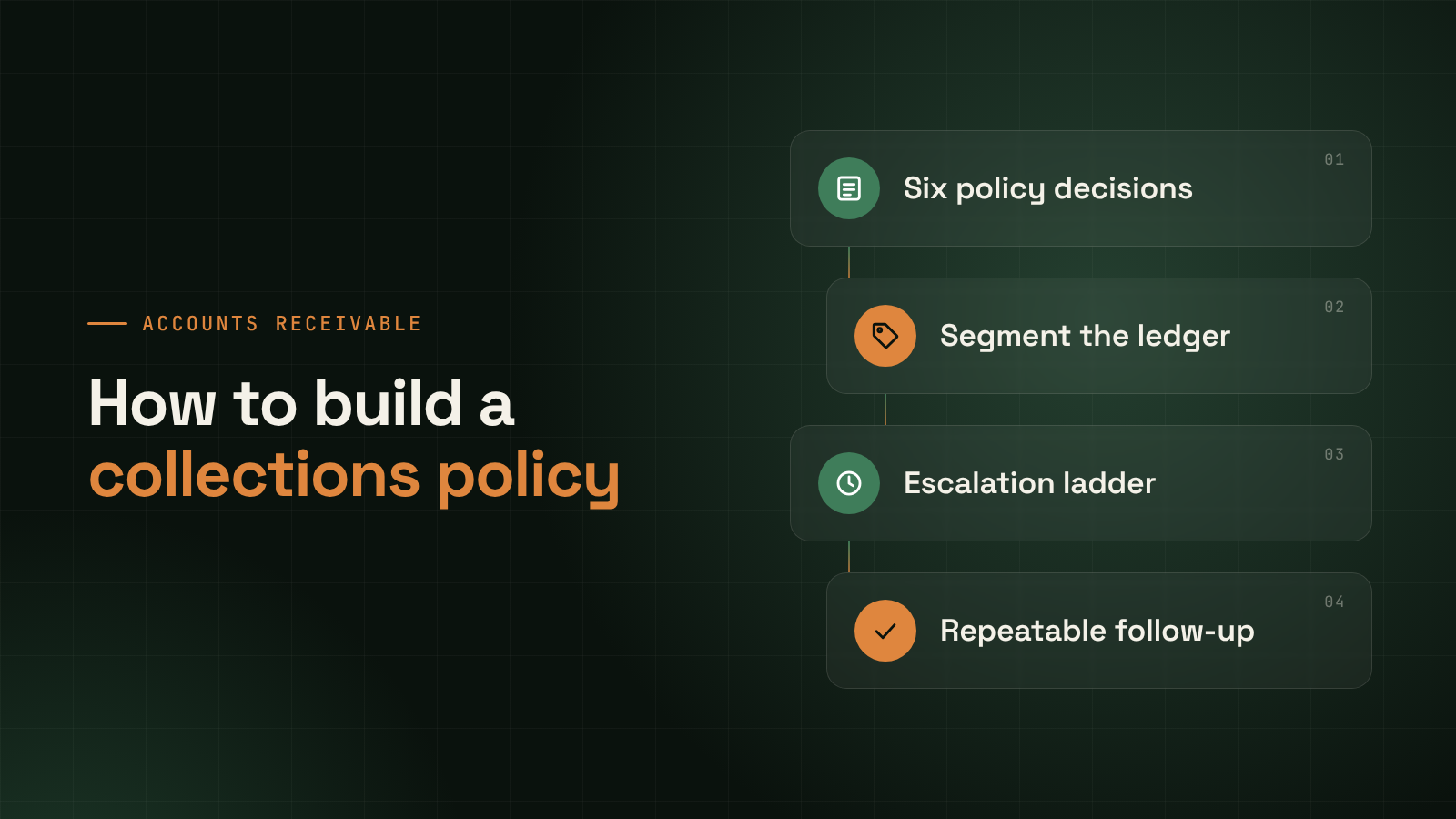
Six decisions carry the whole document: scope, segmentation, cadence, channel, authority and the stop rule. Everything else is detail hanging off those six.
Segment by exposure and payment behavior, not by aging bucket. A customer who has always paid at day 55 is a terms problem. A customer who has drifted from 45 to 75 days in two quarters is the one that becomes bad debt.
Name roles, not people, and write down where sales enters the ladder. The most common failure in a mid-market policy is an informal handoff between finance and the account manager.
A policy runs itself when the trigger does not depend on memory, every contact and commitment is recorded, and the exception queue is small enough to clear daily.
Imagine you run finance at a mid-market chemicals distributor in Rotterdam. Three people touch receivables, and each of them chases in their own way, from memory, when the day allows it. One is excellent and carries forty accounts in her head. When she took two weeks off in August, nothing went out, and two accounts you thought were safe crossed ninety days. A collections policy is a written set of rules that says which overdue accounts get chased, when, through which channel, by whom, and what happens when payment still does not arrive. Write it down and follow-up stops depending on who remembered. What the collections agent reads, drafts and escalates inside your ERP sits on accounts receivable automation.
What is a collections policy?
A collections policy is a document that converts chasing from a set of personal habits into a process producing the same result whoever is working the ledger. It covers scope, timing, wording, ownership and escalation. It starts the day an invoice becomes due and ends when the account is paid, settled, written off or referred.
It is not a credit policy. The credit policy governs what happens before you ship: limits, terms, onboarding checks, security. The collections policy governs what happens after the due date passes. The two should be written and reviewed together, because a ladder that applies credit holds depends on limits the credit policy set.
Why does follow-up end up depending on who remembered?
Because it works for a while. A small team that knows its customers collects well without writing anything down. Nothing breaks until the ledger doubles, a key person leaves, or the business adds a second entity. The absence of a policy stays invisible right up to the week you cannot explain why a large account went ninety days without contact.
The symptoms are consistent, and most are visible in your own system today.
| What you see | What it usually means |
|---|---|
| Thick contact history on ten accounts, nothing on ninety | Chasing follows familiarity, not exposure |
| Every follow-up email reads differently | No approved wording, so escalation tone depends on who is typing |
| Disputes living in one person’s inbox | No dispute owner and no clock running on resolution |
| The same promise given three times by one customer | No promise record, so nobody chased the first broken one |
| Collections stops in the last week of every month | The team is on closing, and the ledger waits |
| A customer on credit hold still receives a shipment | The policy exists in finance but not in sales and dispatch |
None of these is a people problem. Each one is a missing rule.
What decisions does the policy actually have to make?
Six. Scope, segmentation, cadence, channel, authority and the stop rule. Write those on one page before writing anything longer, because they are the decisions a person or an agent will apply hundreds of times a week. A policy that runs to fifteen pages but leaves any of the six unstated will be ignored within a month.
| Decision | The question it answers | A workable mid-market default |
|---|---|---|
| Scope | Which accounts does the policy govern | All trade receivables except strategic accounts, live commercial negotiations and anything in formal dispute |
| Segmentation | How are accounts grouped for treatment | By exposure and payment behavior, reviewed monthly, not by region or alphabetically |
| Cadence | How often, measured from what trigger | A pre-due reminder, then contact at days 3, 10, 21, 35 and 60 past due |
| Channel | Email, phone, messaging or letter, and when | Email as the record for every stage, phone from stage 2 above a value threshold, formal letter only at the legal step |
| Authority | Who can grant time, waive interest or apply a hold | Named by role and currency threshold, with credit holds applied by finance rather than negotiated by sales |
| Stop rule | What takes an account out of the routine | A logged dispute, an insolvency notice, a relationship escalation, or referral for legal recovery |
The authority row is the one most policies skip, and it is the one that causes arguments. If nobody has written down who may agree to a four-week extension on a $70,000 balance, somebody will agree to it anyway.
How should you segment the ledger before setting a cadence?
By what is at risk and how the customer has behaved, not by how overdue the invoice is today. Two accounts in the same aging bucket can need opposite treatment. One is a predictable late payer whose terms are simply wrong. The other has been slipping quarter on quarter and is the account that turns into a write-off.
Four segments cover most mid-market ledgers. Reliable late payers pay in full on their own rhythm, and chasing them harder achieves nothing: the fix is commercial, matching your terms to their payment run or moving your invoice submission deadline earlier. Drifting accounts deserve your earliest action, because the balance is growing and the replies are getting shorter. Blocked accounts are not collections problems at all, since something is unresolved, and a sixth reminder to a customer who raised a dispute twice tells them you are not reading. Genuine distress is a decision for the CFO, and the policy’s job is to surface it early and name who decides.
What does a workable escalation ladder look like?
A ladder names the stage, the day it fires, the owner, the channel and what has to be true before moving up. Published to the team, it removes the daily judgment call about whether today is too early to call someone. The day counts below are a starting point, not a standard.
| Stage | When | Owner | Channel | What it does | Condition to advance |
|---|---|---|---|---|---|
| 0 | 5 days before due | Collections executive | Statement with invoices due, gives time to flag a problem | Due date passes unpaid | |
| 1 | Day 3 past due | Collections executive | Copies of invoices, proof of delivery, a direct ask for a payment date | No dated commitment within 5 days | |
| 2 | Day 10 | Collections executive | Phone, confirmed by email | Asks for a specific date and amount, records it as a promise | Promise not given, or given and broken |
| 3 | Day 21 | Credit controller | Phone to the payables head, account manager copied | Raises the level, confirms whether a dispute exists | Still no payment or credible date |
| 4 | Day 35 | Finance head | Email to the customer’s finance head | States that new orders will need approval, proposes a plan | No agreed plan within 7 days |
| 5 | Day 60 | CFO with the account manager | Formal letter, meeting if the account warrants it | Credit hold applied, settlement or referral discussed | Decision recorded at the review point |
Two rules sit across the whole ladder. A promise recorded with a future date pauses the cadence until that date, then resumes immediately if the promise breaks. A logged dispute removes the invoice from the ladder and starts a resolution clock with a named owner. What separates a real commitment from a brush-off is covered in what is promise to pay in collections.
When does the policy say to stop chasing?
At a decision point you set deliberately, usually between 120 and 180 days, where the account moves to settlement, write-off, legal referral or a recorded commercial hold. Chasing without a decision point is how accounts quietly age past the point where anything can be recovered.
There is an outer boundary worth knowing. Most jurisdictions set a limitation period, a fixed number of years after which a claim for the price of goods sold and delivered can no longer be brought, and the clock usually starts from the due date or the delivery date. The length and the trigger vary, so check your own jurisdiction. That is a legal backstop, not a target. Decide at 120 days, record who decided, and move on.
How do you make a written policy actually run?
Three things. A trigger that does not depend on anyone remembering, a record of every contact and every commitment, and an exception queue small enough that a person clears it daily. Without the first, the ladder runs when the team has time. Without the second, you cannot tell whether it ran at all.
This is where an agent earns its place. The collections agent reads open receivables from your ERP each day, applies the ladder you wrote, drafts in wording your team approved, sends under your approval rules, then reads what comes back and writes the outcome to the account as a promise, a dispute or an escalation. The mechanics of that loop are in how does an AI collections agent work, and the promise queue it feeds is in how do you track promises to pay.
The order matters. Automating a policy you have not written produces faster chaos, not faster cash. Write the six decisions, run them manually for a few weeks, then automate the version that survived contact with your customers.
How do you tell whether the policy is working?
Coverage first. What share of overdue value had a logged contact in the last fourteen days. That number moves within weeks and tells you whether the policy is being followed at all. Then promise-kept rate, disputes logged with an owner and a date, and escalations per month.
Days sales outstanding comes last, because an average needs a quarter of history to roll off before it visibly moves. Teams that watch only that number in month one conclude nothing is working while coverage has already doubled. The fuller set of measures sits in what is DSO and how do you reduce it.
What this doesn’t do
A policy does not collect money. It removes the variability. If your ledger is overdue because invoices go out late or disputes sit unresolved, a tighter cadence chases a problem that was created upstream.
An agent does not set the policy. Scope, thresholds, escalation levels, credit holds and the decision to stop shipping stay with finance. The agent executes what you wrote.
It does not override relationships. Strategic accounts and anything in live commercial discussion belong outside the automated ladder by design, a point covered in will AI collections damage customer relationships.
It does not resolve disputes. The agent surfaces them with evidence, routes them to an owner and starts a clock. Someone still has to issue the credit note.
It is not legal advice. The limitation period above is context for deciding when to escalate, not a substitute for your counsel’s view on an account.
Frequently asked questions
What is the difference between a credit policy and a collections policy?
The credit policy governs what happens before you ship: who gets credit, how much, on what terms, and what checks run at onboarding. The collections policy governs what happens after an invoice is due. Both should name the same thresholds, because a ladder that applies credit holds depends on limits the credit policy set.
How long should a collections policy be?
Short enough that the team reads it. Two to four pages is normal for a mid-market business: the six decisions, the escalation ladder as a table, the authority thresholds by role, and the definitions of a dispute and a promise. Anything longer tends to be a procedures manual, which is a separate document.
Should the cadence be the same for every customer?
No. The cadence should follow exposure and behavior. A reliable payer who is three days late on $2,500 does not need the same treatment as a drifting account with $55,000 outstanding. What should be identical is the rule that decides which treatment applies, so the choice is not made account by account from memory.
Can an AI agent follow the collections policy we already have?
Usually, provided it is specific enough to execute. The agent needs stated triggers, a scope rule, approved wording per stage, authority thresholds and a stop rule. Most existing policies are clear on timing and vague on authority and stop conditions, so that is where the rewrite work tends to sit.
Who should sign off on a collections policy?
The finance head or CFO owns it, sales leadership agrees to the escalation points where account managers are involved, and operations agrees to how credit holds affect dispatch. A policy signed only by finance breaks the first time a held customer gets a shipment anyway.
How often should it be reviewed?
Segmentation monthly, because payment behavior changes. The policy itself once or twice a year, or sooner after a structural change: a new entity, a large new customer category, a shift in terms, or a run of escalations the ladder did not catch early enough.
Does a written policy mean customers get chased harder?
It means they get chased more consistently and earlier, which is a different thing. Most of the friction customers complain about comes from being contacted by four people in one week, or not at all for six weeks and then with a legal-sounding letter.
Where to go next
To see how the collections agent reads your receivables, applies your escalation ladder and records what customers commit to, start with accounts receivable automation. Four related reads:
Cutting DSO with AI receivables agents shows how to segment an overdue ledger before you automate anything.
How does an AI collections agent work walks the daily loop, including what happens when a customer replies.
How do you track promises to pay covers the queue that turns a verbal commitment into forecastable cash.
Will AI collections damage customer relationships sets out which accounts belong outside an automated ladder and why.
A note on sourcing, checked October 1, 2026: this article makes no claims about specific statutes. Limitation periods and collection rules vary by country, so check your own jurisdiction. Nothing here is legal, tax or accounting advice.