Table of Contents
Key takeaways
DSO, or days sales outstanding, is ending total receivables divided by credit sales for the period, times the days in that period. It is the average number of days your business takes to turn credit sales into cash.
DSO on its own misleads. Strong sales lower it even when collections get worse, which is why the Credit Research Foundation publishes it alongside best possible DSO, average days delinquent and the collection effectiveness index.
Benchmark against your own best possible DSO, not a national average. The gap between the two is the part collections can act on.
Most of that gap is not customer refusal. It is late or wrong invoices, unlogged disputes, unapplied cash, and follow-up that depends on who remembered.
Coverage moves first, then cash timing, then DSO. An average over a period is the last number to show that anything changed.
Imagine you run finance at a mid-market auto components maker in Melbourne. Your board pack says DSO is 60 days against 45-day terms, and the same question comes back every quarter: why. Your team is chasing, the aging report is open on three screens, and nobody can say which 15 days are recoverable and which are the cost of how you sell. DSO, or days sales outstanding, is the average number of days your business takes to convert credit sales into cash, calculated as ending total receivables divided by credit sales for the period, times the days in that period. Reducing it means finding where those days accumulate, which is usually earlier than the collections call. What the collections agent reads, drafts and escalates inside your ERP sits on accounts receivable automation.
What is DSO?
Days sales outstanding (DSO) is the average number of days it takes a business to collect payment after a credit sale. It is calculated as ending total receivables multiplied by the days in the period, divided by credit sales for that period, and a lower number means cash is collected faster.
DSO is one number standing in for the speed of your whole order-to-cash cycle. It answers a single question: on average, how many days does money sit as a receivable before it becomes cash. It is an average over a chosen period, not a measure of any one invoice or customer.
Because it is an average, it absorbs everything. A credit note issued late, a dispute that took five weeks to settle, a customer who reliably pays at day 70 on 45-day terms, a receipt that landed last week and was never applied: all of it lands in the same number. That is what makes DSO useful to a board and nearly useless as an instruction to a collections team.
How do you calculate DSO?
Take ending total receivables, divide by credit sales for the period analyzed, and multiply by the days in that period. The Credit Research Foundation states it as ending total receivables times the number of days in the period analyzed, over credit sales for that period. Use credit sales, not total sales, and keep the period consistent.
DSO alone does not show whether slow collection is a terms problem or a chasing problem, so the Credit Research Foundation pairs it with four other measures; the table below computes all five for one illustrative month.
Here is one month, with illustrative figures rather than any company’s reported numbers.
| Input | Value |
|---|---|
| Credit sales for the month | $700,000 |
| Days in the period | 30 |
| Ending total receivables | $1,400,000 |
| Ending current receivables (not yet past due) | $1,050,000 |
| Beginning total receivables | $1,500,000 |
| Standard terms on most accounts | 45 days |
DSO works out to 1.4 million divided by 0.7 million, times 30, which is 60 days. Two decisions matter more than the arithmetic. Use credit sales rather than all sales, because cash-and-carry revenue in the denominator flatters you. And keep receivables and sales on the same basis: receivables carry any sales tax or VAT on the invoice, while the sales line in a management pack often does not. Mixing the two inflates DSO every month and still looks stable, which is worse.
Why does DSO on its own mislead you?
Because sales volume moves it. A strong month pushes credit sales up and DSO down even if your collections team performed worse. The Credit Research Foundation itself warns that DSO is often misused and is useful mainly when tracked consistently, and publishes four companion measures alongside it. Run the same month through all five and you get an instruction rather than a headline.
| Measure | How it is calculated | The example month | What it tells you |
|---|---|---|---|
| DSO | Ending total receivables x days in period, over credit sales for the period | 60 days | How long cash sits in receivables on average |
| Best possible DSO | Current receivables x days in period, over credit sales for the period | 45 days | What DSO would be with no delinquent balances. It should line up with your terms of sale |
| Average days delinquent | DSO minus best possible DSO | 15 days | The part that is genuinely overdue, and therefore the part collections can act on |
| Percent current | Ending current receivables over total receivables | 75 percent | The share of the ledger not yet past due |
| Collection effectiveness index | Beginning receivables plus credit sales for the period, minus ending total receivables, over the same beginning receivables plus credit sales minus ending current receivables, times 100 | 70 percent | How much of what was collectible you actually collected |
Sixty days against 45-day terms looks like a 15-day problem, and average days delinquent confirms it. A collection effectiveness index of 70% means about 30% of the amount that could have been collected in the period was not collected. The Credit Research Foundation notes that values closer to 100 percent indicate more effective collection and that the index can be applied to a department or an individual, which is why it survives arguments about sales mix in a way DSO does not.
DSO also moves with how you measure it. Dividing ending receivables by a single month’s credit sales can overstate DSO after a weak sales month and understate it after a spike, so compare the same measure over several periods and read it alongside average days delinquent.
What actually makes DSO high?
Rarely a customer who refuses to pay. In most mid-market B2B ledgers the days accumulate upstream: invoices raised late or against the wrong purchase order, disputes nobody logged, receipts sitting unapplied, and follow-up that happens when somebody has an hour. Each shows up as overdue, and none of them is a collections failure.
| What you see | Likely cause | Where the days are actually lost |
|---|---|---|
| A cluster of invoices at 30 to 45 days past due with no contact history | Nobody owns the first follow-up | The first 10 days after due date, when a reminder still works |
| One large account always 20 days late, every month | Their payment run date does not match your terms | Terms and the invoice submission deadline, not collections |
| Overdue balance that disappears when you call | Cash already received, applied to the wrong invoice or unapplied | Cash application, which makes the ledger lie to you |
| Repeated short payments on the same customer | An unlogged dispute, usually short supply or a rate difference | Dispute resolution, running on email with no owner |
| A promise given, then nothing, then another promise | No promise record and no diarized review | The gap between a broken promise and the next contact |
The unapplied cash line deserves a separate look. Chasing a customer who has already paid costs you credibility in one email and inflates DSO at the same time. Getting receipts onto the right invoices is a reconciliation job rather than a collections one, and the mechanics are in SAP Business One bank reconciliation.
How do you reduce DSO?
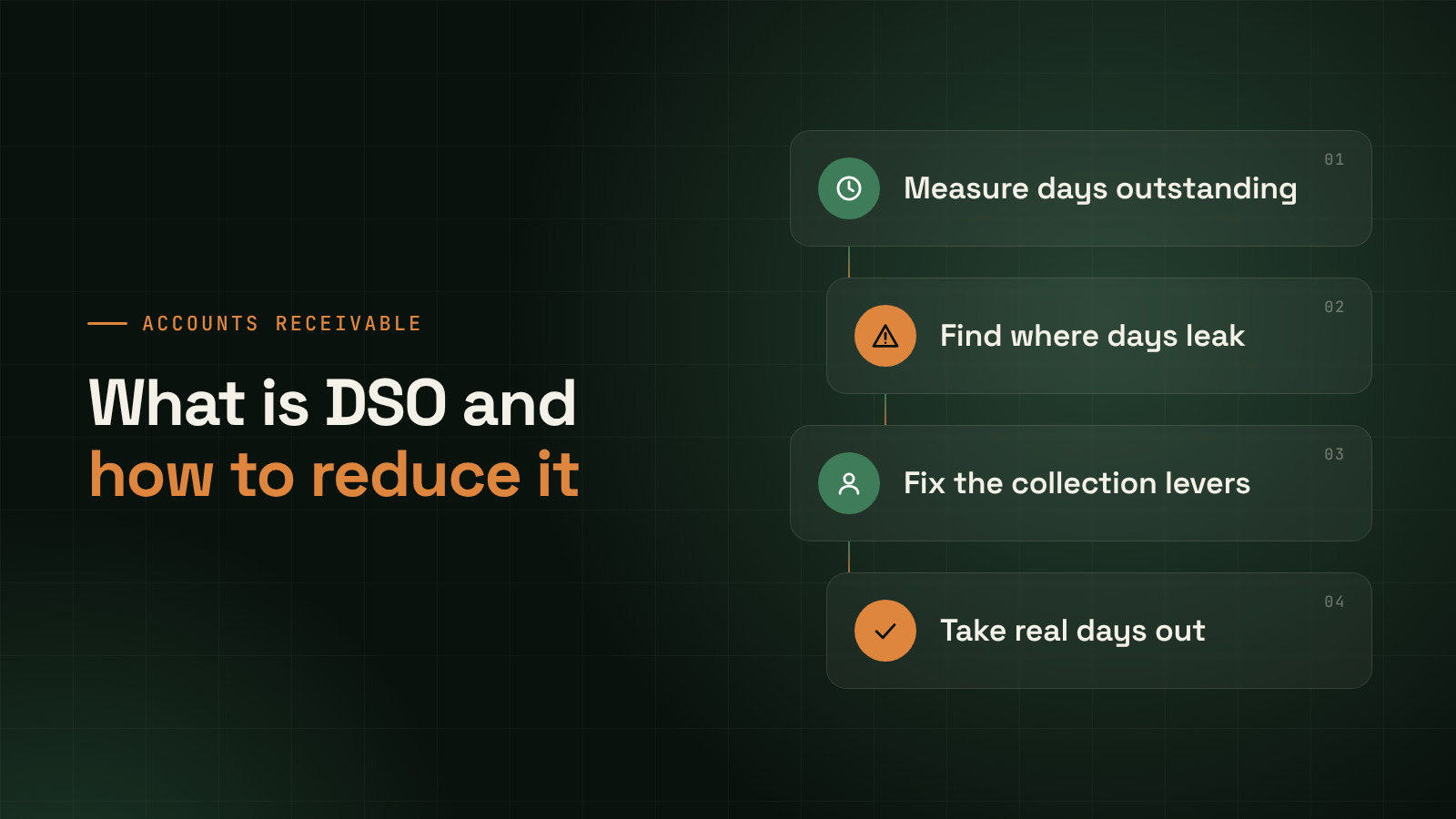
Work the levers in the order the days appear. Invoice accuracy and timing first, dispute resolution second, follow-up discipline third, terms and credit policy last. Automating follow-up on a ledger full of wrong invoices and unlogged disputes just speeds up the chasing of problems you created yourself.
| Lever | What it changes | Typical time to show |
|---|---|---|
| Invoice same day, with the customer’s PO and tax details correct | Removes rejections that restart the clock | Immediate, visible within a cycle |
| Confirm invoice receipt on high-value accounts | Catches the “we never got it” delay before day 30 | One cycle |
| Log every dispute with an owner and a date | Stops disputed invoices sitting in the dunning cadence forever | Four to eight weeks |
| Apply cash daily | Stops chasing paid invoices and corrects the aging | Immediate |
| Capture every promise with a date and specific invoices | Turns vague assurance into a reviewable commitment | Four to eight weeks |
| Chase broken promises within 48 hours | This is where recovered cash actually comes from | Four to twelve weeks |
| Segment the ledger by behavior, not aging bucket | Puts effort where exposure is, not where the report starts | One quarter |
| Revisit terms for persistent late payers | Fixes structural lateness that collections cannot | One to two quarters |
The promise step carries more weight than its position suggests. A promise with a date and named invoices can be reviewed, chased when it breaks and counted in a cash forecast. An undated assurance can be none of those. The distinction is in what is promise to pay in collections, and the review queue that makes it operational in how do you track promises to pay.
What is a good DSO?
Published DSO benchmarks vary widely by country and industry, and the most widely quoted ones come from US or European surveys. For any one business, your own trend and your own terms are the more reliable yardstick.
The Credit Research Foundation’s national summary of domestic trade receivables reported these median figures for the second quarter of 2026: DSO 37.50 days, best possible DSO 34.00, average days delinquent 3.70, percent current 87.92%, collection effectiveness index 79.35, and 0.40% of receivables more than 91 days past due.
Where do AI agents help, and where don’t they?
They help with the volume problems: contacting every overdue account on time, reading what comes back, recording promises, routing disputes to an owner, chasing broken promises within days. They do not fix billing accuracy, pricing disputes or terms you agreed to, and those are often where most of the gap sits.
The collections agent reads open receivables from your ERP, ranks accounts by exposure and behavior, drafts follow-up under your approval rules, then reads the reply and acts on it. That loop is in how does an AI collections agent work, and the operating model around it in cutting DSO with AI receivables agents. Once promise dates exist as data they feed a receipts forecast instead of a due-date assumption, the point made in AI cash flow forecasting and on cash flow management software.
How long does it take to move DSO?
Coverage first, within weeks. Cash timing second, within a month or two. DSO last, because a quarter of history has to roll off an average before it moves visibly. Teams that watch only DSO in month one conclude nothing is working, when average days delinquent and the collection effectiveness index have already moved.
What this doesn’t do
DSO does not tell you who to call. It is an average. The worked list comes from exposure, aging and behavior on individual accounts, not from the headline number.
Reducing DSO does not always mean collecting faster. Tightening terms or dropping a slow-paying customer also reduces it. Those are commercial decisions, not collections wins, and should be labeled as such.
A collections agent does not set policy. Escalation thresholds, credit holds and the decision to stop shipping stay with finance and sales.
It does not resolve disputes or fix billing. It surfaces and routes them with evidence. A short supply claim still needs someone in operations to check the dispatch.
It does not apply cash or post financial documents. Receipt matching, credit notes and journals stay inside your existing controls.
It does not replace the relationship call. When a long-standing dealer is under real pressure, the right next step is two people who know each other talking.
Frequently asked questions
What is a good DSO for a B2B business?
There is no universal benchmark, and published numbers vary by country and industry, so treat any single number you see with suspicion. The defensible target is your own best possible DSO: current receivables over credit sales for the period, times the days in the period, which should align with your terms of sale. The gap between actual DSO and that figure is your real collections opportunity.
How is DSO different from average days delinquent?
DSO includes every receivable, including invoices not yet due. Average days delinquent is DSO minus best possible DSO, so it isolates the genuinely overdue portion. If your terms are 45 days and DSO is 60, average days delinquent of 15 is the number a collections team can be held to.
Does DSO include VAT or sales tax?
Your receivables balance includes any VAT or sales tax charged on the invoice, so the sales figure in the denominator has to be on the same basis for the result to mean anything. Many management packs report revenue net of tax while the ledger carries the gross invoice value, which inflates DSO every month without ever looking unusual. Pick one basis and keep it consistent across periods.
Can you reduce DSO without damaging customer relationships?
Most of the levers never touch the customer at all: invoice accuracy, same-day billing, daily cash application, logging disputes with an owner. What strains a relationship is chasing someone who already paid, or ignoring a dispute they raised twice. Consistent, accurate follow-up reads as competence.
Will AR automation reduce DSO on its own?
Not on its own. It removes the delay caused by nobody having time to follow up, which is usually worth a meaningful share of the gap. It does not fix late invoicing, unresolved disputes or terms that do not match a customer’s payment run. If those dominate your ledger, automation will simply chase faster.
What is the fastest lever to move DSO?
Daily cash application, in most ledgers. It costs nothing in goodwill, corrects an aging report that is overstating your problem, and stops the team chasing invoices that are already paid. Capturing dated promises is usually next.
Where to go next
To see how the collections agent reads your receivables, prioritizes the day’s chase and records what customers commit to, start with accounts receivable automation. Four related reads:
Cutting DSO with AI receivables agents turns the levers above into an operating model and shows how to segment an overdue ledger first.
How does an AI collections agent work covers the daily loop, including what happens when a customer replies.
What is promise to pay in collections separates a real commitment from a brush-off, which is what makes a promise worth forecasting.
AI cash flow forecasting shows what a receipts forecast looks like once promise dates exist as data.