Table of Contents
Key takeaways
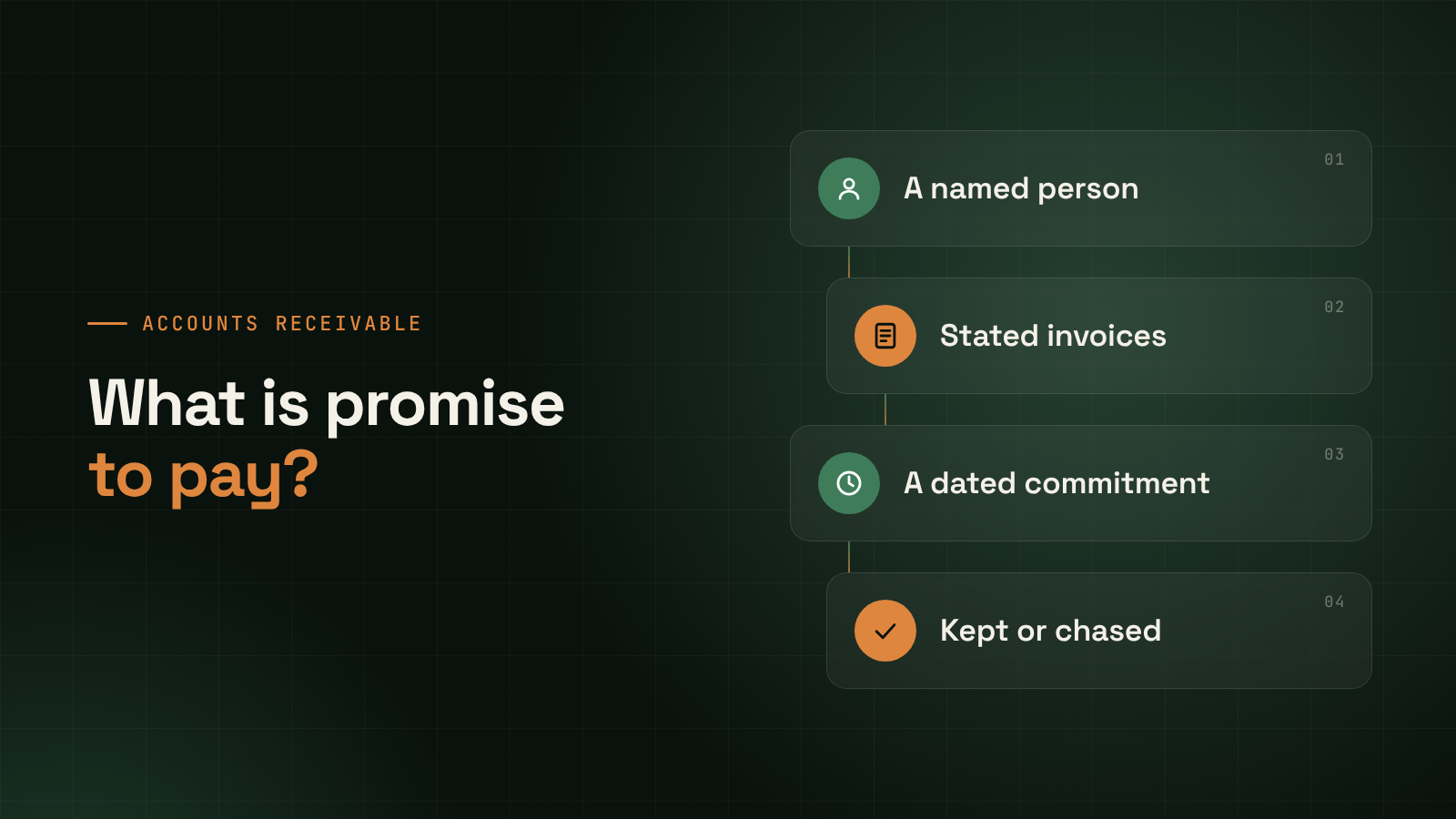
A promise to pay needs four things: a named person at the customer, a stated amount, specific invoices and a date. If any one is missing, it is a conversation, not a promise.
Reminders measure your activity. Promises measure the customer’s intent, and only one of those becomes a bank credit.
Kept rate, the share of promises honored in full by the promised date, separates a stretched customer from an evasive one faster than an aging report.
Depending on where your customer is based, how you capture the promise can matter beyond collections: a signed written acknowledgment of a debt can affect how long you have to bring a claim.
The step most teams skip is chasing the broken promise within a day or two of the date passing. That follow-up is where the cash arrives.
A promise to pay (PTP) in collections is a customer’s commitment to pay a stated amount against named invoices by a specific date, given by a named person. It is the smallest unit of collections work you can track, measure and forecast from.
Imagine you run credit control at a mid-market pump manufacturer in Texas. Your collectors spent last week on the phone, and most calls ended with the customer saying something reassuring. Nobody wrote down what was said, by whom, for how much, or against which invoices. On Friday the CFO asks which overdue accounts will pay before month end. You can describe the conversations. You cannot answer the question. A promise to pay, usually shortened to PTP, is a dated commitment from a named person at a customer to pay a specific amount against specific invoices by a specific date. It is the smallest unit of collections work that can be tracked, forecast and measured, and most mid-market finance teams never capture it.
What is a promise to pay in collections?
A promise to pay is a commitment from a named person at the customer to pay a stated amount, against stated invoices, by a stated date. It is recorded the moment it is given, assigned a review date, and checked on that date. Anything missing one of those four elements is a conversation, not a promise.
Each element does a job. The named person gives you someone to return to when the date passes. The amount shows whether the customer is committing to the whole overdue balance or a slice. The invoice reference prevents the argument three weeks later about which payment covered what. The date gives the promise an expiry, which is what separates it from an intention. A payment plan is simply several promises agreed at once, each tracked separately.
Why does a promise to pay matter more than another reminder?
Because a reminder is something you did and a promise is something the customer committed to. Reminder counts measure your team’s effort. Promises measure the customer’s intent, and intent is what becomes cash. A ledger carrying forty live, dated promises can be forecast. A ledger showing four hundred reminders sent cannot.
Most collections reporting in mid-market companies is activity reporting: calls made, statements emailed, escalations raised. None of it says what the other side agreed to, which is how a team looks busy all quarter and is still surprised in the last week. Promise tracking changes the question to “what did they commit to, and did they do it,” and that answer feeds a cash forecast, as cash flow forecasting with AI agents describes.
What separates a real promise from a brush-off?
Specificity, and nothing else. Customers rarely refuse outright. They offer a sentence designed to end the call politely, and an inexperienced collector files it as a promise. Below are the common phrases and the question that turns each into something trackable.
| What the customer says | Is it a promise? | What to do next |
|---|---|---|
| “We will release it in the next payment run” | No. No date, no amount, no invoice | Ask which run, on what date, covering which invoices |
| “$7,700 against invoices 1142 and 1156 will be released on November 12” | Yes. Person, amount, invoices, date | Record it, confirm it in writing, set a review on November 12 |
| “It is with accounts” | No. A status, not a commitment | Ask who holds it now and when they expect to clear it |
| “There is a problem with the freight line on that bill” | No. This is a dispute | Log it as a dispute with an owner and a resolution date |
The second row is what a captured promise looks like. Note how little it has in common with the other three, and how often all four get recorded as the same outcome.
Does a promise to pay mean anything legally?
Not as a spoken promise. But how you capture it can matter. In many jurisdictions, a written acknowledgment of a debt, signed or sent by the party that owes it, can affect how long you have to bring a claim, in some places by starting a fresh limitation period. The details differ widely, including what counts as an acknowledgment and how long the period is, so check the rules where your customer is based.
An email confirming an amount owed, or a signed statement of account, is the kind of document that may help. Whether a particular document qualifies turns on its wording, who sent it and the local law, so treat this as a reason to collect written confirmations rather than as legal advice.
A second pattern runs the other way. In many countries, statutory late payment rules protect smaller suppliers, for example default payment terms and interest on late business-to-business payments in the EU and the UK. If you are a small supplier, check whether such rules give you a claim, and what conditions apply, before you rely on them.
So ask for the promise in writing, in the customer’s own words, with the amount and invoice numbers in it.
What should you record when a customer makes a promise?
Six fields, captured in the same minute the promise is made rather than reconstructed later from memory. If recording one takes more than thirty seconds collectors stop doing it, so the list has to fit on a single screen.
| Field | Why it matters | What goes wrong without it |
|---|---|---|
| Promised date | Creates the follow-up trigger | Nobody knows when to chase, so nobody does |
| Promised amount | Makes the ledger forecastable | The forecast becomes a guess dressed as a number |
| Invoices covered | Lets you confirm the promise was kept | Part payments get argued about for weeks |
| Person and role | Gives you a name to return to | The account hides behind a shared inbox |
| Channel and evidence | Email, call note or message, stored | The promise becomes one person’s recollection |
| Outcome | Kept, part kept or broken, logged on the date | Kept rate cannot be measured at all |
The last row is the one teams add last and should add first. Without a recorded outcome, the whole exercise is a diary with no feedback loop.
What is promise-to-pay kept rate, and what does it tell you?
Kept rate is the share of promises honored in full, on or before the promised date, over a chosen period. Measured per customer it separates the genuinely stretched from the habitually evasive. Measured per collector it shows who is extracting real commitments and who is collecting polite noise.
Kept rate = promises paid in full on or before the promised date ÷ promises that came due in the period. Count part payments separately as “part-kept” so they do not inflate the figure.
Example (illustrative): 20 promises came due in a month. 12 were paid in full on time, 4 were part-paid and 4 were not paid. Kept rate is 12 ÷ 20 = 60%; part-kept rate is 20%.
Track a value-weighted version too (rupees kept ÷ rupees promised), because one large broken promise can hide behind a high count-based rate.
Count a promise as kept only when the full amount lands on time. Anything else is part kept or broken. Teams that count part payments as kept end up with a flattering number and a ledger that still surprises them.
| Pattern in the data | What it usually means | What to change |
|---|---|---|
| High kept rate, always paying after due date | They honor commitments and ignore your terms | A terms conversation with sales, not a collections problem |
| Many promises, low kept rate | Promises are being used to end the call | Stop accepting undated commitments; require amounts and invoice numbers |
| Few promises, slow replies | Disengagement, or a dispute nobody logged | Check open disputes and unapplied credits before chasing harder |
| Kept rate falling over two quarters | Possible credit deterioration | Review the credit limit and ask sales what they are hearing |
The last row is why a finance head should care about this metric. A falling kept rate usually shows up before the aging bucket shifts, because a customer under pressure starts breaking small promises before paying visibly late.
What happens when a promise is broken?
You go back within one or two working days, to the same person, referencing the exact commitment. Not a generic reminder and not a fresh statement. The follow-up names the amount, the invoices and the date they gave, then asks what changed. Much of the cash in a disciplined collections process arrives at this step.
Speed does the work. A chase on day two reads as diligence and signals that commitments to your company get tracked. The same chase on day fifteen reads as routine and teaches the customer that promises to you are free. A second broken promise should move the account up the escalation path in your collections policy, whether that means a call from the finance head, a credit hold or a conversation with the sales owner. What matters is that the path is set in advance and applied the same way to every account, as cutting DSO with AI receivables agents sets out.
How does a collections agent handle promises to pay?
It reads the replies. When a customer responds, the agent extracts the commitment, records it against the specific invoices in SAP, sets the review date and chases it when that date passes. Promises stop depending on whether a collector remembered to write one down, which is the real failure point in most teams.
Outbound reminder automation has existed for twenty years and it solves the half of the problem that was never the bottleneck. The bottleneck is inbound: the reply containing a date, a dispute or a part-payment plan, sitting in a shared mailbox while the next reminder goes out regardless. Because every promise is captured with an amount, an invoice set and an outcome, kept rate becomes a by-product of the work rather than a reporting exercise. What the agent reads, writes and escalates is set out on accounts receivable automation.
What this doesn’t do
It does not decide credit limits or hold supply. A falling kept rate is a signal for a credit review. That review, and any decision to stop shipping, stays with finance and sales leadership.
It does not make legal judgments. It records what a customer wrote and when. Whether a message amounts to an acknowledgment of liability is a question for your counsel.
It does not replace the relationship call. With a long-standing dealer under real pressure, the right next step is often a conversation between two people who know each other.
It does not resolve disputes. It identifies and routes them, which stops disputed invoices being chased as though they were simply late. And it does not create cash that is not there: better tracking surfaces distress earlier, it does not change the outcome.
Frequently asked questions
What does PTP stand for in collections?
PTP is the standard abbreviation for promise to pay. It means a recorded commitment from a customer to pay a specific amount against specific invoices by a specific date, tracked as its own item rather than a note on an account.
Is a verbal promise enough, or does it have to be in writing?
No, record it, but ask for written confirmation with the amount and invoice numbers, because a signed written acknowledgment can start a fresh limitation period under Section 18 of the Limitation Act, 1963.
What is a good promise-to-kept rate?
There is no single target. We have not found a credible published kept-rate benchmark for mid-market B2B ledgers [date checked], so compare your own rate over time, by customer and by collector.
How is a promise to pay different from dunning?
Dunning is the outbound sequence of reminders you send as an invoice ages. A promise to pay is what the customer commits to in response. Dunning is your activity; the promise is their intent. Tracking only the first half measures effort, not results.
Does the collections agent contact our customers without approval?
No, your team sets the policy, approves the message templates and chooses the accounts in scope; the agent runs that cadence and escalates exceptions.
Does it work with SAP Business One and S/4HANA?
Yes. The agent reads open items, aging, customer master data and payment history from your ERP, and records promises against the actual invoice documents. No parallel receivables database sits alongside your ledger.
Will tracking promises damage relationships with long-standing dealers?
Done badly, chasing can. Done properly it usually helps, because the customer stops receiving identical reminders after already telling you when they will pay. Following up on the date they agreed reads as attentive, not aggressive.
Where to go next
To see what the collections agent reads, records and escalates inside SAP, start with accounts receivable automation, the current home for collections detail while a dedicated collections page is built. Three related reads:
Cutting DSO with AI receivables agents sets out the operating model promise tracking sits inside, including how to segment an overdue ledger first.
AI agent governance: approvals, audit trails and human-in-the-loop controls answers the control questions that arise as soon as an agent talks to your customers.
The MSME 45-day payment rule and your AP cycle time covers one example of that statutory clock from the buyer side, in India.
A note on sourcing, checked October 28, 2026: the legal points above are deliberately general. Limitation periods, the effect of a written acknowledgment and statutory late-payment regimes differ by country, so no section numbers, periods or rates are stated and you should confirm the rules in your own jurisdiction. The 60-day default for B2B payments under the EU Late Payment Directive is cited as one example among several. No kept-rate or DSO benchmark is quoted, because no first-hand source publishes one for mid-market B2B ledgers. Nothing here is legal advice, and the opening scenario and sample phrases are illustrative.