Table of Contents
Key takeaways
Tracking a promise to pay means giving it a record of its own, a review date and a logged outcome. A note typed into an account comment box is not tracking.
Every promise needs a status that changes over time: open, due today, kept, part kept, broken or superseded. Without the status, nobody knows what to chase this morning.
The review queue is the whole system. If promises falling due today do not appear in front of a named person before lunch, the rest of the design does not matter.
Four numbers tell you whether tracking is working: kept rate, promise coverage of the overdue ledger, median days to chase a broken promise, and promised cash actually received.
Promise tracking breaks at scale for ordinary reasons: part payments nobody matched, collectors who left, and reviews that slip to Friday.
Imagine you run collections for a mid-market auto components maker in Manchester. Four collectors worked the overdue ledger last week and came back with twenty-two commitments, now sitting in four places: a spreadsheet, two notebooks and a shared inbox. On the 10th, six of those dates pass and nobody notices, because nothing anywhere shows a promise coming due. Tracking promises to pay means giving each commitment its own record, a review date and a logged outcome, then working that review queue every day. It is the difference between a ledger you can forecast and a stack of conversations you can only describe. For the underlying definition, what is promise to pay in collections covers what makes a commitment a promise rather than a brush-off. This article is about the machinery around it.
What is the simplest way to track promises to pay
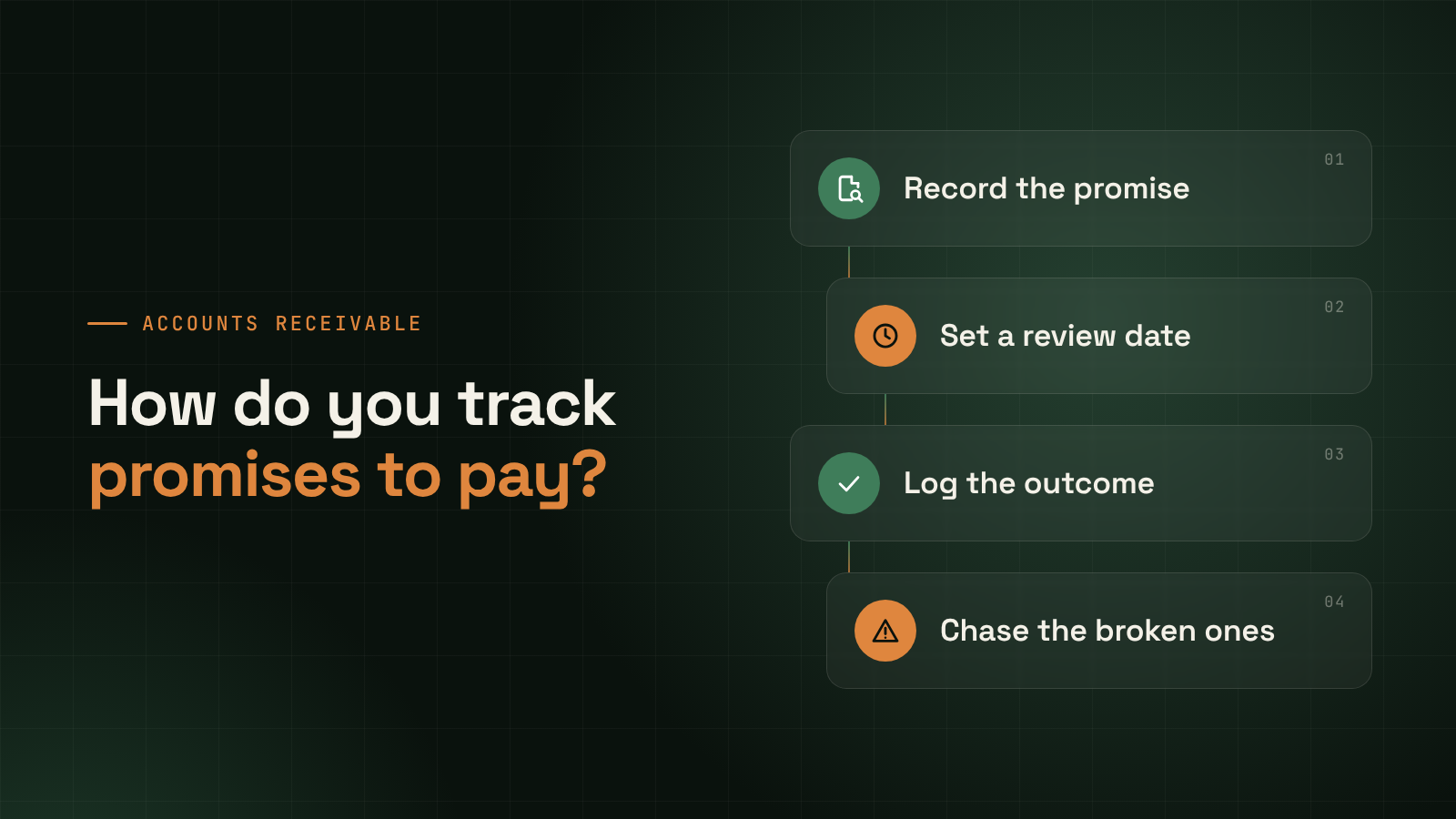
Record every promise as its own entry with the customer, invoices covered, amount, promised date and owner; set a review date; log the outcome as kept, part kept or broken; and chase broken promises within two working days. A shared spreadsheet is enough while the number of live promises is small.
Those five steps are the whole method. What separates a team that collects from a team that chases is whether step four actually happens. Most teams capture something, put a date on it, and even look at the list occasionally. Then the date passes, the payment either arrives or does not, and nobody writes down which. The record stops being a tracking system and becomes an archive of good intentions.
Where should promises live: a spreadsheet, the CRM or the ERP?
Next to the invoices. A promise that sits away from the open items it covers has to be reconciled by hand, which is where the discipline dies. Put it in the ERP against the specific documents if you can. A spreadsheet works at small volume provided one person owns it. A sales CRM is almost always the wrong home.
A spreadsheet works for a single collector with a short list of live promises; once several people or the ERP’s open items are involved, the promise needs to sit next to the invoice it relates to.
| Where it lives | Works when | Where it fails |
|---|---|---|
| Spreadsheet | One or two collectors, under roughly forty live promises, one owner | Nobody can tell what is live today; version conflicts; the file leaves with the person who built it |
| Sales CRM | Sales owns the chase and already lives there | Promises are not linked to invoice documents, so part payments cannot be matched without manual work |
| Shared inbox and notes | Never, as a system of record | The promise exists only inside a thread nobody else reads |
| ERP, against the open items | You want the promise, the invoice and the receipt in one place | Mid-market ERP setups often have no promise object, so teams improvise with user-defined fields |
The last row is where most SAP-running mid-market companies land. SAP documents a promise to pay object in Collections Management for S/4HANA, but plenty of teams run SAP Business One, or run S/4HANA without that component configured, and carry promises in a user-defined field instead. The design question is not which tool to buy. It is where the promise record sits in relation to the invoice.
What does a promise record need to be trackable?
Beyond the person, amount, invoices and date, it needs two things a static note never has: a status that changes, and an owner who sees it change. The status is what the review queue filters on. The owner is who gets asked when a promise goes quiet.
Six statuses cover almost every real case.
| Status | What it means | What happens next |
|---|---|---|
| Open | Promised date is in the future | Nothing. It sits in the queue and waits |
| Due today | The promised date has arrived | Check receipts before close of business and set an outcome |
| Kept | Full amount received on or before the date | Close it; the invoices should now be cleared |
| Part kept | Some of the promised amount received | Log the shortfall and get a new promise for the balance, as a new record |
| Broken | Date passed, nothing received | Chase within two working days, then escalate per policy |
| Superseded | The customer renegotiated before the date | Close the original as superseded and open the replacement; never edit the original |
The superseded rule matters more than it looks. Teams that overwrite the original date lose the only evidence that an account keeps moving the goalposts, which is the most useful thing promise history tells you about a customer.
How do you run the daily promise review?
Someone opens the queue each morning, filters for promises due today and overdue-unresolved, and checks them against yesterday’s bank receipts. Each one gets an outcome before the day closes. Fifteen minutes for most mid-market ledgers. The review is a fixed slot, not a task that happens when the week is calm.
Three things make it survive a busy month end. Pair the review with your bank receipt posting, so you are checking against applied cash rather than a hunch; getting receipts onto the right invoice is covered in SAP Business One bank reconciliation. Give the queue one owner per day, because a shared queue is an unworked queue. And treat an unresolved promise from last week as more urgent than a new one falling due today.
Part payments deserve their own rule. When $4,500 arrives against a promise of $7,700, the temptation is to mark it kept and move on. Log it as part kept, record the shortfall, and raise a fresh promise for the balance with its own date. Otherwise the ledger shows a customer who keeps every promise while owing you money every month.
How do you chase a broken promise without damaging the relationship?
Go back fast, to the same person, quoting their own commitment. Name the amount, the invoices and the date they gave, then ask what changed. One short message or call, not a reissued statement. Speed is what makes it read as diligence rather than pressure, and the first chase recovers a good share of broken promises.
Set the escalation ladder in advance and apply it the same way to every account, so no collector has to decide in the moment how hard to push.
| Event | Action | Who owns it |
|---|---|---|
| First broken promise | Same-person follow-up within two working days, quoting the commitment | Collector |
| Second broken promise on the same invoices | Written follow-up copying the customer’s finance lead, new date required in writing | Collections lead |
| Third broken promise, or a new dispute raised at the chase | Account review: credit limit, open disputes, the sales owner’s read on the account | Finance head with sales |
| Promised amount unpaid beyond the agreed escalation window | Decision point: credit hold, payment plan or recovery route | Finance leadership |
None of those steps is an automated reminder sequence. Dunning cadences handle invoices that are simply late. A broken promise is a different event, because the customer already told you what they would do, and treating it as another dunning cycle teaches them that promises to your company cost nothing.
How do you know whether promise tracking is working?
Watch four numbers monthly. Kept rate shows whether the commitments you accept are real. Promise coverage shows how much of the overdue ledger is covered by a live promise at all. Days to chase shows whether the queue is being worked. Promised cash received shows whether any of it reached the bank.
How do you calculate the promise kept rate?
Promise kept rate by count is promises kept divided by promises due. Kept rate by value is the amount received against promises divided by the amount promised. If ten promises are due and nine are kept, the count rate is 90%; if the one broken promise was $40,000 of a $100,000 total, the value rate is 60%. Track both: the count shows discipline, the value shows cash.
Kept rate on its own flatters you, because a team that records only the promises it expects to be kept reports a fine number against an unchanged ledger. Coverage is the honest partner metric: if $390,000 is overdue and promises cover $68,000 of it, most of your ledger is not in a conversation at all. Median days to chase should be two or lower. Promised cash received, against promised cash due in the period, is the number a CFO will ask for, and it is what makes a promise ledger usable as a forecast input alongside AI cash flow forecasting.
Why does promise tracking break down at scale?
Rarely because the design was wrong. It breaks because the daily review slips, because part payments go unmatched, because a collector leaves with an undocumented queue, or because promises were captured in a channel nobody searches. Each failure is ordinary, and each shows up early in the coverage number.
| What you see | Likely cause | Fix |
|---|---|---|
| Kept rate looks excellent, ledger unchanged | Only comfortable promises are being recorded | Measure coverage of the overdue balance, not kept rate alone |
| Promises captured on calls, none from email replies | Replies land in a shared inbox nobody mines | Capture from every channel the customer actually uses |
| Lots of promises due today, no outcomes logged | The review slot is not owned | One named owner per day, fifteen minutes, fixed time |
| Repeat part payments marked kept | No part-kept status exists | Add the status and raise a new promise for the balance |
| Queue empties when a collector is on leave | Promises live with the person, not the account | Move the record next to the invoices in the ERP |
How does a collections agent track promises to pay?
It reads customer replies across email and messaging, extracts the commitment with its amount, invoices and date, writes the promise against the open items in SAP, sets the review date and raises the chase when the date passes. Capture stops depending on whether a collector remembered. The queue is built from what customers actually said.
Two consequences matter more than the automation. The first is coverage: when every reply is read, promises come from the whole ledger rather than from the accounts a collector had time to call. The second is evidence: each promise carries the message it came from, so the chase can quote the customer’s own words. Part payments get matched against the promise rather than the invoice alone, so a shortfall shows up as a shortfall. What the agent reads, writes and escalates inside your ERP is set out on accounts receivable automation.
What this doesn’t do
It does not decide who gets chased harder. Escalation thresholds, credit holds and the decision to stop shipping stay with finance and sales leadership. The agent applies the ladder you wrote; it does not invent one.
It does not send whatever it likes. Your team approves the templates, the cadence and the accounts in scope. Anything outside the approved pattern escalates to a person rather than being improvised.
It does not judge creditworthiness. A falling kept rate is a signal for a credit review, not a verdict.
It does not replace the relationship call. With a dealer of fifteen years under real pressure, the right next step is often two people who know each other talking, and the tracking is what tells you that call is needed.
It does not create cash that is not there. Better tracking surfaces distress earlier and removes excuses. It does not change what a struggling customer can pay.
Frequently asked questions
How do you track promises to pay in a spreadsheet?
One row per promise, with columns for customer, person, amount, invoice numbers, promised date, status and outcome, and a filter for everything due today or overdue-unresolved. It works at low volume with a single owner. It stops working once promises outlive the person maintaining the file or part payments need matching against invoices.
How often should promises to pay be reviewed?
Daily, in a fixed slot, against the previous day’s bank receipts. A weekly review means a promise broken on Monday is not chased until Friday, by which point the follow-up reads as routine rather than attentive. Most mid-market ledgers need fifteen minutes a day.
What should you do when a customer breaks a promise to pay?
Contact the same person within two working days, quoting the amount, invoices and date they committed to, and ask what changed. Then apply whatever your escalation policy says for a first, second or third break. The speed of that first chase matters more than its tone.
Can promises to pay be tracked inside SAP?
Yes, though how depends on your setup. SAP’s Collections Management for S/4HANA documents a promise to pay object. Teams on SAP Business One, or on S/4HANA without that component configured, usually track promises in user-defined fields against the open items, which keeps the promise next to the invoices it covers.
What is the difference between tracking promises and running a dunning cadence?
Dunning is your outbound sequence as an invoice ages. Promise tracking records what the customer committed to in response and follows up on that commitment. One measures your activity, the other their intent. Running only the first is why teams send reminders to customers who already gave a date.
Does promise tracking need a separate system alongside our ERP?
It should not. A separate database means reconciling promises against invoices by hand, which is the step teams stop doing within a quarter. Keep the promise against the open items in the ERP so that receipts, invoices and commitments are read from the same place.
What counts as a kept promise: the amount, the date, or both?
Both. A kept promise is one where the promised amount arrives by the promised date, allowing a short grace window you define in advance, such as one working day for bank clearing. Less than the full amount is part kept; nothing by the end of the window is broken. Write the rule down so every collector logs outcomes the same way.
Should a customer’s promise pause the payment reminders?
Usually yes, until the promised date. Chasing a customer who has just committed to a named day can sour the relationship and add noise. Pause routine reminders for the invoices the promise covers, keep chasing any other overdue items, and restart the cadence the day after the date passes if the money has not arrived.
How do you log a promise that covers several invoices?
Record one promise with the total amount and list every invoice it covers, so the payment can be matched to the whole commitment. If the customer pays some invoices but not others, mark the promise part kept, record what arrived, and log a new promise for the balance. Split it by invoice only if the customer gave a separate date for each.
What do you do when a customer keeps promising and not paying?
Treat repeated broken promises as a signal, not a routine. Follow the escalation ladder: after the second broken promise, the collections lead follows up in writing; after the third, the finance head and sales step in together. Stop accepting open-ended promises, and ask for a named date, an amount and a payment method each time.
How do you report promise performance to the CFO?
Keep it to one page: promises due this week, kept rate by count and by value, broken promises with the days since the promised date, and the share of the overdue balance covered by a dated promise. Lead with value, because one large broken promise can outweigh many small kept ones.
Where to go next
To see how the collections agent captures promises from customer replies and chases them inside your ERP, start with accounts receivable automation, which is the current home for collections detail while a dedicated collections page is built. Three related reads:
What is promise to pay in collections defines the commitment itself and shows how to tell a real promise from a brush-off.
Cutting DSO with AI receivables agents places promise tracking inside a full collections operating model, starting with how to segment an overdue ledger.
AI agent governance: approvals, audit trails and human-in-the-loop controls answers the control questions that follow once an agent is writing to your ledger and messaging customers.