Key takeaways
- Days sales outstanding (DSO) measures how long, on average, it takes to turn credit sales into cash. To reduce DSO with AI, you first have to know which part of the delay is yours: late invoicing, unapplied cash, disputes or customers who simply pay late.
- Segment before you automate. A single reminder cadence for every customer treats a reliable payer, a disputing payer and a slow, stretched one identically, and it is wrong for all three.
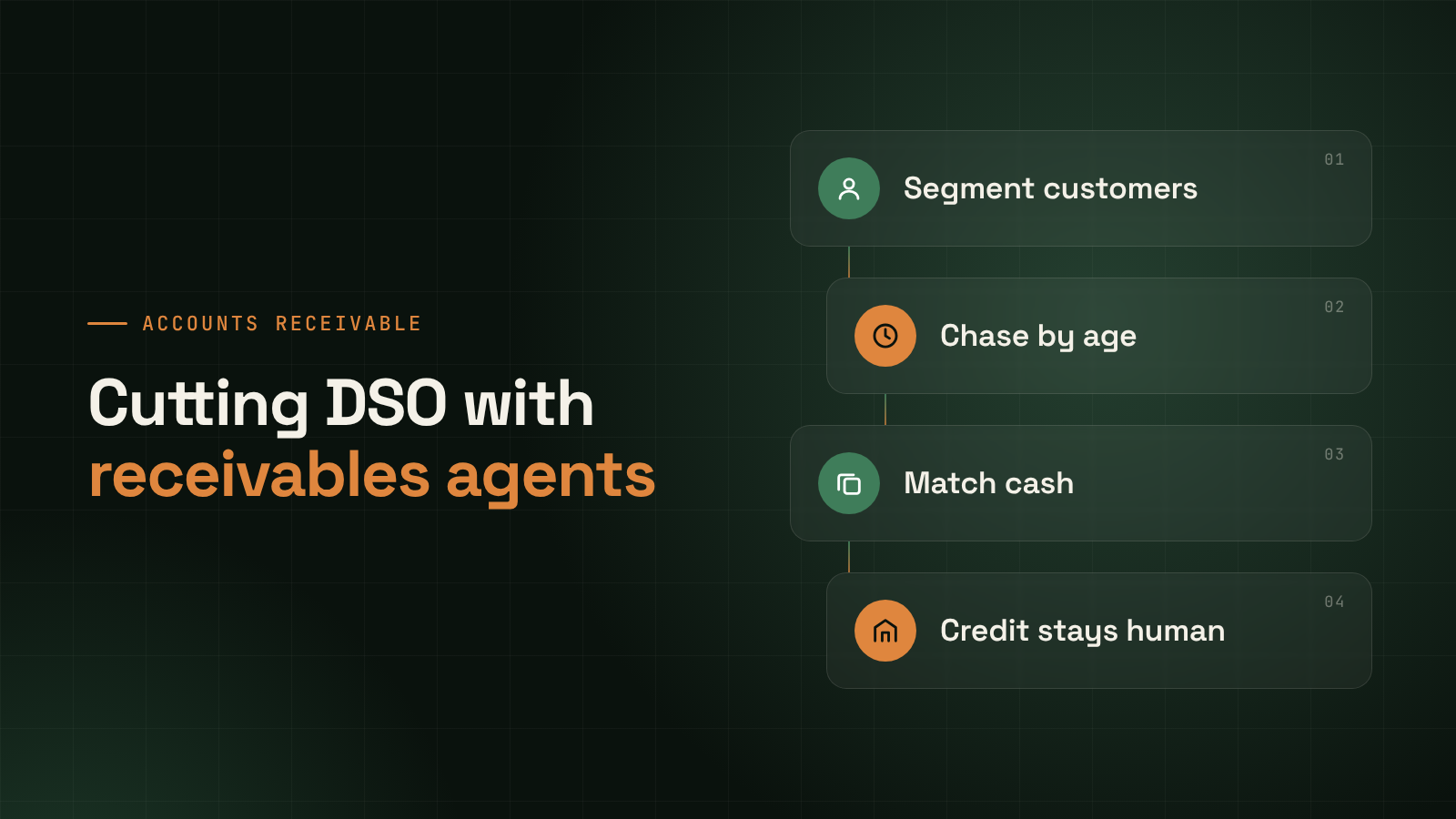
- An agent earns its keep in three places: cash application, reminders paced by each customer’s behavior, and triage of disputes. Each removes handling time that otherwise delays cash.
- Credit decisions stay human. Limits, holds, write-offs and concessions are decisions about risk and relationships, and an agent should prepare the case, not make the call.
- Measure DSO alongside its parts. A falling average that hides a growing tail of old invoices is not an improvement.
Days sales outstanding is the average number of days it takes a business to collect payment after a credit sale, conventionally calculated as accounts receivable divided by credit sales for the period, multiplied by the number of days in that period. The lower it is, the sooner sales turn into cash.
Imagine you run a business that sells goods to other companies on credit. Your sales are healthy, yet cash always seems a fortnight behind. Three things are happening at once. Invoices go out days after dispatch. Payments land in the bank but sit unapplied for a week because the remittance reference does not match. And your collections team sends the same reminder to everyone on the same day, including the customer who pays in time and the one who is quietly disputing a short delivery. Only one of those is a collections problem.
This article sets out an operating model: where the delay sits, how to segment, and where an agent works and must not.
What is DSO and how is it calculated?
DSO is accounts receivable divided by credit sales for a period, multiplied by the days in that period. A business with receivables equal to half a month’s credit sales has a DSO of about fifteen days. Definitions vary slightly, so fix yours and apply it consistently before comparing periods.
| Variation | What changes | Why it matters |
|---|---|---|
| Total or credit sales | Whether cash sales are in the denominator | Mixing cash sales makes DSO look better than collections are |
| Period length | Month, quarter or trailing twelve months | Short periods swing with seasonality and billing dates |
| Best possible DSO | Commonly, only receivables not yet due over credit sales | The gap to actual DSO isolates overdue balances |
The gap between actual DSO and best possible DSO is the most useful framing for an operating model, because it separates delay you can act on (overdue balances) from delay agreed in your terms.
For the working-capital view of why it matters, see AI cash flow forecasting, which turns the same receivables into a forward cash position.
Where does the delay in DSO actually come from?
Five places, and only some of them are collections. Late invoicing, unapplied cash, disputes, customers paying outside terms and credit terms that are simply long. An agent can help with the first three directly. The last two are commercial and credit decisions.
| Source of delay | What it looks like | Who owns it | Agent role |
|---|---|---|---|
| Late or wrong invoicing | Invoice issued days after dispatch, or rejected for an error | Sales operations, billing | Flags uninvoiced dispatches |
| Unapplied cash | Money in the bank, invoice still open | Finance | Matches payments to invoices |
| Disputes | Customer holds payment over a quantity, price or quality issue | Sales, operations | Triages and routes with evidence |
| Habitual late payment | Customer pays on its own schedule | Credit control | Paces reminders, escalates patterns |
| Long agreed terms | Net terms offered to win the order | Commercial leadership | None; this is a policy choice |
Part of your DSO may be a decision somebody made at quotation. The way an order moves from quote to cash is covered in quote-to-cash automation and cycle time.
How should you segment before you automate?
Group customers by how they behave, not by size alone, and give each group its own treatment. Four segments cover most mid-market books: reliable payers, predictable late payers, disputers and high-risk accounts. Without segmentation, automation just sends the wrong message faster.
- Reliable payers. They pay within terms or a day or two outside. Leave them alone, or send a light reminder shortly before the due date. Chasing them damages the relationship and wastes effort.
- Predictable late payers. They pay consistently, but at a fixed lag after the due date. Pace reminders to their rhythm and treat the lag as information rather than failure.
- Disputers. They withhold payment pending a specific issue. Reminders are counterproductive until the dispute is resolved, so route these to whoever can resolve it.
- Higher-risk accounts. Payment is deteriorating, or the pattern has changed. These need a person, with the agent supplying history and aging.
Build segments from how long each customer actually took to pay recently, not from their terms, and revisit them as behavior changes.
Where does the agent work?
In three places: applying cash to invoices, pacing reminders by customer behavior, and triaging disputes. Each is high in handling and low in judgment, which is precisely where an agent removes delay without taking on risk.
Cash application. The agent reads bank and remittance information, matches receipts to open invoices, and handles the messy cases: one payment covering several invoices, short payments, deductions and references that differ from your records. Unmatched items go to a person with a likely explanation. Faster application means your open-invoice list tells the truth, which stops you chasing customers who have already paid. The matching itself is explained in how AI reconciliation matching works, and for SAP Business One users, bank reconciliation in SAP Business One covers the bank side.
Dunning by behavior. Instead of a fixed calendar, reminders follow the segment. Reliable payers get a light touch, predictable late payers are nudged before their usual lag runs out, and promises to pay are recorded and followed up. The tone, channel and escalation path are set by you, not improvised by the agent.
Dispute triage. When a customer queries an invoice, the agent classifies the reason, pulls the supporting documents such as the order, delivery record and invoice, and routes it to the owner. This matters because a dispute that waits three days for the right person is three days of delay you are attributing to the customer.
The cash flow management agent then uses the cleaner receivables to project cash. All of this sits alongside, not above, your credit control.
What must stay human?
Credit decisions. Setting limits, placing accounts on hold, agreeing payment plans, offering concessions and writing off balances are judgments about risk and relationships, and they carry authority. An agent should assemble the case and recommend, and a named person should decide and be recorded as having decided.
A wrong reminder is an embarrassment. A wrongly applied credit hold can stop a key customer’s deliveries. Keep the agent on the first kind of action and a person in front of the second. The principles for bounding what an agent may do are in AI agent governance controls.
How do you measure whether it is working?
Track DSO alongside the components that explain it, not on its own. A single average can fall while old invoices accumulate, or rise because of a billing-date change that has nothing to do with collections.
| Measure | What it tells you | Warning sign |
|---|---|---|
| DSO and best possible DSO | Total delay, and the overdue part of it | The gap is not narrowing |
| Aging profile | Where balances sit by days overdue | A growing tail of old items behind a good average |
| Time to apply cash | Days from receipt to application | Unapplied cash building up |
| Dispute cycle time | Days from query to resolution | Disputes aging in a queue |
| Promise-to-pay kept rate | How often commitments are honored | Promises recorded and then ignored |
Take a baseline before any change, and compare like periods to allow for seasonality. If you cannot show the baseline, any improvement is a claim rather than a result.
What this doesn’t do
- It does not make customers pay faster by itself. It removes your own delay and focuses effort, but a customer who chooses to pay late still has to be managed by a person.
- It does not set credit terms or limits. Those are commercial and risk decisions.
- It does not fix late or wrong invoicing at source. It can flag the problem, but billing discipline sits with your own team.
- It does not resolve disputes. It classifies and routes them with evidence, and someone with authority decides.
- It does not guarantee a DSO figure. Results depend on your customers, terms and starting point.
Frequently asked questions
How do you reduce DSO with AI?
Start by finding where your delay actually sits, then use an agent where handling time is the cause: applying cash, pacing reminders by customer behaviour and triaging disputes. It does not change customers’ intentions. It removes your internal delay and focuses people on the accounts that need them.
What is a good DSO?
There is no single good figure, and you should be cautious of anyone who quotes one. It depends on your industry, your payment terms and your customer mix. A more useful target is the gap between your actual DSO and your best possible DSO, which isolates overdue balances.
Can an AI agent apply customer payments automatically?
Yes, within rules you set. It matches receipts to open invoices, including payments covering several invoices or short payments, and sends unmatched items to a person with a likely cause. Unclear cases should always be reviewed, not forced.
Will automated reminders upset customers?
They can, if every customer gets the same message on the same day. Behaviour-based reminders reduce that risk by leaving reliable payers alone and holding reminders for customers with open disputes. You set the tone, timing and channel, and review them.
Should an AI agent decide credit holds or write-offs?
No. These are decisions about risk and relationships, and they carry authority. The agent can prepare the history and a recommendation, and a named person should make and record the decision.
How long does it take to see an effect on DSO?
It depends on your starting point. Gains from faster cash application tend to appear first because they remove an internal delay. Change from behavioral reminders and dispute handling takes longer to show, since it depends on customer response. Baseline first, then compare like periods.
Where to go next
To see how the collections agent applies cash, paces reminders and routes disputes inside your SAP, start with accounts receivable automation.
Related reading:
- AI cash flow forecasting, on turning receivables into a forward cash view.
- Quote-to-cash automation and cycle time, on where delay enters before the invoice.
- How AI reconciliation matching works, on the matching behind cash application.