Table of Contents
Key takeaways
- A gap between GSTR-2B and your purchase register is normal. The two are built on different clocks: your books record an invoice when you book it, GSTR-2B records it when your supplier files it inside a fixed window.
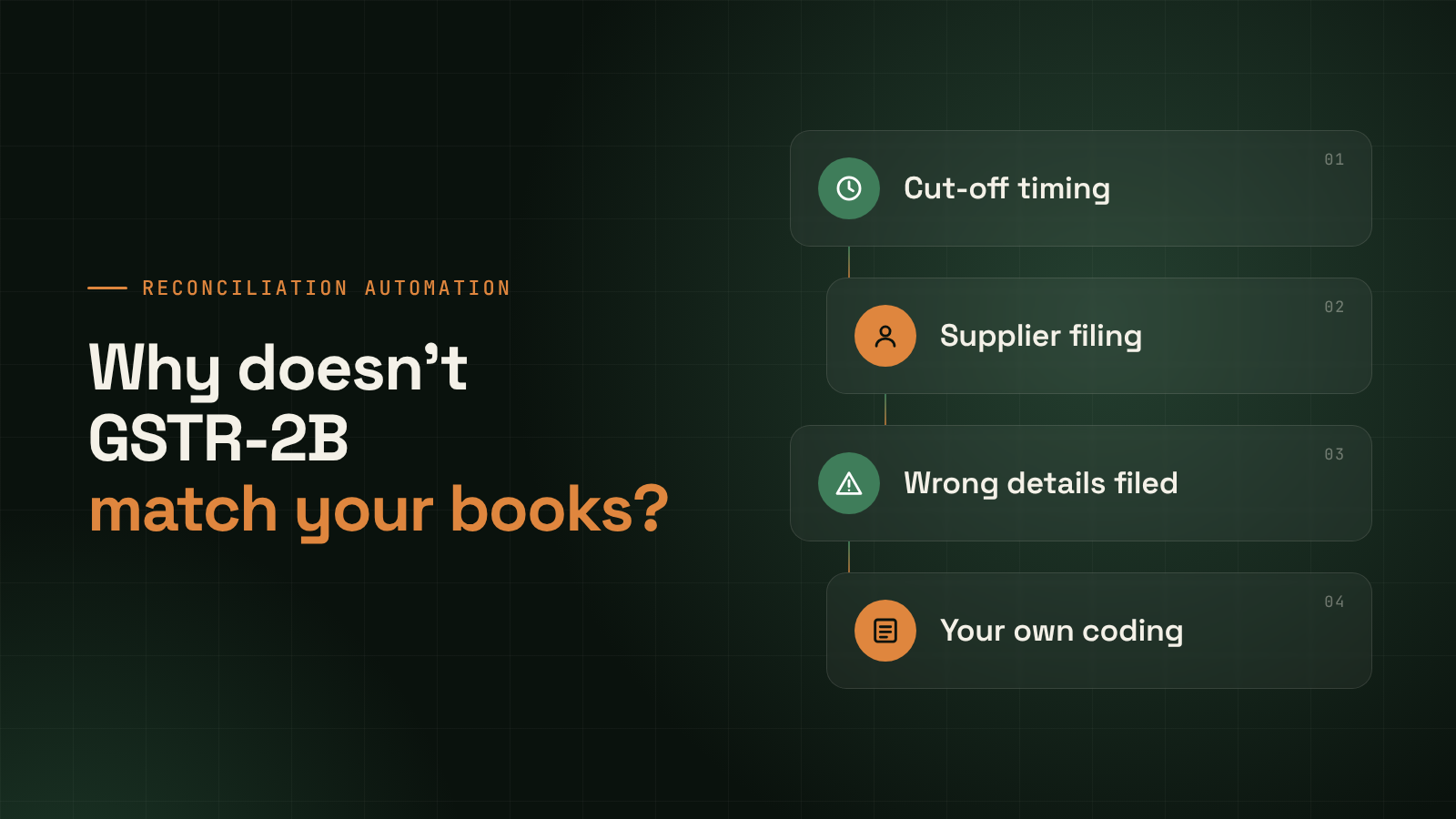
- Eight causes explain almost every difference, and they fall into three groups: differences that are not errors at all, differences the supplier must fix, and differences that sit in your own books.
- The group matters more than the cause. A timing difference needs nothing, a supplier difference needs a chase with a date on it, and a books difference needs a correction you can make today.
- GSTR-2B shows credit as “not available” in only two situations. Everything else that is ineligible is for you to identify and reverse yourself.
- You can usually name the cause from the pattern of the difference before opening a single invoice. The diagnostic table below is built for that.
Why does GSTR-2B not match your books? GSTR-2B is the credit statement India’s GST portal builds for every registered buyer, so if you buy from, sell into or run an entity in India, a mismatch is a monthly event. Teams elsewhere see the same pattern when VAT returns meet supplier filings. A finance controller opens GSTR-2B on the 14th, drops it beside the purchase register, and finds the totals do not agree. The reflex is to assume somebody made a mistake. Often nobody did. The statement and the register are answering different questions, on different dates, from different sources, and a gap between them is the default state rather than a fault.
That does not make the gap harmless. Some of it resolves itself next month. Some of it is credit sitting on a supplier’s unfiled return. This article sorts the causes so that you spend your effort on the second kind.
If you want the mechanics of the comparison itself, how to reconcile GSTR-2B with your purchase register covers the match fields and result categories. This piece is about what the differences mean once you have them.
Why does GSTR-2B not match your books?
Because GSTR-2B is built from what your suppliers filed, inside a fixed cut-off window, while your books record what you received and booked. Timing, supplier errors, supplier non-filing and your own coding all open a gap, and some purchases never appear in GSTR-2B by design.
The GST portal describes GSTR-2B as a read-only, static statement. You cannot edit it or add a document to it. So when the two disagree, the statement is not the thing that will change. Either the next statement will carry the document, or somebody has to correct a record at source.
Which differences are not errors at all?
Four. These are the ones to rule out first, because chasing them wastes a supplier’s patience and your own time.
| Cause | What you see | Why it is not an error |
|---|---|---|
| Cut-off timing | Invoice in your books this month, in next month’s GSTR-2B | The statement picks up filings made between the 12th of the month and the 11th of the next. A supplier who files on the 13th lands in the following statement |
| Quarterly filer | A supplier’s invoices arrive together at quarter end | Quarterly filers have a different window, running from the 14th to the 13th, and the statement is generated per quarter for them |
| Reverse charge | Purchase booked with credit, absent from the available-credit total | Reverse charge supplies are listed separately, tax is declared and paid by you, and credit follows payment |
| Import of services | Booked in your register, nowhere in GSTR-2B | The portal states that reverse charge credit on import of services is not part of the statement |
Two further cases belong in the same group but behave differently. Import of goods comes from customs data, and the portal notes it takes time for bill of entry details to update from ICEGATE after the reference date. Courier imports may not be available at all. If an import line is missing in a month, check the bill of entry before suspecting your supplier.
Which differences does the supplier have to fix?
Three. These are real, and you cannot close them yourself.
The supplier has not filed. The invoice is in your books and absent from every GSTR-2B. This is the expensive one, and the only fix is the supplier filing. It is covered in more detail in the complete guide on GST reconciliation.
The supplier filed it wrongly. A wrong GSTIN, an incorrect document number, the wrong tax head or a wrong value. The record exists, but not as the one in your books. A supplier can amend through the next GSTR-1, or through GSTR-1A, which the portal describes as an optional form with no due date that can be filed until the GSTR-3B for that period is filed. After that, the correction goes into a later period.
A credit note or amendment landed in a different period. The portal shows credit notes in a separate part of the statement, and amended documents appear as the difference between the amended and the original value. So a partial credit note issued in one month and reported in the next will make both months look wrong until you read them together.
Which differences are sitting in your own books?
Your own coding, and it is the group teams are slowest to suspect. An invoice booked against the wrong GSTIN, the wrong period, or with CGST and SGST where the supplier charged IGST will each open a gap that no supplier can close. The same applies to document numbers keyed with a different prefix, spacing or leading zeros from the original.
The test is simple. If the supplier has filed, and the document is in GSTR-2B under a recognizable number and amount, the work is on your side.
How can you tell which cause you are looking at?
By the pattern of the gap, before you open any invoice. This is the table to keep next to the reconciliation.
| What the gap looks like | Most likely cause | First check | Owner |
|---|---|---|---|
| Whole invoice missing, supplier usually files late | Cut-off timing | Look for it in next month’s statement | Nobody, wait |
| Whole invoice missing, and it was missing last month too | Supplier has not filed | Ask the supplier for their GSTR-1 filing status | Supplier |
| Whole invoice missing, supplier is a quarterly filer | Quarterly window | Check the supplier’s filing option | Nobody, wait to quarter end |
| Document present, values differ | Supplier value error, or your own booking | Compare the invoice copy with both records | Whoever is wrong |
| Total tax agrees, head split does not | Place of supply, IGST against CGST and SGST | Check the supplier’s state against the place of supply | Depends on the facts |
| Document present under a different number | Numbering difference | Compare prefixes, slashes and leading zeros | You |
| Document present under a different GSTIN | Wrong GSTIN, on either side | Check the vendor master first | Usually you |
| Credit shows as negative or in a reversal section | Credit note or amendment | Read the original month alongside | Both |
| Import line missing | Customs data lag, or courier import | Check the bill of entry status | You |
| In GSTR-2B and shown as not available | Section 16(4) time bar, or same-state supplier and place of supply | Read the portal’s reason | You |
Note the last row. The portal’s FAQ states that credit appears as not available only where the recipient is not entitled to it under section 16(4), or where the supplier and place of supply are in the same State but the recipient is in another. Other grounds of ineligibility exist, and the system does not flag them. Those are yours to find and reverse in GSTR-3B.
Which direction of gap costs you money?
A purchase in your register that is not in GSTR-2B. Credit you have booked against a document the supplier has not reported is the one at risk, and it ages. Section 16(4) of the CGST Act closes credit on an invoice after 30 November following the end of the financial year, or the filing of the annual return if earlier. A gap that is a wait in October is a loss in November of the following year.
Report the month by value and age, not by match rate. A sheet that says “94 percent matched” hides whether the missing 6 percent is three small invoices or one supplier with a large unfiled month.
What does a reconciliation agent change?
It changes how fast you get from a gap to a named cause. The reconciliation agent runs the comparison inside SAP, proposes a cause category for each difference with its reasoning attached, groups one-sided records by supplier, and carries each open item forward with an age. The question “which of these are timing and which are real?” is answered before the team starts, not after.
What this doesn’t do
- It does not make a supplier file. It makes the exposure visible early enough for the call to be worth making.
- It does not file or amend anything on the GST portal. Returns, IMS decisions and GSTR-1A corrections stay with the people responsible for them.
- It does not decide eligibility. Blocked credit, apportionment and reversals the system does not flag remain judgment calls for you and your advisor.
- It does not repair your vendor master. A wrong GSTIN in your records breaks matching before any logic runs.
How does this compare outside India?
The eight causes here are framed around India’s GST, but several have close relatives elsewhere. Timing differences arise wherever a supplier reports on a different date from the one on which you book. Wrong identifiers and wrong values on a supplier’s record cause trouble anywhere tax authorities match buyer and seller data. Credit notes landing in a different period than the original invoice are a universal source of confusion. In the EU and the UK, input VAT recovery generally rests on a valid supplier invoice, and e-invoicing mandates are spreading in a number of countries, which makes supplier-reported data more widely available to compare against.
Other causes are India-specific: the 12th to 11th cut-off window, quarterly filer windows, the treatment of reverse charge and imports in the statement, and the two situations the portal flags as credit not available. Do not assume any of them exist elsewhere. If your team works across several countries, keep the diagnostic idea, which is to name the cause from the pattern of the gap before chasing anyone, and check the local rules of each jurisdiction with your advisors.
Frequently asked questions
Is it normal for GSTR-2B to differ from the purchase register every month?
Yes. The two are built from different sources on different dates, so some difference is the default. What matters is that every line has a cause. A difference that is explained and aged is under control; an unexplained one is not, regardless of its size.
How do I know if a missing invoice is a timing difference or a non-filing?
Look at the next statement. If a supplier’s invoice shows up there, it was timing, because the portal places a late filing in the next open statement whatever date it was filed on. If it is absent again, ask the supplier whether it has been reported in their GSTR-1.
Can I add a missing invoice to GSTR-2B myself?
No. The portal states that you cannot change or add documents to GSTR-2B. The record has to come from the supplier’s filing, so the only action open to you is to chase the supplier and, if needed, track the credit as unavailable until it appears.
Why does GSTR-2B show credit as not available when I think I am eligible?
The portal states two situations: credit that is time barred under section 16(4), and supplies where the supplier and place of supply are in the same State while you are in another. If the reason shown does not fit your facts, check the supplier’s place of supply and the invoice date. Confirm the position with your advisor before claiming.
Do reverse charge purchases appear in GSTR-2B?
Reverse charge supplies from registered suppliers are listed in a separate part of the statement, with the instruction that the tax must be paid by you and declared in GSTR-3B. Reverse charge credit on import of services is not part of the statement at all.
Does automation fix mismatches caused by supplier errors?
No. It finds them faster and names the likely cause, but a wrong GSTIN or value on the supplier’s filing is corrected by the supplier. What changes is that you chase the right supplier for the right reason, with the evidence attached.
Does this apply outside India?
The cut-off windows, the reverse charge treatment and the portal’s not-available flags are specific to India’s GST statement. The diagnostic approach, sorting gaps into timing, supplier and books causes, carries over to VAT and similar regimes. Check your own jurisdiction for the details.
Where to go next
The natural next step is ledger and tax reconciliation, which shows how matching, tolerance bands and exception handling work against your own ledgers inside SAP.
Three related reads:
- GST reconciliation: the complete guide for Indian finance teams, the wider picture this article sits inside.
- What is GSTR-2B reconciliation?, the statement itself and what the Invoice Management System changed.
- How to reconcile GSTR-2B with your purchase register, the match fields and result categories.