Table of Contents
Key takeaways
- GSTR-2B reconciliation is the monthly comparison of your purchase register against Form GSTR-2B, the static auto-drafted input tax credit statement the GST portal generates for you on the 14th of the following month.
- GSTR-2B is read-only. You cannot file it, edit it or add to it: errors are corrected by the supplier, which is why the statement is a starting point for chasing rather than a conclusion.
- Under the Invoice Management System, accept, reject and pending are decisions you take per record. Taking no action is treated as acceptance when GSTR-2B is generated.
- Since the October 2025 tax period, records that can be kept pending may only stay pending for one tax period. After that the system treats inaction as acceptance.
- The cost of a stale mismatch is statutory, not administrative. Section 16(4) closes credit on 30 November following the financial year, and rule 37A can force you to reverse credit you already claimed.
If you buy from, sell into or run an entity in India, GSTR-2B reconciliation is a monthly job, and teams elsewhere face a similar pattern under VAT and e-invoicing regimes. Finance teams that run SAP in India usually meet GSTR-2B as a download. Someone pulls it on the 14th, pastes it beside the purchase register, and spends two days turning red cells green. That is the mechanical version of the job, and it is why the same mismatches reappear in March having quietly aged past the point where anything can be done about them.
This article covers what GSTR-2B reconciliation is, what the statement contains, what the Invoice Management System changed, and what an unmatched line costs when nobody closes it.
What is GSTR-2B reconciliation?
GSTR-2B reconciliation is the comparison of the purchase invoices in your books against Form GSTR-2B, the GST portal’s static, auto-drafted statement of the input tax credit available to you for a tax period, so that the credit you claim in GSTR-3B is credit you are actually entitled to, and so that differences are identified while they can still be fixed.
The second half of that sentence is the part most teams drop. Matching tells you which lines agree. Reconciliation finishes when every line that does not agree has a cause, an owner and a date.
What is actually in Form GSTR-2B?
Form GSTR-2B is an auto-drafted ITC statement built from what your suppliers filed, not from what you booked. The GST portal describes it as read-only and static: you do not file it, you cannot change or add documents to it, and corrections have to come from the supplier’s side.
It is drawn from supplier filings in GSTR-1, GSTR-1A and the invoice furnishing facility, from GSTR-5 for non-resident taxpayers, from GSTR-6 for input service distributors, and from ICEGATE for IGST paid on imports and inward supplies from SEZ units and developers. It splits credit two ways: table 3 covers ITC available, Part A what may be availed in GSTR-3B, Part B what must be reversed, and table 4 covers ITC not available, which should not be entered in table 4(A) of GSTR-3B.
One detail deserves more attention than it gets. Table 4 Part A flags only two situations: documents caught by the time limit in section 16(4), and documents where the supplier and the place of supply sit in the same state while the recipient is in another. Every other ground on which credit is restricted is left to you, and the portal says so plainly: taxpayers are advised to exercise caution and to self-assess and reverse such credit. “ITC available” in GSTR-2B means available according to the statement, not eligible according to the law.
How is GSTR-2B different from GSTR-2A?
GSTR-2A is dynamic and keeps moving as suppliers file. GSTR-2B is generated once for a tax period, from filings inside a fixed cut-off window, and does not change afterward. That fixity is the whole reason it is the statement you reconcile against: a moving target cannot be signed off.
| GSTR-2A | GSTR-2B | IMS dashboard | |
|---|---|---|---|
| Nature | Dynamic, updates continuously | Static, generated once per period | Live working list of supplier records |
| Generated | Continuously | 14th of the following month | Records appear as suppliers file |
| Can you act on it? | No | No: read-only | Yes: accept, reject or keep pending |
| What it decides | Nothing directly | Credit indicated as available | What reaches your GSTR-2B and GSTR-3B |
| Use in reconciliation | Visibility only | The basis you reconcile against | Where the decision is recorded |
For monthly GSTR-1 and GSTR-1A filers, the cut-off for a given GSTR-2B runs from 00:00 on the 12th of the relevant month to 23:59 on the 11th of the following month; for quarterly filers, from 00:00 on the 14th to 23:59 on the 13th. An invoice your supplier files after the cut-off is not lost: it lands in your next statement.
What did the Invoice Management System change?
It moved GSTR-2B from something you receive to something you produce. On IMS you accept, reject or keep each supplier record pending, and that action determines what flows into your GSTR-2B and auto-populates into GSTR-3B. If you take no action at all, the record is treated as deemed accepted when GSTR-2B is generated.
| Your action on IMS | Effect on GSTR-2B | Effect on GSTR-3B |
|---|---|---|
| Accept | Appears as ITC available | Auto-populates |
| Reject | Appears under ITC rejected | Does not auto-populate |
| Pending | Excluded from this period’s statement | Does not auto-populate |
| No action | Deemed accepted | Auto-populates |
Two mechanics matter operationally. Actions taken after the 14th, and any change to an action already taken, require you to recompute GSTR-2B from the dashboard. And GSTR-2B for a period is generated only once the previous period’s GSTR-3B has been filed, so one late return delays the next statement behind it.
Pending is also narrower than most teams assume. From the October 2025 tax period it covers credit notes and their upward amendments, downward amendments of a credit note whose original was rejected, and downward amendments of an invoice, debit note or ECO document where the original was accepted and the GSTR-3B already filed. Those records can stay pending for one tax period only, until the GSTR-3B due date of the period following the relevant GSTR-2B period, after which inaction becomes acceptance. Remarks can be saved against a reject or pending action, and are mandatory in the partial-reversal and no-reversal cases.
What does an unreconciled invoice cost?
Three separate provisions turn an open mismatch into money, and all three run on statutory clocks rather than your month-end calendar.
Section 16(2) sets the conditions for claiming credit at all. Clause (aa) requires the supplier to have furnished the details of the invoice or debit note in its statement of outward supplies, and those details to have been communicated to you; clause (ba) requires that the credit communicated to you under section 38 has not been restricted. A line that is in your books and not in GSTR-2B is not merely unmatched: it has not met a condition.
Section 16(4) is the outer limit. Credit on an invoice or debit note cannot be taken after the 30th of November following the end of the financial year to which it pertains, or after the annual return is furnished, whichever is earlier.
Rule 37A is the one that reaches backwards. Where you have availed credit on a document your supplier reported in GSTR-1 but the supplier has not filed its GSTR-3B for that period by 30 September following the end of the financial year, you must reverse that credit in a return filed on or before 30 November. Miss that, and the amount is payable with interest under section 50. If the supplier files later, you may re-avail the credit in a subsequent return.
Read together: the exposure from a supplier who has not filed runs on two clocks, and both expire in November. A reconciliation that reports only this month’s match rate is watching neither.
What does the monthly cycle look like?
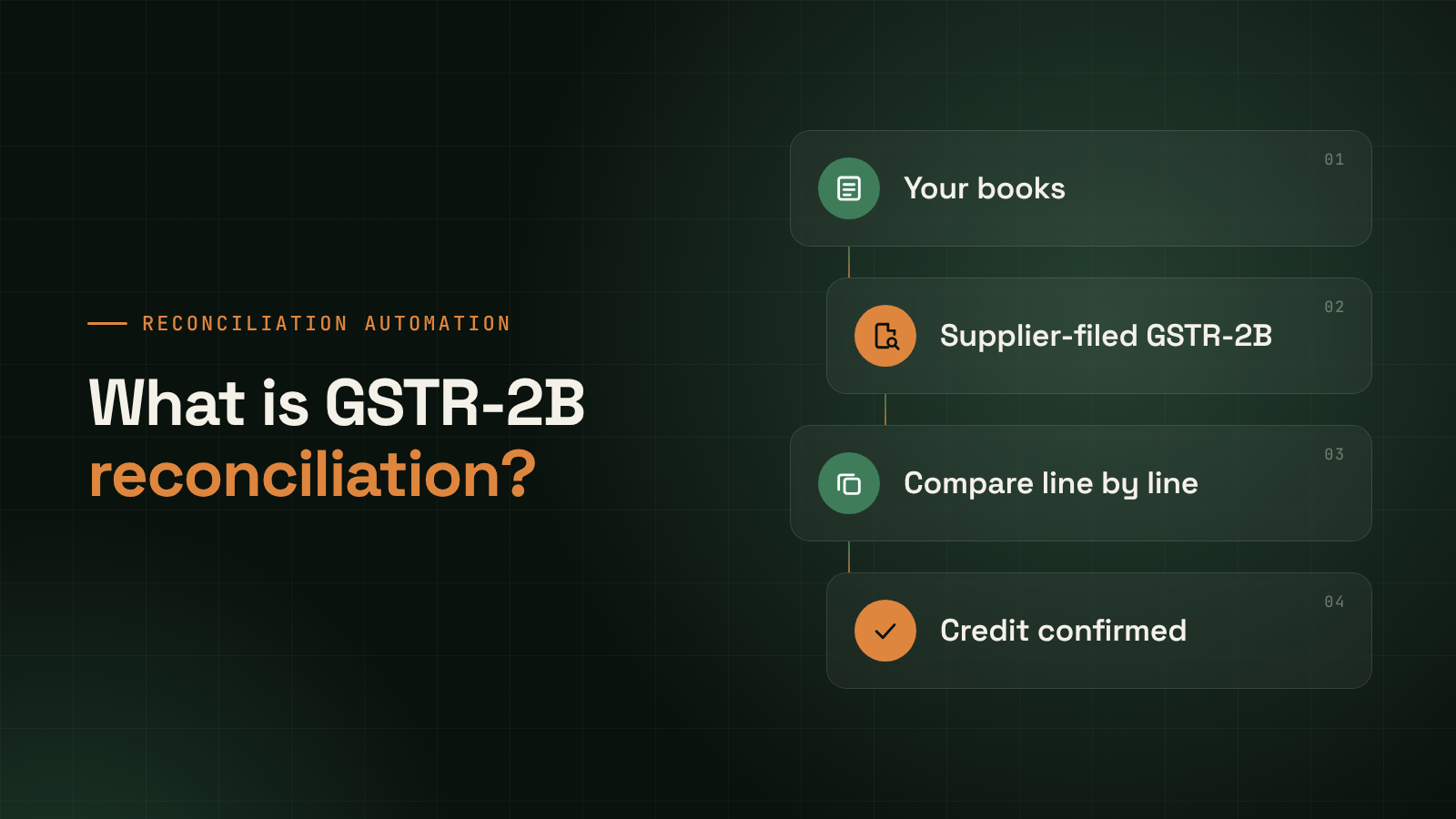
Four steps, and the matching is the least interesting of them. Pull the register against GSTR-2B with logic that tolerates real supplier numbering; take the IMS decisions, with a remark where one is required; then age the exceptions and track the credit at risk.
Those last two are what separate a reconciliation from a comparison. Age tells you which gaps are timing and which have a name behind them: thirty days is usually the cut-off; ninety days is a problem. Credit at risk is the value claimed against suppliers who have not filed, and it is your rule 37A exposure. It should be visible in July, not discovered in October.
What this doesn’t do
The reconciliation agent runs inside a boundary, and the boundary is tighter here than elsewhere because the subject is a statutory filing.
- It does not file anything. It does not prepare, sign or submit GSTR-3B, and it does not act for you on the GST portal.
- It does not accept, reject or park records on IMS by itself. It proposes a treatment with the reasoning attached. Deemed acceptance is a tax consequence, and consequences need a named owner.
- It does not decide eligibility. Blocked credits, apportionment and the self-assessment the portal explicitly leaves to you stay judgment calls. The agent assembles the facts behind each one.
- It does not fix your vendor master. Wrong or missing GSTINs break matching at source, and that cleanup is yours.
- It does not make a non-filing supplier file. It makes the exposure visible early enough for the phone call to be worth making.
How does this compare outside India?
GSTR-2B belongs to India’s GST, but the problem behind it is not unique. Wherever a business recovers input tax on purchases, there is a gap between what you booked and what your supplier reported. In the EU and the UK, input VAT recovery generally depends on a valid supplier invoice, and finance teams routinely check their purchase ledger against supplier records before they file. Several countries are rolling out e-invoicing or real-time reporting, which gives tax authorities supplier-side data much as GSTR-2B does here. Statutory late-payment interest regimes for business invoices exist in many places, so an unresolved mismatch can carry a cost beyond the tax itself.
The India-specific parts are the statement itself, its cut-off windows, deemed acceptance on IMS and the November dates for time limits and reversals. Those should not be assumed anywhere else. If you have an Indian entity, a supplier registered in India or a shared service center that files GST returns, they apply directly. For every other jurisdiction, check the local rules with your advisors and borrow only the habit: reconcile on a schedule, and give every open difference a cause, an owner and a date.
Frequently asked questions
Is GSTR-2B reconciliation mandatory?
There is no separate form to file called a reconciliation. What is mandatory is the outcome: the credit you take in GSTR-3B has to satisfy the conditions in section 16, including that the supplier furnished the details and that they were communicated to you. Reconciliation against GSTR-2B is how a finance team demonstrates that, and since IMS it is also how your GSTR-2B gets built.
When is GSTR-2B generated, and can it change afterward?
It is generated on the 14th of the month following the tax period. The statement itself is static, but if you take or change an IMS action after the 14th, you must recompute GSTR-2B from the dashboard for that action to be reflected. A period’s statement is also only generated once the previous period’s GSTR-3B has been filed.
What happens if we simply take no action on IMS?
Every record you leave alone is treated as accepted when GSTR-2B is generated, and the credit auto-populates into GSTR-3B. Silence is not neutral. For records that may be kept pending, the pending window now runs for one tax period, after which inaction has the same effect.
Does reconciliation automation post anything into SAP?
Only where you have configured a rule that allows it. A clean match inside your tolerance can be posted with a record of what it matched against and which rule cleared it. Anything outside tolerance stops and goes to a person, with the reasoning attached rather than a bare flag.
Can it handle our supplier invoice numbering?
That is usually where exact-match tools fail. Real purchase registers carry branch codes, leading zeros, slashes and inconsistent spacing, so matching has to tolerate variation while still being explainable. Expect a proposed match with its reasoning, not a tick.
How long before we see a difference?
The first complete, aged mismatch list usually lands within one reconciliation cycle. The compounding benefit takes a quarter or two, because the value is in mismatches closed before 30 September, not in finishing the monthly match a day earlier.
Does GSTR-2B reconciliation apply outside India?
GSTR-2B is an Indian GST statement, so the form, the IMS actions and the section 16 and rule 37A dates apply to Indian registrations. Other regimes have their own supplier-matching rules, so check your jurisdiction. The method of comparing your books against supplier-reported data and aging the exceptions carries over.
Where to go next
The natural next step from here is ledger and tax reconciliation: how matching, tolerance bands and exception handling work against your own ledgers inside SAP.
Three related reads:
- GST reconciliation: the complete guide for Indian finance teams: the wider picture this article sits inside.
- Can AI post invoices directly into SAP?: what posts automatically, what waits, and what the audit trail records.
- GRN invoice matching: the matching discipline upstream of your tax position.
A note on sourcing, checked September 22, 2026: the description of Form GSTR-2B, its generation date, cut-off windows, source returns, the table 3 and table 4 split and the self-assessment caution are taken from the GST portal’s own GSTR-2B FAQ. The IMS actions, deemed acceptance, mandatory recomputation and sequential generation are from GSTN’s revised IMS advisory; the current pending rules, the one-tax-period limit and the remarks requirement are from GSTN’s FAQs on the new IMS changes applicable from the October 2025 tax period. The conditions for availing credit are section 16(2) of the CGST Act, the outer time limit is section 16(4), and the reversal and re-availment provisions are rule 37A of the CGST Rules, as published by CBIC. No benchmark statistic, accuracy percentage or industry average appears in this article: the figures commonly quoted in this category trace to vendor-commissioned surveys rather than primary research and could not be verified first-hand, so they have been left out. Statutory provisions are summarized in general terms and should be confirmed with your own advisors against the current law.