Table of Contents
Key takeaways
- Your input tax credit depends on somebody else’s filing discipline. Section 16(2)(aa) of the CGST Act makes credit conditional on the supplier having furnished the invoice details and those details having been communicated to you.
- There are two separate vendor failures, and only one of them shows up as an ITC mismatch in GSTR-2B. The invisible one is worse.
- A supplier who files GSTR-1 but not GSTR-3B gives you a clean match and a reversal later. Rule 37A requires you to reverse that credit if they have not filed by 30 September following the financial year.
- Supplier filing status is public. You can see whether a GSTIN has filed, period by period, from the GST portal without logging in.
- The deadlines are statutory, not negotiable: credit closes on 30 November following the financial year under section 16(4), with no extension for a supplier who was slow.
If you buy from, sell into or run an entity in India, your input tax credit depends on your suppliers’ GST filings, and an ITC mismatch in GSTR-2B is how that dependency first shows up. Teams elsewhere face a similar pattern under VAT regimes, where recovery can hinge on what a supplier reported. Finance teams treat the monthly reconciliation as a matching exercise. Lines that agree are cleared, lines that do not are chased, and the chase runs on whoever picks up the phone. By March, the invoices nobody managed to close have quietly aged into credit that can no longer be taken.
The uncomfortable part is that the matching exercise does not show you the whole exposure. Some of the credit most at risk sits in the green rows.
What is an ITC mismatch in GSTR-2B?
An ITC mismatch in GSTR-2B is a purchase in your books with no corresponding record in the statement, or a record whose values differ from yours. The most common cause is a supplier who has not reported the invoice in their GSTR-1, which means the credit has not met the conditions for being claimed at all.
That phrasing matters. A missing line is not an administrative inconvenience you can reason around at the year end. It is a statutory condition that has not been satisfied.
Why does a supplier’s GSTR-1 decide your credit?
Because the Act says so. Section 16(2)(aa) requires that the details of the invoice or debit note “has been furnished by the supplier in the statement of outward supplies and such details have been communicated to the recipient”. Section 16(2)(c) separately requires that the tax charged “has been actually paid to the Government”.
Read together, those two clauses describe the real dependency. The first is satisfied by the supplier’s GSTR-1. The second is satisfied by their GSTR-3B. You can hold a perfect tax invoice, have the goods in your yard and the payment out of your bank, and still not be entitled to the credit, because neither of those conditions is in your control.
Which is worse: an unfiled GSTR-1 or an unfiled GSTR-3B?
An unfiled GSTR-1 is visible, because the invoice is missing from your GSTR-2B; an unfiled GSTR-3B is invisible, because the invoice appears but the tax was never paid to the government.
The unfiled GSTR-3B, because you will not see it. A missing GSTR-1 produces a visible gap in GSTR-2B. A supplier who files GSTR-1 but skips GSTR-3B gives you a matched line, a clean reconciliation and a credit you may be required to reverse months later under rule 37A.
| Supplier has not filed GSTR-1 | Supplier filed GSTR-1, not GSTR-3B | |
|---|---|---|
| In your GSTR-2B? | No | Yes |
| How it appears | An exception on the reconciliation | A matched line, no flag |
| Condition that fails | Section 16(2)(aa) | Section 16(2)(c) |
| What happens to the credit | Never claimable until they file | Claimed, then reversed |
| The rule that bites | Section 16(4) time limit | Rule 37A reversal |
| When you find out | This month | Potentially a year later |
| Recoverable? | Yes, if they file in time | Yes, re-availed when they file |
Rule 37A is the provision worth reading twice. Where you have taken credit on a document your supplier reported in GSTR-1, but the supplier has not furnished their GSTR-3B for that period by 30 September following the end of the financial year in which you availed it, you must reverse the credit in a GSTR-3B filed on or before 30 November. If you do not, the amount is payable with interest under section 50. If the supplier files later, you may re-avail it.
So the reconciliation that only compares documents is answering half the question. A complete view of credit at risk tracks whether the supplier filed the invoice and whether they paid.
Why does one late supplier get steadily worse?
Because the portal locks them out. Rule 59(6)(a) states that a registered person “shall not be allowed to furnish the details of outward supplies… in FORM GSTR-1, if he has not furnished the return in FORM GSTR-3B for the preceding month”. For quarterly filers, rule 59(6)(b) applies the same bar to the preceding tax period.
A supplier who falls behind on GSTR-3B therefore cannot file GSTR-1 either. Every month that passes adds another month of your invoices to the pile, and the fix is not one filing but a sequence of them. This is why a vendor two months behind is a different conversation from a vendor one month behind, and why “they’ll catch up” is a weaker assumption than it sounds.
How do you find out whether a vendor has filed?
The Invoice Management System (IMS) on the GST portal lists the invoices your suppliers have reported through GSTR-1 or the Invoice Furnishing Facility and lets you accept, reject or hold each one before your GSTR-2B is generated. An invoice the supplier has not reported does not appear in it, so IMS shows you what has arrived, not what is missing.
From the GST portal, without logging in. The Search Taxpayer facility returns a GSTIN’s profile along with details of returns filed, and the filing table can be opened by financial year. You do not need the supplier’s cooperation to know whether they have filed, which changes the tone of the call considerably.
In practice the useful move is to stop treating this as a lookup you do when something goes missing, and start treating it as a register you maintain for the suppliers who matter.
| Field to track | Why it earns its place |
|---|---|
| Purchase value and tax value at risk, by supplier | Ranks the chase by money, not by line count |
| Age of the oldest open item | Tells you how close the 30 November limit is |
| GSTR-1 filing status, last three periods | Separates a one-off from a pattern |
| GSTR-3B filing status, last three periods | The rule 37A exposure, invisible in GSTR-2B |
| Periods behind | A supplier two periods behind is blocked by rule 59(6) |
| Whether the invoice appeared in a later statement | Distinguishes timing from non-filing |
| Who owns the relationship internally | Procurement usually has more leverage than finance |
Two suppliers can each hold about $4,500 (₹4 lakh) of your credit and need entirely different handling: one filed late last month and will clear, the other has not filed since July and is blocked from filing until they settle their own returns. Only the register tells you which is which.
When does exposure become a loss?
On fixed dates that have nothing to do with your month end. The sequence below is the one to work backwards from.
| Date | What happens |
|---|---|
| 11th of the following month | GSTR-1 due for monthly filers |
| 13th after quarter end | GSTR-1 due for quarterly filers |
| 14th of the following month | GSTR-2B generated for the period |
| 30 September after the financial year | Supplier’s GSTR-3B deadline for rule 37A purposes |
| 30 November after the financial year | Credit closes under section 16(4); rule 37A reversals due |
Section 16(4) is absolute in its terms: no credit on an invoice or debit note after 30 November following the end of the financial year to which it pertains, or the furnishing of the annual return, whichever is earlier. There is no clause for a supplier who meant to file.
What does a reconciliation agent change here?
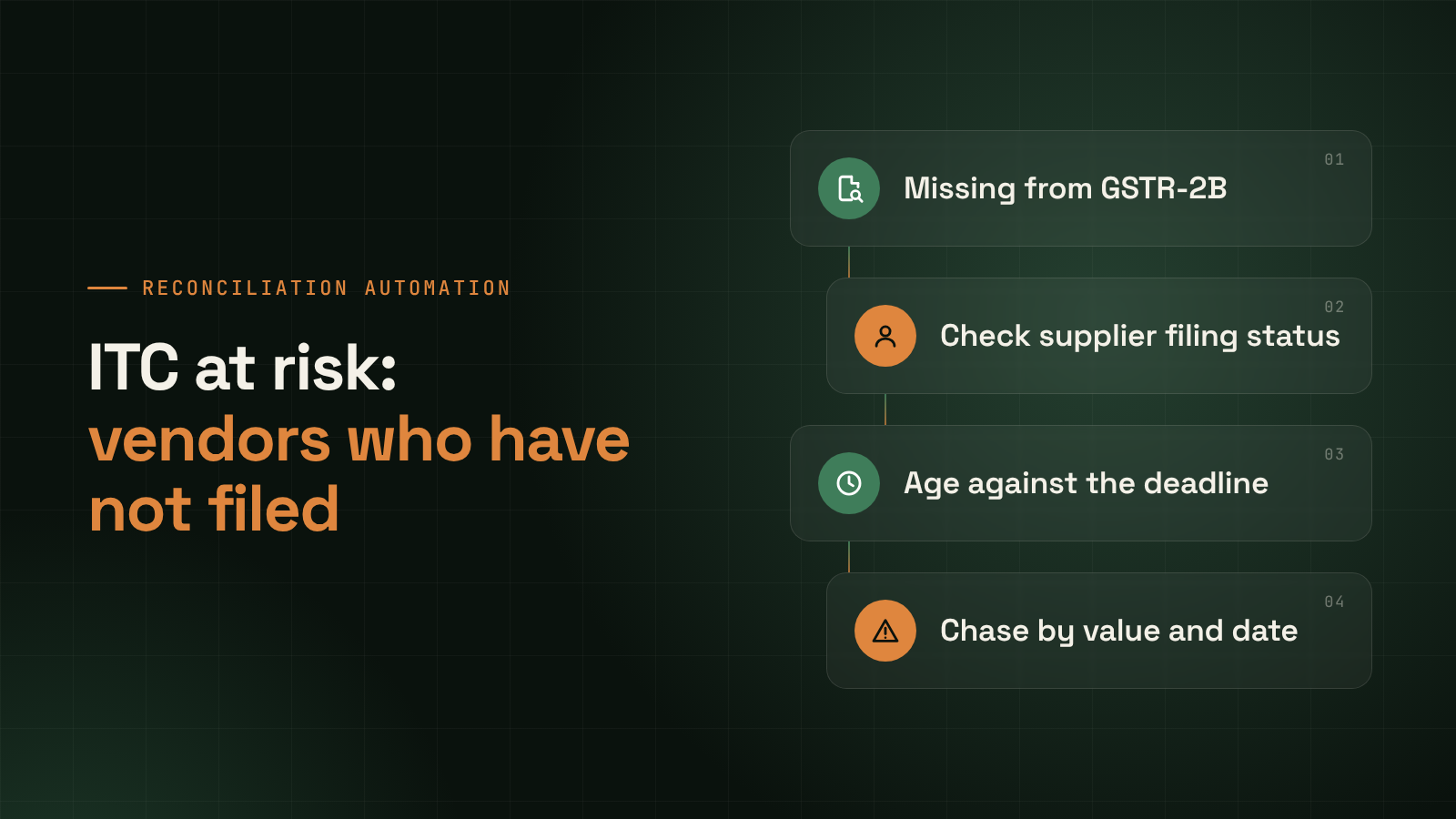
It changes when you find out. The reconciliation agent runs the GSTR-2B comparison against your purchase register inside SAP, groups one-sided records by supplier rather than by line, carries each open item forward with its age against the 30 November limit, and maintains filing status per vendor so that the rule 37A exposure sitting inside your matched lines is visible rather than inferred.
The output is a chase list ordered by value and deadline, with the evidence attached. The work that disappears is the assembly of that list, not the judgment about what to do with it.
What this doesn’t do
- It does not make a supplier file. It gets you to the conversation earlier, with a number attached.
- It does not file, amend or reverse anything on the GST portal. Returns, IMS actions and GSTR-3B reversals stay with the people accountable for them.
- It does not decide eligibility. Blocked credit, apportionment and the reversals GSTR-2B does not flag remain judgment calls for you and your advisor.
- It does not replace your vendor master. A wrong GSTIN in your records breaks the tracking before any logic runs.
How does this compare outside India?
Credit that depends on a supplier’s filing is not an Indian invention. In the EU and the UK, for example, a buyer’s input VAT recovery generally depends on a valid supplier invoice, and authorities can query claims where a supplier’s registration or reporting is in doubt. Several countries are adding e-invoicing or real-time reporting, which gives the tax authority supplier-side data, and many publish ways to verify a supplier’s tax registration. Statutory late-payment interest regimes for business invoices also exist in many places, which shapes how hard you can push a supplier who is behind.
The specific mechanics in this article are Indian: section 16 conditions, the rule 37A reversal, the rule 59(6) filing bar, the public Search Taxpayer lookup and the September and November dates. They apply to Indian registrations and should not be assumed elsewhere. What carries over is a vendor filing register: tax at risk by supplier, age of the oldest open item and the supplier’s recent filing history where it can be checked. Confirm what is available in your own jurisdiction with local advisors.
Frequently asked questions
Can I claim ITC if my supplier has not filed GSTR-1?
No. Section 16(2)(aa) makes credit conditional on the supplier having furnished the invoice details and those details having been communicated to you. Until the invoice reaches your GSTR-2B through their filing, the condition is unmet. Claiming it anyway creates an exposure you will have to unwind later.
How can I check whether a vendor has filed their GST returns?
Use the Search Taxpayer facility on the GST portal. Entering a GSTIN returns the taxpayer’s profile and details of returns filed, with a filing table you can open by financial year. It works without logging in, so you can check a supplier’s position before you call them.
What happens if my supplier files GSTR-1 but never files GSTR-3B?
The invoice appears in your GSTR-2B and your reconciliation matches, but rule 37A requires you to reverse the credit if the supplier has not filed their GSTR-3B for that period by 30 September following the end of the financial year. The reversal goes into a GSTR-3B filed on or before 30 November, and the amount carries interest under section 50 if you miss it.
Can I re-claim credit I reversed under rule 37A?
Yes. Rule 37A provides that where the supplier subsequently furnishes the GSTR-3B for that period, the credit may be re-availed in a return for a later tax period. The reversal is a cash cost in the meantime, not a permanent loss, provided the supplier eventually files.
Is there a deadline after which a missing invoice is lost for good?
Yes. Section 16(4) bars credit on an invoice or debit note after 30 November following the end of the financial year to which it pertains, or the furnishing of the relevant annual return, whichever is earlier. A supplier’s delay does not extend it, which is why a September gap needs chasing in September.
Why can’t my supplier just file all the pending GSTR-1s at once?
Because rule 59(6) blocks it. A taxpayer who has not furnished GSTR-3B for the preceding month cannot file GSTR-1, so a supplier who has fallen behind has to work through their returns in sequence. The practical consequence is that a vendor several periods behind needs a longer runway than one who simply missed a date.
Does this only matter for large suppliers?
No, and value can mislead. A single unfiled month from a mid-sized supplier can hold more credit than a dozen small gaps, but the risk is best ranked by tax value and age together. A small amount approaching 30 November is more urgent than a large amount filed late last week.
Does this apply outside India?
The section 16 conditions, rule 37A reversal and rule 59(6) filing bar are specific to India’s GST, so they apply to Indian registrations. Other regimes have their own supplier-dependence rules, so check your jurisdiction. Tracking tax at risk by supplier and age is a habit that carries over.
Where to go next
The natural next step is ledger and tax reconciliation, which shows how matching, tolerance bands and exception handling work against your own ledgers inside SAP.
Three related reads:
- GST reconciliation: the complete guide for Indian finance teams, the wider picture this article sits inside.
- Why doesn’t GSTR-2B match your books?, the full taxonomy of mismatch causes and how to tell them apart.
- What is GSTR-2B reconciliation?, the statement itself and what the Invoice Management System changed.