Table of Contents
Key takeaways
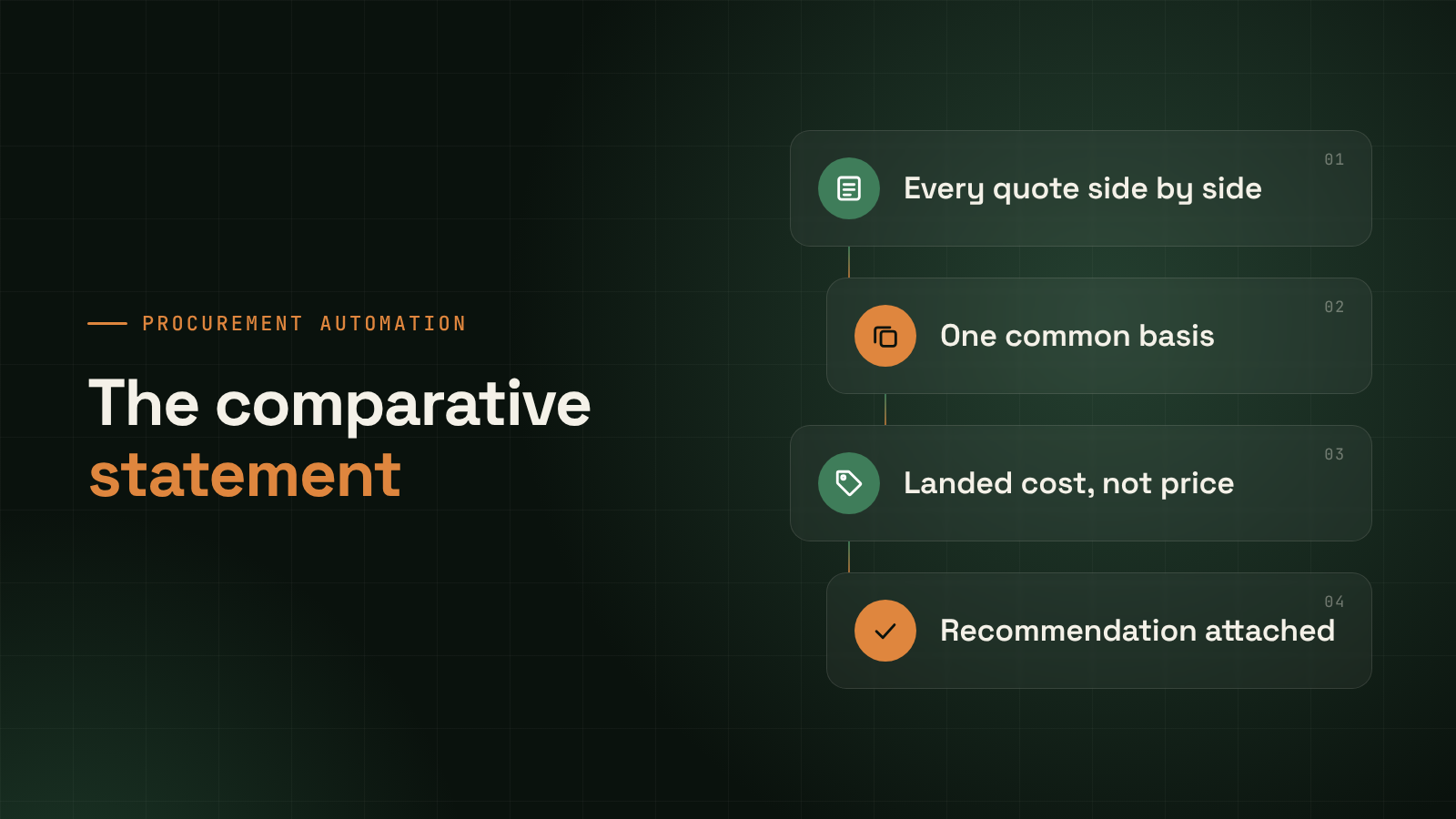
- A comparative statement in procurement is a single document that places every quote received for one requirement side by side, on a common basis, with a recommendation underneath it.
- The term is standard in India, the Gulf and much of South and Southeast Asia. In the United States the same document is usually a bid tabulation or bid tab, and in Europe a tender comparison or bid evaluation.
- The format is the easy part. The work is normalizing quotes that arrive on different delivery terms, units of measure, currencies, tax treatments, lead times and payment terms.
- The lowest quoted number is not the lowest cost until delivery basis and scope are equalized. Incoterms 2020, published by the International Chamber of Commerce, exist because those responsibilities differ by rule.
- Preparing the sheet can be automated. Awarding against it should not be, and the approval threshold belongs in writing before any agent touches a requisition.
Imagine you run purchasing at a 600-person packaging manufacturer with two plants and roughly 400 active suppliers. A requisition for extrusion film lands on Monday. You send it to five vendors, four reply over three days, the fifth sends a revised price on Friday, and now somebody has to get all of it onto one sheet before anyone can decide anything. A comparative statement in procurement is that sheet: a single document setting every quote received for one requirement side by side, on a common basis, with a recommendation underneath.
The word changes by region. The job does not. And the difficulty is not the layout, which any spreadsheet handles. It is making five quotes genuinely comparable before you line them up, which is the step that decides whether the sheet is true. It is also the step procurement RFQ automation is built around.
What is a comparative statement in procurement?
A comparative statement is the evaluation record for a single buying decision. It lists the requirement, the vendors approached, the vendors who responded, each commercial offer broken into its parts, the basis on which those offers were made equivalent, the recommended vendor and the reason.
Two things separate it from a price list. It is an audit object: six months later it is the document showing why the order went where it went. And it is supposed to be complete. A comparison that quietly drops the vendor who quoted an unusable lead time is not a comparison, it is a justification. Every response gets a row, including the ones that disqualify themselves, with the reason stated.
What is the same document called outside India and the Gulf?
Different words, same discipline. The clearest written definitions sit in public procurement rules, because public buyers are legally obliged to be explicit about something private buyers handle by convention. Private mid-market companies are not bound by those rules. Their purchase policies borrowed the logic anyway.
| Where | What buyers usually call the document | Where the evaluation discipline is written down |
|---|---|---|
| India, Sri Lanka, Bangladesh, Nepal | Comparative statement, often shortened to CS | Convention and company purchase policy. Every quote received appears side by side, with the recommendation written underneath. |
| Gulf states and much of the Middle East | Comparative statement, quotation comparison | Usually a company purchase manual rather than a statute, following the same convention. |
| United States | Bid tabulation, bid tab, quote comparison | For federal buying, FAR 15.101 sets a “best value continuum”: either a tradeoff process, where all evaluation factors and their relative importance must be stated in the solicitation (FAR 15.101-1), or lowest price technically acceptable, where “tradeoffs are not permitted” (FAR 15.101-2). |
| European Union | Bid evaluation, tender comparison | For public contracts, Directive 2014/24/EU Article 67 requires award on “the most economically advantageous tender”, identified “on the basis of the price or cost, using a cost-effectiveness approach, such as life-cycle costing”, and states that award criteria “shall not have the effect of conferring an unrestricted freedom of choice”. |
| Private buyers anywhere | Any of the above, or simply “the comparison sheet” | No statute. Company policy sets the quote threshold, the minimum number of responses and who signs. |
Two points are worth lifting out even if you never sell to a government. Criteria have to be fixed before the quotes arrive, not after you have seen them. And price is explicitly not the only permitted basis, provided the other factors are named in advance.
What goes into a comparative statement?
At minimum: the item and specification, the quantity, the vendors approached with the date each was contacted, each vendor’s unit price, delivery basis, taxes and duties, freight and packing, lead time, payment terms, quote validity, the normalized landed cost per unit, and the recommendation with its reason.
The normalized landed cost per unit is the column that does the work. Everything to its left is raw input. If that column is calculated differently for different rows, the sheet is decorative. It also helps to carry two reference points beside it: your last price paid for the same item, and the spread across this round. A quote twenty percent under the next bidder is sometimes a win and sometimes a vendor who read the specification differently from everyone else.
Why is the lowest quoted price often not the cheapest offer?
Because quotes arrive on different bases, and the headline number only describes the part of the cost each vendor chose to include. Equalizing them is the real task, and the common distortions are predictable.
| What differs between two quotes | What it does to a naive comparison | What normalizing it requires |
|---|---|---|
| Delivery terms | One vendor quotes ex works, another delivered to your plant. The ex works price looks lower and is not. | One agreed delivery basis for every row. The Incoterms 2020 rules published by the ICC allocate carriage, insurance and customs formalities, and fix the point at which risk passes. They do not set the price. |
| Unit of measure | Per piece against per kilogram against per hundred, on an item whose master carries a third unit. | Convert to the unit on your item master, and flag any row where the factor is assumed rather than stated. |
| Currency | Two currencies, no stated rate, and a quote valid for thirty days. | One currency, one stated rate, one stated date, all recorded on the sheet. |
| Taxes and duties | Recoverable tax inflates one row and not another, and import duty may sit outside the quote entirely. | Compare on the cost you bear after recovery, with the tax line shown separately. |
| Lead time | A four-week quote and a fourteen-week quote are not the same offer at any price. | Set a cutoff and disqualify above it, or price the delay through expediting or stock cover. |
| Payment terms | Net 30 against net 90 is a financing difference dressed as a price difference. | Keep terms in their own column. Do not fold a notional financing benefit into the unit price. |
| Scope inclusions | Installation, commissioning, testing, spares, warranty period, training. | List inclusions, then add the cost of buying each missing item separately. |
| Minimum order quantity | A better rate that requires three times the quantity you need. | Compare at the quantity you will consume, and note the carrying cost if you take the larger lot. |
None of this is sophisticated. It is slow, and slowness is what pushes buyers toward comparing the three numbers that are easy to compare. The same normalization problem reappears downstream, which is why three-way matching fails more often on units and delivery basis than on price.
Who is allowed to award against a comparative statement?
Somebody other than the person who prepared it. That is why the document exists as a separate artifact: the buyer assembles the comparison, an approver with a spend limit makes the commitment. Ordinary segregation of duties, and what turns the sheet into a control rather than paperwork.
Most mid-market policies set thresholds. Below some value a buyer may award on a single quote, above it three responses are required, above a higher value the finance head or a committee signs. Write those down before automating anything, because an agent cannot infer them and will otherwise hold either too much authority or none. The model for classifying agent actions by consequence is in AI agent governance, approvals and audit trails.
Where does the comparative statement break down in practice?
In four places, none of them about the template. Quotes arrive in mixed formats on mixed channels: a PDF, a scanned letter, a photograph of a price list, three lines in an email body. All of it gets retyped, and retyping is where transcription errors enter.
The sheet also goes stale. A vendor revises a price, the revision sits in an inbox, and the comparison reaching the approver is a day old. Nobody notices until the invoice does not match. Meanwhile vendors who did not respond vanish from the record, so it never says whether the fifth supplier was approached and ignored it or was never approached at all. That gap is the one an auditor finds.
The fourth undermines everything else. If the same component sits under three codes with two units of measure, the comparison is between numbers that were never comparable, and no care in the sheet recovers it. Fix the item master before automating on top of it.
Can a comparative statement be produced automatically?
The preparation can be. An agent can issue the request to the vendor list, read replies in whatever format they arrive, pull each offer into its components, convert units and currency, apply the delivery basis, compute landed cost per unit against your item master and last price paid, and present the finished comparison with every source document attached to its row.
| Step | By hand today | What an agent can do | What stays with a person |
|---|---|---|---|
| Send the request | Four or five emails written individually | One request to the vendor list, on the channel each vendor answers | Deciding who is on the list |
| Collect responses | Chasing by phone, watching an inbox | Replies read as they land, non-responses tracked and chased | Judging when to stop waiting |
| Extract the offer | Retyping from PDFs and messages | Fields pulled per vendor, source document kept against the row | Checking anything flagged low confidence |
| Normalize | Manual conversions, often skipped under pressure | Unit, currency, tax, freight and delivery basis applied consistently | Setting the rules, and the tolerance for assumed conversions |
| Compare | A spreadsheet rebuilt each time | The sheet regenerated whenever a revised quote lands | Reading it |
| Recommend | Buyer’s judgment, written up afterward | A proposed award with the reasoning and the trail behind it | The award itself |
The dividing line is between assembling evidence and committing the company. Assembly is clerical, repetitive and exactly the work that degrades under time pressure. The decision is not. If a vendor is being developed, or a second source kept alive deliberately, or engineering has a view on equivalence, none of that lives in the numbers. Where the conversation goes past collecting prices, see how AI negotiates with suppliers.
What should you measure?
Coverage first: the share of purchase value that went through a real comparison rather than a single quote and a signature. In most mid-market companies that number is lower than anyone expects, and it moves first.
Then time from last quote received to recommendation ready, which is what automation actually compresses. Then the share of comparisons where every approached vendor appears, responded or not, which is the audit measure. Then realized price against your own last price paid for the same item, unit and delivery basis, because no first-hand source publishes a usable market benchmark for mid-market category pricing.
What this doesn’t do
- It does not pick the vendor. The comparison produces a recommendation with reasoning attached. The award is a human commitment, and relationship, risk and second-source strategy sit outside the numbers.
- It does not judge technical equivalence. A different grade, make or specification at a lower price is an engineering call. The agent flags the difference and stops.
- It does not repair a bad item master. Duplicate codes and mixed units make every comparison unreliable, and automation reproduces that error faster than a person would.
- It does not create competition that is not there. On a single-source item there is nothing to compare, and the real lever is qualifying a second supplier, which is a sourcing project rather than a document.
- It does not replace your purchase policy. Thresholds, minimum quote counts and approval limits have to exist in writing first. An agent enforces a policy; it cannot invent one.
Frequently asked questions
What is a comparative statement in procurement, in one sentence?
It is a single document setting every quote received for one requirement side by side on a common basis, showing unit price, taxes, freight, delivery terms, lead time and payment terms for each vendor, with a recommended award and the reason for it. It serves as both the decision aid and the audit record for that purchase.
Is a comparative statement the same as a bid tabulation?
In substance, yes. Comparative statement is the usual term in India, the Gulf and much of South and Southeast Asia; bid tabulation or bid tab is the common equivalent in the United States, and tender comparison or bid evaluation in Europe. Public procurement rules add requirements around stating criteria in advance, but the private-sector document does the same job under each name.
How many quotes should a comparative statement contain?
That is a policy decision, not a universal rule. Many mid-market purchase policies require three responses above a stated value and allow a single quote below it, with a documented exception route for proprietary and single-source items. What matters is that the threshold is written down and applied consistently, so the sheet means the same thing every time.
Does this work across multiple legal entities and currencies?
It has to, because normalization is the point. Each quote is converted to one stated currency at one stated rate and date, both recorded on the sheet, and entity-specific tax treatment is shown as its own line rather than folded into the unit price. If different entities use different item masters, reconcile the codes before relying on any cross-entity comparison.
Which ERP versions does this work with?
The procurement agent reads from and writes back to SAP S/4HANA, SAP ECC and SAP Business One, where most mid-market deployments sit. It needs read access to the item master, vendor master, open requisitions and purchase history. Write-back, meaning creating or changing a purchase document, is a separate decision with its own approval controls.
Can it handle quotes that arrive as PDFs, scans or messaging apps?
Yes, and that is usually the practical reason to automate this step. Vendor replies rarely arrive in a structured format, and the retyping that follows is where most comparison errors start. Fields extracted from an unstructured document should carry a confidence score, with low-confidence rows routed to a buyer rather than used silently.
Does the agent raise the purchase order once a winner is clear?
Not unless you configure it to, and not above the value threshold you set. A sensible starting configuration commits nothing automatically for the first several weeks, after which low-value repeat items inside policy may proceed while everything else returns for a signature.
Where to go next
To see how the procurement agent gathers quotes across email, messaging and voice, and where the approval gate sits at each step, start with procurement RFQ automation. Three related reads:
- RFQ automation for procurement covers the coordination layer that gets quotes in before any comparison can be built.
- How AI negotiates with suppliers picks up where the comparison ends, on the purchases worth a second round.
- AI agent governance, approvals and audit trails sets out how to classify agent actions by consequence, which is how the award threshold gets decided.