Table of Contents
Key takeaways
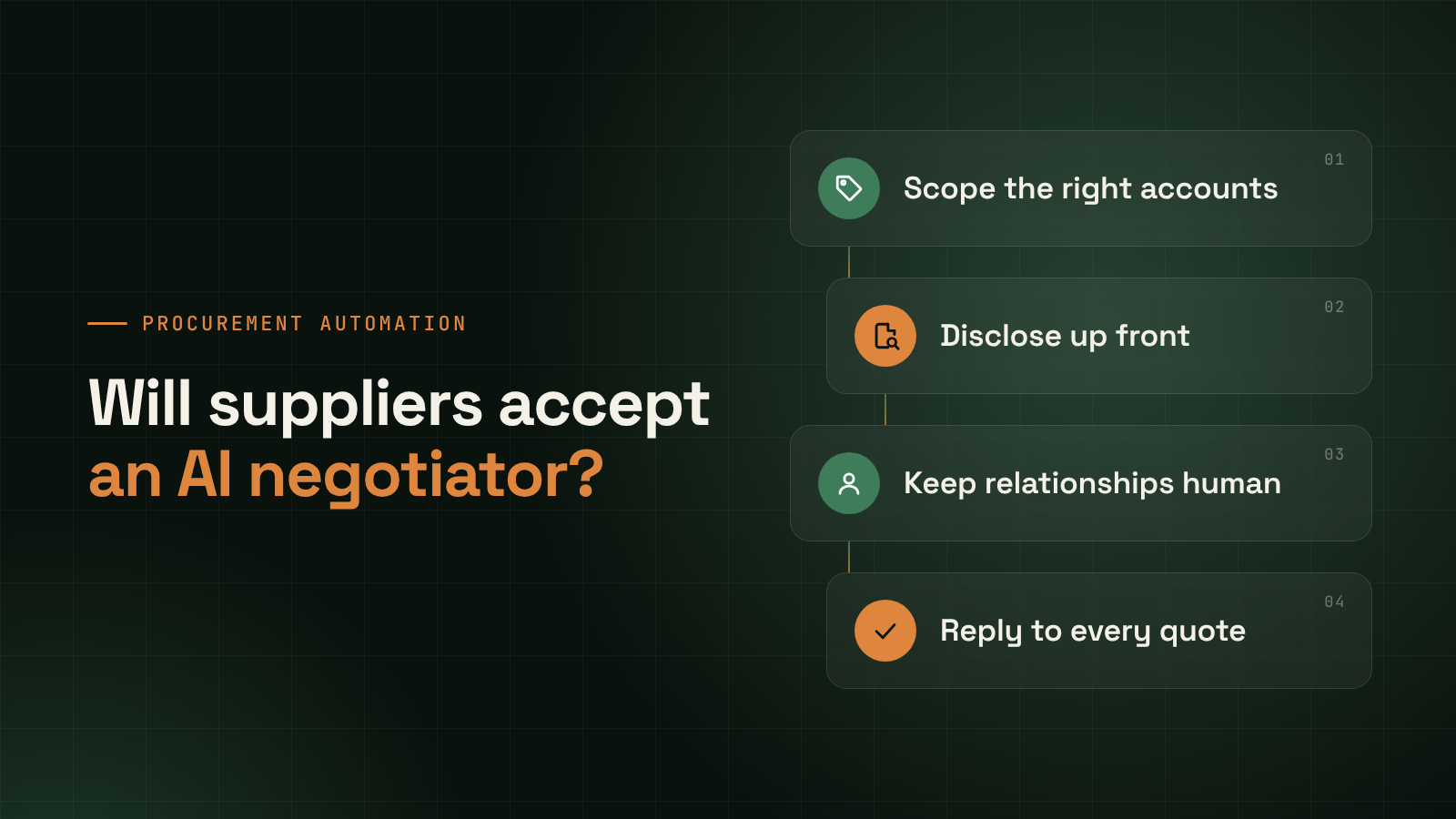
- Supplier acceptance is a scoping decision, not a technology question. Tail purchases to the agent, relationship accounts to your buyers, and the objection mostly never gets raised.
- Disclose it in the first message. A vendor told up front usually shrugs. One who works it out three rounds in feels handled, and a better price will not fix that.
- What vendors notice first is rarely the software. It is that someone finally replied to a quotation they sent two weeks ago.
- Channel decides engagement more than wording. Email and WhatsApp carry the conversation; SMS and voice sit inside local telemarketing and messaging-consent rules.
- Every conversation needs a named human reachable in one reply, and payment terms can be legally bounded for small vendors.
Imagine you run procurement at an auto components maker in Leeds with two buyers and a forging supplier your senior buyer has dealt with since 2009. Someone proposes an AI agent to handle the quotation back-and-forth, and your procurement head’s first reaction is that suppliers will never stand for it. Supplier acceptance of AI negotiation is the question of whether vendors will engage, and keep engaging, with a buying process where the commercial exchange runs on software inside rules you set rather than on a person at a desk. The answer depends on which vendors you point it at and whether you tell them, which is the same scoping logic behind procurement RFQ automation.
Will suppliers accept negotiating with an AI?
Mostly yes, under two conditions: they know what they are dealing with, and the process gives them something they did not have before, usually a faster reply and a clearer specification. Acceptance breaks down where the agent is pointed at relationship accounts, conceals what it is, or asks questions no vendor can answer.
Notice what the objection protects. When a procurement head says vendors will not accept it, the picture in their head is the forging supplier and a dozen others. Those accounts should stay with your buyers. It says nothing about the two hundred vendors who get a purchase order and silence, whose quotations sit unanswered because nobody has the hours. For them the comparison is not a human buyer against an agent. It is an agent against nothing.
Should you tell suppliers they are dealing with an AI?
Yes, in the first message, every time. Name your company, say the message comes from an automated procurement assistant working on your behalf, and give a way to reach a person in one reply. Disclosure costs nothing commercially. Concealment costs the relationship on the day it unravels.
That is a sentence and a signature block, not a legal notice. Two things make it work: the named human has to be a real person who answers, not a shared inbox, and the escape hatch has to be honored, so a vendor who asks for a person gets one and keeps them. A vendor who knows they are writing to software also answers the question asked and stops burying the delivery date in paragraph three.
Which suppliers push back, and which do not?
Acceptance tracks the kind of relationship, not the size of the vendor. The more a purchase depends on judgment, history or a favor, the less it belongs in an agent’s scope. That makes vendor classification the first piece of work, not an afterthought.
| Supplier type | Likely reaction | What to do |
|---|---|---|
| Long-standing strategic supplier | Takes it personally, often raises it with your management | Flag for human handling, and tell them before rollout |
| Tail and transactional vendors | Largely indifferent, often more engaged than before | Start here. Most of the gain sits in this group |
| Distributors and traders of branded items | Comfortable, since they quote to many buyers all day | Good early scope, provided part numbers are clean |
| Job work subcontractors | Mixed, since scope and capacity move together | Only where the work instruction is tight enough to compare |
| Single source and OEM | Unmoved. There is nothing to negotiate against | Leave out. The lever is qualifying a second source |
Resistance concentrates in the top ten to fifteen percent of your vendor master, which is also where an agent adds least. Scoping is not a compromise here. It is the design.
What are suppliers actually objecting to when they object?
Rarely the technology. The stated objection is usually a symptom of a process problem that predates the agent, and the fix is a configuration change or a data cleanup rather than an argument about AI.
| What the supplier says | What it usually means | What fixes it |
|---|---|---|
| “I want to talk to a person” | A condition they will not put in writing to a machine | A named buyer reachable in one reply, handover on request |
| “Your system keeps messaging me” | Follow-up too frequent, or two agents chasing one vendor | A cap per vendor per week, one owner per conversation |
| “The requirement is not clear” | Your specification or drawing reference is incomplete | Fix the item master and requisition, not the wording |
| “You are squeezing us” | The concession rule moves one way, with nothing back | Give it levers beyond price: volume, lead time, freight |
| “Who is approving this?” | They have been burned by a buyer with no authority | Say it plainly: the agent proposes, a named person awards |
Two of those five are vendor master or requisition problems. An agent does not create them. It surfaces them fast enough that they stop being ignorable.
Does the channel decide whether a supplier engages?
More than the wording does. A vendor who replies to WhatsApp in four minutes and to email in four days gets logged as unresponsive if you only use email, and the agent has told you nothing except which channel you chose. Channel is also where regulation applies unevenly.
| Channel | How vendors behave | What governs it |
|---|---|---|
| Reliable for drawings and records, but slower | Your own record keeping rules | |
| Fastest replies from proprietors. Weak for documents | Platform business messaging rules, plus your template review | |
| SMS | Low engagement. Notification, not conversation | Local telemarketing and messaging-consent rules, plus any sender registration |
| Automated voice | Works for short confirmations, poorly for terms | The same local rules, plus identification at the start |
| Supplier portal | Mid-market vendors mostly do not log in | Nothing, which is why coverage quietly fails here |
Many countries regulate commercial SMS and automated voice calls, through telemarketing rules, messaging-consent requirements and data-protection law (the US TCPA and GDPR-style regimes are two examples, so check yours). Some also require sender registration or approved message templates. Treat that as a design constraint before launch, and keep the open conversation on email and WhatsApp.
What has to be true inside the negotiation for a supplier to stay in it?
Four things, in order: the agent asks for something answerable, it moves when the vendor moves, it never promises what your company cannot honor, and it stops. A negotiation that repeats the same ask three times does not read as persistence. It reads as nobody reading.
Payment terms need their own rule, because a concession there creates a liability rather than a cost. Many countries limit B2B payment terms or charge statutory interest on late payment, often with extra protection for small suppliers. The EU Late Payment Directive sets a 60-day default for business-to-business payments, the UK has statutory late payment interest, and India applies a 45-day rule for micro and small suppliers. Check your own jurisdiction. A long term agreed with a protected vendor is not a working capital win, and the vendor often knows the rule better than the buyer does. Block the agent from trading terms there. The link to invoice booking speed is covered, using India as a worked example, in the MSME 45-day payment rule and your AP cycle time.
How do you roll this out without a vendor revolt?
Sequence it so the first vendors who meet the agent have the least invested in how things were done before. Tail categories first, relationship accounts last or never, and a written note to your top suppliers before the agent reaches anyone.
Two weeks to clean the vendor master enough to carry a classification flag, a channel preference and an owner per vendor. Weeks three to six, one or two tail categories with every message reviewed by a buyer before it goes, which is slow on purpose and shows where the agent reads a reply wrongly. Weeks seven to twelve, release low-value repeat items without pre-review and hold anything above a value threshold for signature. That note to your top suppliers is the step most often skipped, and it is what stops a strategic vendor hearing about your automation from a competitor’s sales rep.
How do you know whether suppliers accepted it?
Measure response behavior for the same vendors before and after, segment by segment. Aggregate numbers hide what you need to see, which is whether tail engagement rose while relationship accounts stayed untouched.
Four measures are enough. Response rate by vendor segment and channel, against your own baseline rather than an industry figure. Time to first reply. The count of handover requests and opt-outs, which is the clearest acceptance signal you will get and should fall after the first few weeks. And the share of conversations ending in a quote you can compare. If handover requests keep climbing after week six, the problem is scope or frequency, not vendor attitude.
What this doesn’t do
- It does not decide who gets the business. The agent reaches a position and documents how it got there. The award, the order split and any decision to pay more for a relationship stay with your procurement head.
- It does not work on vendors you have not classified. Without a strategic or tail flag and a micro or small enterprise status, it cannot tell which conversations it should not be having.
- It does not repair a relationship it damaged. If a long-standing supplier was contacted by mistake, that is a phone call from a person, the same day.
- It does not override a channel preference. A supplier who says email only gets email.
- It does not make an unclear requirement clear. Where the drawing, grade or delivery basis is missing, the agent should stop and ask your buyer.
Frequently asked questions
Do we have to tell suppliers that an AI is handling the negotiation?
You should, in the first message rather than a footer. Disclosure removes the one genuinely damaging outcome, which is a vendor discovering it later and concluding they were handled. Most vendors care more about a prompt, specific reply than about who typed it.
What happens when a supplier refuses to deal with the agent?
The conversation hands over to the named buyer and stays there, and the vendor is flagged for human handling so it does not recur. Treat a refusal as a permanent preference rather than a one-time exception.
Will this upset vendors we have worked with for twenty years?
Only if you point it at them, which you should not. Strategic suppliers belong outside the agent’s scope, marked in the vendor master, with a note sent before any rollout. The vendors who gain most are the tail accounts that get no conversation at all today.
Can the agent talk to vendors on WhatsApp?
WhatsApp coverage is the point, since vendor communication runs there rather than on a supplier portal. Language support should be confirmed against your actual vendor base during scoping rather than assumed, and templates stay under your review.
Does the agent commit us to anything with the supplier?
No purchase order is raised and no quantity confirmed without the approval step you configured. The agent works to a target, a reserve and an authority limit, and anything above that limit returns for a signature before the vendor is told anything is agreed.
What does it need from our SAP system?
Read access to the vendor master, item master, purchase history and open requisitions, plus classification and channel preference fields if you do not hold them already. Writing back into SAP is a separate decision with its own controls.
How long before we can tell whether suppliers have accepted it?
Give it six to eight weeks on a narrow scope. The first fortnight is dominated by vendor master data problems rather than vendor reaction, and handover requests only mean something once the same vendors have seen two or three cycles.
Where to go next
To see how the procurement agent runs multi-vendor conversations across email, WhatsApp and voice, and where the human gate sits, start with procurement RFQ automation. Three related reads:
- How does AI negotiate with suppliers? covers the mandate, the levers and the round structure this article assumes.
- AI agent governance, approvals and audit trails explains how to classify agent actions by consequence, which sets the authority limit.
- RFQ automation for procurement covers the coordination layer that must work before negotiation is worth running.
A note on sourcing, checked October 1, 2026: the one statutory statement here, India’s 45-day payment rule for micro and small suppliers, comes from the Ministry of MSME’s Samadhaan portal (samadhaan.msme.gov.in), quoted as stated there and attributed by that portal to Section 16 of the MSMED Act, 2006.