Table of Contents
Key takeaways
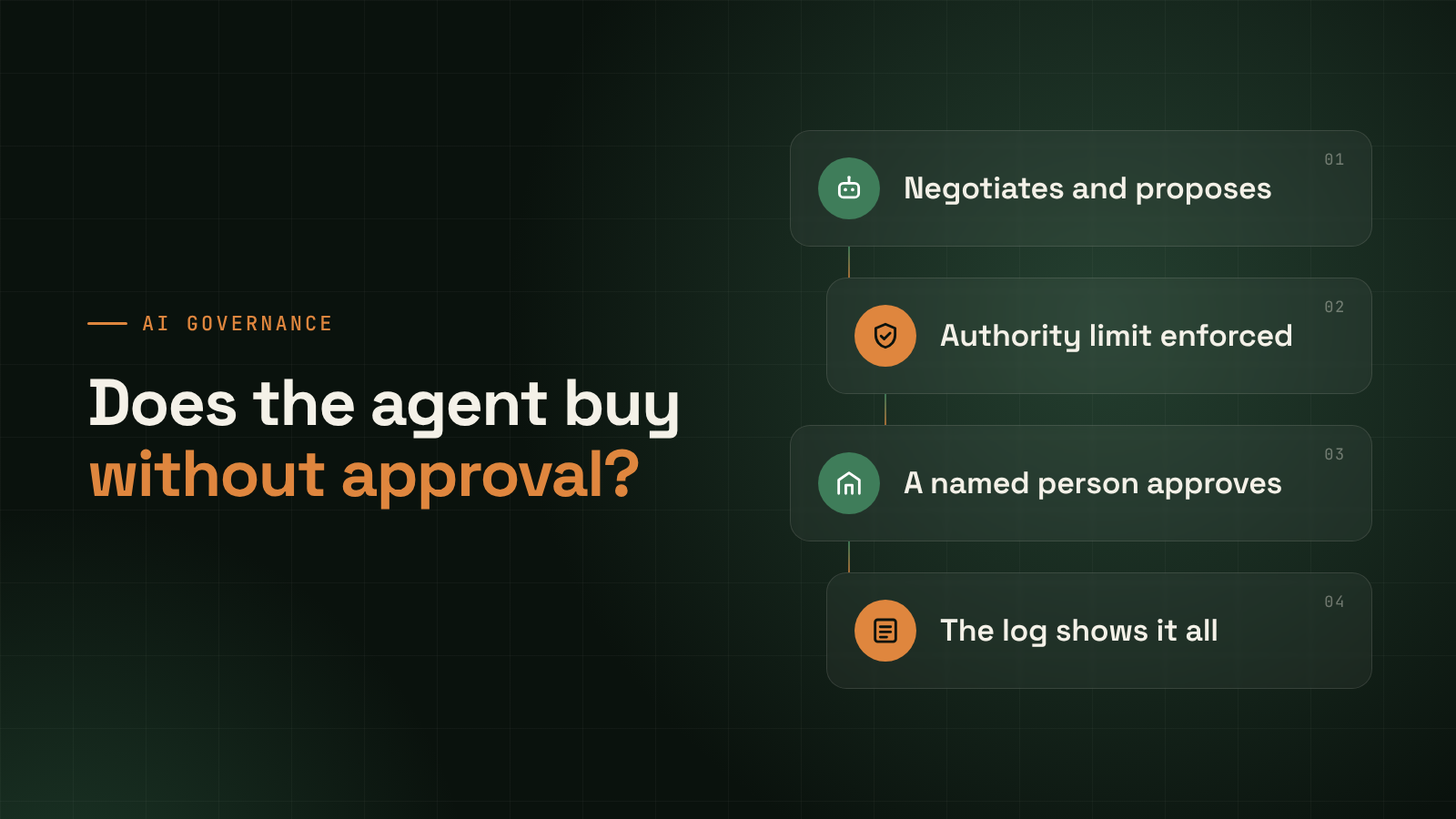
No. A procurement agent negotiates and proposes. Raising the purchase order is an authorization, and authorizations stay with a named person in your ERP.
A commitment is anything a vendor can reasonably act on, which includes a confirmation message. The agent’s language has to be bounded as tightly as its spending limit.
The limit must be technical, not editorial. Ask for the SAP authorization objects, not a description of how the agent behaves.
An unapproved commitment to a registered micro or small supplier starts a statutory payment clock, so a loose boundary surfaces as a finance problem, not a procurement one.
The audit question is never whether the AI was accurate. It is who authorized this, under what limit, on what date.
Imagine you run procurement at a sheet metal fabrication company in Melbourne. Two buyers, a few hundred active vendors, and a proposal on your desk to put an AI agent on the inquiry traffic. Your CFO reads one line about multi-vendor negotiation and stops. If this thing talks to vendors on our behalf, what stops it telling one of them to go ahead? A procurement agent is software that runs the sourcing conversation, meaning inquiries, quotations, follow-ups and negotiation inside a written mandate, and then hands a recommendation to a person. So the answer to whether the AI agent commits to a purchase without approval is no. The answer alone is worth little. What matters is where the stop sits and how it is enforced.
Does the AI agent commit to a purchase without approval?
No. The agent floats inquiries, chases quotations, negotiates within a mandate you wrote and assembles a position with its reasoning attached. It does not raise a purchase order, confirm an order to a vendor, or vary a contracted term past the limit you set. Each of those is an authorization, and authorizations belong to named people.
That boundary is not a setting to be switched on once everyone is comfortable. It is where the design puts the consequence. The agent lives on the conversational side of procurement, the side that eats your buyers’ week. The commitment stays on the controlled side, where your approval matrix and your auditor already are. How the conversational half runs across email, WhatsApp and voice is covered on procurement RFQ automation.
The question lands harder here than for any other agent. An accounts payable agent processes something that already happened. A procurement agent is in the room while the obligation is created.
What counts as a commitment in the first place?
Anything a vendor can reasonably act on. A signed purchase order obviously counts. So does a message saying go ahead, a confirmed quantity, an accepted delivery date and an agreed payment term. If a supplier would cut steel on the strength of it, treat it as a commitment regardless of which system it was typed into.
| What the vendor receives | Commitment? | Who may send it |
|---|---|---|
| An inquiry with specification and quantity | No, it is a request | The agent |
| A follow-up asking for a revised rate | No | The agent |
| A counter-offer at a stated price, marked subject to approval | No, if the wording holds | The agent, within mandate |
| “Confirmed, please proceed” | Yes | A buyer with authority, never the agent |
| A purchase order document | Yes | The approver, in the ERP |
| A revised payment term offered to the vendor | Yes, it varies the contract | Procurement head, inside policy |
The third row needs attention during scoping. A counter-offer that reads as an acceptance is a commitment in everything but name, and the fix sits in the template language rather than in the model. Vendors rarely parse carefully. They read the number and start planning.
Where does the agent stop in an RFQ-to-PO cycle?
At the point where the next step would create an obligation. Everything before that is coordination and comparison, which is where most of the elapsed time sits anyway. Everything after it is authorization, which is where your controls already are.
| Step | Who does it | Where it happens |
|---|---|---|
| Pick up the approved requisition | Procurement agent | Reads SAP |
| Select vendors and float the inquiry | Agent, from your vendor master | Email, WhatsApp, voice |
| Chase non-responders, clarify specification | Agent | Same channels |
| Normalize quotes to a comparable basis | Agent | Comparative statement |
| Negotiate within the mandate | Agent | Same channels |
| Decide who wins the order | Procurement head | A human decision |
| Approve the spend | Approver per the matrix | ERP workflow |
| Raise and release the purchase order | Buyer or approver | SAP |
| Tell the vendor the order is confirmed | Follows the PO | SAP output or a person |
Read the last row carefully. The vendor is told after the authorization exists, not before. Plenty of mid-market procurement failures are just ordering that ran in the right sequence socially and the wrong sequence on paper, so an invoice arrives against a commitment nobody approved. An agent that confirmed first would industrialize that mistake.
How is the authority limit enforced rather than described?
By what the agent can technically reach. A mandate document describes intent. An authorization object list describes capability. Only one of those survives a staff change, a prompt change or a bad week.
Three layers are worth asking about separately. ERP authorization: a service user with display rights on purchasing objects cannot create or release a purchase order whatever it has been told to do. The mandate: target price, reserve, maximum quantity, permitted levers, and the value band above which everything returns for a signature. The channel: what the agent may say, held in reviewed templates rather than generated fresh.
Ask for evidence of all three. A vendor saying the agent only acts after approval is describing behavior. A display-only authorization set describes something the software could not do if asked. How to sort agent actions by consequence is set out in AI agent governance.
What should the authority matrix look like?
Like the one you already have for your buyers, with the agent added as a role below your most junior buyer. The exercise is not inventing a control model. It is writing down the one you operate informally and giving the agent a row in it.
A workable shape, to be adapted to your own value bands rather than copied: the agent negotiates freely on repeat, specified, multi-vendor items up to a stated order value, and never touches payment terms, incoterms or specification at any value. Above the band it still negotiates, but every position returns for a signature before the vendor hears it. Capital items, single-source items and new vendors sit outside scope. Which purchases suit this at all is covered in how AI negotiates with suppliers.
Why does an unapproved commitment cost more than a budget overrun?
Because it can start a statutory clock. Many countries set default payment terms or late-payment interest for B2B purchases. The EU Late Payment Directive has a 60-day default for business-to-business payments, the UK has statutory late payment interest, and India’s MSME rule applies compound interest where a micro or small supplier is not paid within 45 days of acceptance. Check your own jurisdiction.
So a commitment made outside your approval flow is not only unplanned spend. Where such a rule applies to the supplier, the clock can run on acceptance or invoice date whether or not your payables team has seen a purchase order, and a casual 90 day term becomes an exposure with interest attached. That link between the rule and booking speed is covered, using India as a worked example, in the MSME 45-day payment rule and your AP cycle time. It is also why the vendor master matters more than the model: where classification is stale, the safe default is to leave terms untouched.
What does the audit trail have to show?
Who decided, under what authority, on what evidence, and when. The agent’s contribution appears as an input to that decision, never as the decision. A log showing a price agreed with no named approver against it means a control was replaced rather than a process automated.
The structure is recognized outside procurement too. NIST’s AI Risk Management Framework states under MAP 3.5 that processes for human oversight are defined, assessed and documented, and under MANAGE 2.4 that mechanisms are in place and applied, and responsibilities are assigned and understood, to supersede, disengage or deactivate AI systems that demonstrate performance or outcomes inconsistent with intended use. That second half is what buyers forget to ask about. Somebody must be named as the person who can stop the agent mid-cycle, and that name should exist before go-live, not after the first bad week.
The record itself holds the requisition, the vendors approached, every quotation with its channel and timestamp, each negotiation round with its mandate, the recommended position, the human decision with a name and a date, and the purchase order that followed.
What do you ask a vendor to prove this?
Five things, all answerable during a proof of concept, none satisfied by a slide.
| Ask for | What a bounded agent looks like | What should worry you |
|---|---|---|
| The SAP authorization object list for the agent’s service user | Display rights on purchasing objects, no create or release | Create or change authority on purchase orders, held for convenience |
| The mandate configuration | A file you can read and edit, with limits and excluded levers stated | Limits living in a prompt, or only in the vendor’s configuration |
| The outbound templates for commercial statements | Reviewed templates carrying a subject-to-approval line | Free-text generation of prices and confirmations |
| A sample audit record for one closed cycle | Named approver, dated, with the agent’s position attached as evidence | A log that shows the price but not the person |
| The stop procedure | A named owner who can halt the agent mid-cycle, tested | Nothing written down |
If the first and the last are answered well, the rest usually follow.
What this doesn’t do
It does not raise a purchase order. No PO, no release, no order confirmation to a vendor. The output is a position with reasoning; the authorization is a separate act by a person in your ERP.
It does not vary payment terms, incoterms or specification. Those carry legal and statutory consequences, and they stay out of the mandate at every value.
It does not override your approval matrix. If a spend needs two approvers today, it needs two afterward. The agent has no route into that matrix and should hold no authorization to reach it.
It does not protect you from a buyer who confirms an order informally. A message from a personal handset sits outside the agent and outside your controls, which is a policy problem covered in can procurement run on WhatsApp.
It does not work on a broken vendor master. Missing small-supplier classification, duplicate suppliers and dead contacts make every limit unreliable, and that cleanup is yours to do first.
Frequently asked questions
Can the agent ever be given authority to issue a purchase order?
Not in this design, and the reason is control rather than capability. The PO is where your company becomes obligated, and your delegation of authority and your audit process both assume a named person stands behind it. Raising that limit would mean a different control review, not a configuration change.
What stops the agent from telling a vendor to go ahead by accident?
Commercial statements go out as reviewed templates carrying a subject-to-approval line, rather than being written fresh each time. Test that wording against your own vendor base during scoping, because the risk is not what the agent writes but what a supplier in a hurry reads. Anything above the mandate returns for a signature before the vendor hears a number.
Who is accountable if we accept a recommendation and it turns out badly?
The person who approved it, exactly as today. The agent’s position sits in the record as supporting evidence with the assumptions it rested on, which usually makes the review easier. Accountability does not transfer to software that authorized nothing.
Does it need write access to SAP?
Not for this. The procurement agent reads the vendor master, item master, purchase history and open requisitions. Writing back into SAP is a separate decision with its own authorization review, and nothing in the negotiation workflow requires it.
How do we prove to our auditor that the AI did not approve anything?
Show the authorization set, not the behavior. A service user with display-only rights on purchasing objects cannot create or release a purchase order, which is a stronger statement than any product description. Pair it with one closed cycle showing a named approver and a date.
Does the same boundary apply to your other agents?
The principle does; the limits differ by consequence. The collections agent has send authority and escalation gates, the cash flow agent holds no payment credentials, and the accounts payable agent posts into SAP under a confidence threshold with an exception path. Each line is drawn where the action starts to carry consequence outside the system.
Where to go next
How the procurement agent is scoped, what it can reach and what it is prevented from doing sits on security, the current home for control detail while a dedicated trust and governance page is built.
Three related reads:
How does AI negotiate with suppliers? sets out the mandate, the levers and the round structure the authority limit sits on top of.
Will suppliers accept negotiating with an AI? covers disclosure, vendor reaction and which suppliers to keep out of scope.
AI agent governance, approvals and audit trails explains how to classify agent actions by consequence across the whole portfolio.
A note on sourcing, checked November 11, 2026: one statement comes from a primary source and nothing else does. The payment-terms point is a general pointer to well-known regimes (the EU Late Payment Directive, UK late payment interest and India’s MSME rule), not a quoted figure, so confirm the current rules for your own jurisdiction. The oversight language is quoted from NIST’s Artificial Intelligence Risk Management Framework (AI RMF 1.0, NIST AI 100-1), subcategories MAP 3.5 and MANAGE 2.4, read from the NIST-hosted publication. No figure is quoted for maverick spend, procurement savings or approval cycle time, because no first-hand source publishes one for the mid-market. Nothing here is legal advice, and the opening scenario and example authority bands are illustrative. The trust and governance page this article supports is not live yet, so the links point to the security page instead.