Table of Contents
Key takeaways
- This is the buy side: comparing the quotations your suppliers send you, not the quotations your sales team sends to customers.
- Comparing vendor quotations means converting every offer to one common basis, calculating landed cost per unit, and then weighing price against the factors you agreed on before the quotations arrived.
- The arithmetic decides more than the negotiation does. A quotation that looks cheaper on the headline number routinely lands higher once delivery terms, units, currency, duty and order quantity are equalized.
- Set your evaluation criteria and their relative importance in writing first. Public procurement rules in the United States, the European Union and the United Kingdom all require exactly that, and the reason applies to private buyers too.
- The assembly work can be automated end to end. The award cannot, and the approval threshold belongs in your purchase policy before any agent touches a requisition.
Imagine you run purchasing at a 350-person electrical equipment maker, and five vendor quotations for the same gearbox have just landed in your inbox. One is a PDF, one is three lines in an email, one is a photograph of a price list, one quotes in another currency, and one arrives two days late with a minimum order quantity you did not ask for. Comparing vendor quotations means putting all of those offers onto one common basis, calculating what each will actually cost you per unit delivered, and judging them against criteria you fixed before any of them arrived.
Most buyers do the judging well and the converting badly. The judgment is the skilled work, and it sits on top of hours of conversion arithmetic nobody has time for, which is why comparisons collapse into reading the three numbers that happen to be comparable already. The conversion is also the part a machine does better, start to finish. That is the premise behind procurement RFQ automation.
What does it actually mean to compare vendor quotations?
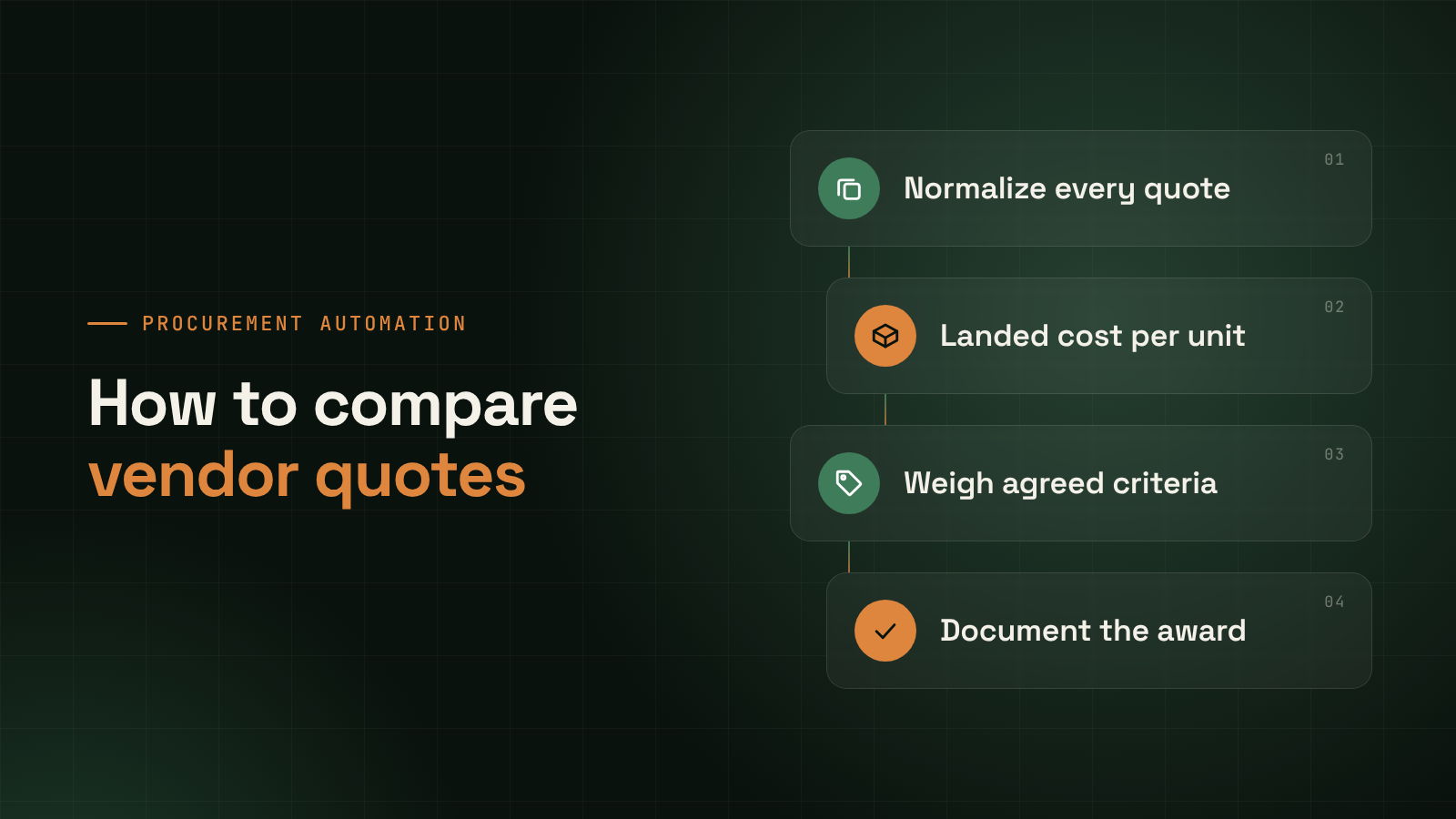
It means four things in order: confirm every quotation answers the same requirement, convert all of them to one commercial basis, calculate landed cost per unit, then score them against criteria agreed in advance. Skip any of the four and you are not comparing offers. You are ranking numbers that were never equivalent.
The first step is the one most often assumed. Check that each vendor quoted the specification you issued, the quantity you asked for and the full scope. A quotation that silently excludes testing, packing or a one-year warranty is answering a different question from one that includes them, and the cost of buying the missing piece separately belongs in the comparison as its own line.
What do you have to normalize before comparing anything?
Delivery terms, unit of measure, currency, recoverable and non-recoverable tax, freight and packing, duty and clearance, order quantity, and scope inclusions. Each of these moves the headline number without changing the offer. Normalizing them is not analysis. It is clerical conversion, and it is where the comparison is either made honest or quietly broken.
Delivery terms do the most damage, because the words look like formalities and behave like money. Incoterms 2020 are 11 rules published by the International Chamber of Commerce, and each states which party, if any, must arrange carriage, which must provide cargo insurance, and who carries out and pays for the customs formalities. The US International Trade Administration is explicit that they do not list the contract price and do not determine when title passes. A quotation on ex works terms and one delivered to your plant are therefore two different bundles, and only one includes the freight you will pay anyway.
Currency is the second trap, and it is one of record-keeping rather than math. Convert at one rate, on one date, and write both onto the comparison. A rate that lives in somebody’s head cannot be reproduced three months later.
How do you calculate landed cost per unit?
Take the quoted unit price, convert the currency at a stated rate and date, add inbound freight, insurance, packing, duty and clearance per unit, subtract any tax you can recover, then divide across the quantity you will actually consume rather than the quantity the vendor wants to ship. The result is the only number worth ranking.
The arithmetic below is illustrative, using invented figures for 2,000 units of a machined component. It shows the two things that happen most often: the cheapest headline price finishing last, and a second vendor overtaking on freight alone.
| Line | Vendor A | Vendor B | Vendor C |
|---|---|---|---|
| Quoted price | $18.40 per unit, ex works | $19.10 per unit, delivered to plant | EUR 16.10 per unit, free carrier at seller’s port |
| Quantity on the quote | 2,000 | 2,000 | 3,000 (vendor minimum) |
| Converted at 1.08, rate dated the day of comparison | $18.40 | $19.10 | $17.39 |
| Inbound freight, insurance and packing | $1.05 | included | $1.60 |
| Import duty and clearance | not applicable, domestic | not applicable, domestic | $0.78 |
| Landed cost per unit | $19.45 | $19.10 | $19.77 |
| Carrying cost of the 1,000 surplus units, spread over the 2,000 you use | none | none | $0.49 |
| Comparable cost per unit consumed | $19.45 | $19.10 | $20.26 |
| Lead time | 6 weeks | 4 weeks | 9 weeks |
| Payment terms | net 30 | net 45 | net 60 |
Vendor C quoted the lowest number and is the most expensive offer on the sheet. Vendor A looked 70 cents cheaper than Vendor B and is 35 cents dearer once freight is counted. Neither result needs sophisticated analysis. It needs the conversion done before the meeting rather than during it.
One caution on the surplus line. That carrying cost assumes a 10 percent annual carrying rate and six months of average holding, which are assumptions rather than facts. Put them on the sheet so the approver can disagree. A hidden assumption that changes the ranking is worse than no adjustment at all.
How do you weigh price against everything else?
By fixing the criteria and their relative importance before the quotations arrive, then scoring every offer against them. Landed cost usually carries the largest single weight, and it is rarely the only one that matters. Lead time, technical compliance, supply risk and payment terms all have a price, and some of them are not expressible as one.
A defensible structure for a mid-market purchase looks like this. The weights are an example, not a standard: a spares purchase for a line that is down should not be weighted like an annual consumable contract.
| Criterion | Example weight | How to score it |
|---|---|---|
| Comparable landed cost per unit consumed | 50 percent | Lowest cost takes full marks, others scored in proportion |
| Lead time and delivery reliability | 20 percent | Quoted lead time against your requirement, adjusted by the vendor’s own on-time record |
| Technical compliance | 15 percent | Fully compliant, compliant with deviations named, or not compliant |
| Supply risk and continuity | 10 percent | Single site against multiple, financial standing, whether this award leaves you single sourced |
| Payment terms | 5 percent | Days of credit against your standard terms, kept separate from unit price |
Writing the criteria down in advance is not a nicety. Public procurement regimes make it compulsory, which is a fair signal about how the alternative tends to end.
Do the rules for comparing offers differ by country?
For public buyers, yes, in wording and detail. In substance the three major regimes agree: state the criteria before you ask for offers, state how much each one counts, and do not award on a basis you invented after reading the bids. Private mid-market buyers are not bound by any of this. Most purchase policies have borrowed the logic anyway.
| Where | What the rule requires when offers are compared | Source checked |
|---|---|---|
| United States, federal buying | Under a tradeoff process, “all evaluation factors and significant subfactors that will affect contract award” must be listed and “their relative importance shall be clearly stated in the solicitation”. The solicitation must also state whether non-cost factors are significantly more important, approximately equal, or significantly less important than cost or price. | FAR 15.101-1, acquisition.gov |
| European Union, public contracts | Award goes to the most economically advantageous tender, “identified on the basis of the price or cost, using a cost-effectiveness approach, such as life-cycle costing”. The authority must specify “the relative weighting which it gives to each of the criteria”, except where price alone decides. | Directive 2014/24/EU, Article 67 |
| European Union, what life-cycle cost covers | Costs “relating to acquisition”, “costs of use, such as consumption of energy and other resources”, “maintenance costs”, and “end of life costs, such as collection and recycling costs”. | Directive 2014/24/EU, Article 68 |
| United Kingdom | Award criteria must “relate to the subject-matter of the contract”, be “sufficiently clear, measurable and specific” and be “a proportionate means of assessing tenders”. With more than one criterion, the authority indicates relative importance by percentage weighting, by ranking, or by describing it another way. | Procurement Act 2023, section 23 |
| Private buyers, any market | No statute. Your purchase policy sets the quotation threshold, the minimum number of responses and who may award. | Company purchase policy |
The EU life-cycle list is the one worth borrowing. Acquisition, use, maintenance and end of life is a four-line total cost model that works on a pump, a forklift or a software subscription, and it is the quickest way to show an approver why the cheapest purchase price was not the cheapest decision.
How many vendor quotations do you need?
That is a policy question, not a universal rule. Most mid-market purchase policies allow a single quotation below a stated value, require three above it, and require a documented exception for proprietary or single-source items. The number matters far less than applying the same number every time.
Approaching five vendors to get three usable responses is normal, and the two who did not reply belong on the comparison with the date they were contacted. That record of who was asked is what an auditor looks for, and it is the first thing a rebuilt spreadsheet loses. On a genuinely single-source item there is nothing to compare, and chasing a token second quotation to satisfy a form wastes a week.
Where does vendor quotation comparison go wrong in practice?
In the inputs, almost always. The template is not the problem and neither is the arithmetic. Four failures account for most unreliable comparisons, and every one of them is mechanical rather than analytical: retyping, stale revisions, missing non-responses, and an item master that was never clean enough to compare against.
Quotations arrive in mixed formats on mixed channels and get retyped, so transcription errors enter before any analysis starts. The sheet then goes stale when a vendor revises a price and the revision sits unread in an inbox. Vendors who were approached and did not respond disappear from the record. And if the same component sits under three item codes with two units of measure, the comparison was never valid, and no care in the sheet recovers it. Fix the item master first.
Can an agent compare vendor quotations for you?
The preparation, yes, completely. An agent can issue the request, read replies in whatever format and on whatever channel they arrive, extract each offer into its components, convert units and currency, apply the delivery basis, calculate landed cost against your item master, score against your weights, and attach every source document to its row.
What it does not do is award. The recommendation arrives with its reasoning and a person commits the company, which is ordinary segregation of duties. Where a purchase is worth a second round rather than an award, see how AI negotiates with suppliers. The document itself and what it must contain is covered in what a comparative statement is.
What should you measure?
Four numbers, in this order. Start with the share of purchase value that went through a real comparison rather than a single quotation and a signature. In most mid-market companies that figure is lower than the finance head expects, and it is the one that moves first once the comparison stops being manual.
Then time from last quotation received to recommendation ready, which is what automation compresses. Then the share of comparisons where every approached vendor appears, responded or not. Then realized price against your own last price paid for the same item, unit and delivery basis, because no first-hand source publishes usable market price data for mid-market categories.
What this doesn’t do
- It does not choose the supplier. The output is a ranked comparison with its reasoning. Awarding is a commitment, and relationship, development plans and second-source strategy sit outside the numbers.
- It does not judge technical equivalence. A different grade, make or specification at a lower price is an engineering decision. The agent flags the deviation and stops.
- It does not fix a bad item master. Duplicate codes and inconsistent units make every comparison unreliable, and automation reproduces the error faster.
- It does not manufacture competition. On a single-source item there is nothing to compare, and the lever is qualifying a second supplier.
- It does not set your weights. Criteria and their relative importance are a policy decision. An agent applies them consistently; it cannot decide that lead time matters more than price this quarter.
Frequently asked questions
How do you compare vendor quotations, step by step?
Confirm every quotation answers the same specification, quantity and scope. Convert all of them to one delivery basis, one unit of measure and one currency at a stated rate and date. Calculate landed cost per unit including freight, duty and recoverable tax, divided across the quantity you will actually use. Then score the offers against criteria and weights you fixed before the quotations arrived.
Should you always award to the lowest vendor quotation?
No, and the lowest quoted number is often not the lowest cost. Apparent price differences frequently turn out to be differences in delivery terms, included scope, order quantity or tax treatment. Once those are equalized the ranking changes more often than buyers expect, and lead time or supply risk can still outweigh a small remaining gap.
How do you compare vendor quotations in different currencies and across several legal entities?
Convert every quotation to one reporting currency at a single stated rate and date, and record both on the comparison so the decision can be reproduced later. Show entity-specific tax treatment as its own line rather than folding it into the unit price, since recoverability differs by entity and country. If your entities run different item masters, reconcile the item codes before trusting any cross-entity comparison.
What is the difference between a vendor quotation comparison and a comparative statement?
They are the same work under different names. Comparative statement is the common term in India, the Gulf and much of South and Southeast Asia; bid tabulation is the usual United States equivalent, and tender comparison or bid evaluation is common in Europe. The comparison is the method; the statement is the document it produces.
Which ERP versions does this work with?
The procurement agent reads from and writes back to SAP S/4HANA, SAP ECC and SAP Business One, where most mid-market deployments sit. It needs read access to the item master, vendor master, open requisitions and purchase history to calculate landed cost and compare against last price paid. Creating or changing a purchase document is a separate permission with its own approval controls.
Can it handle quotations that arrive as PDFs, scans or messaging apps?
Yes, and that is usually the practical reason to automate this step rather than the math. Vendor replies rarely arrive in a structured format, and the retyping that follows is where most comparison errors start. Every field pulled from an unstructured document should carry a confidence score, with low-confidence rows sent to a buyer instead of used silently.
Does the agent raise the purchase order once a winner is clear?
Not unless you configure it to, and not above the value threshold you set. A sensible starting configuration commits nothing automatically for the first several weeks, after which low-value repeat items inside policy may proceed while everything else comes back for a signature. The authority model is set out in whether the agent commits to a purchase without approval.
Where to go next
To see how the procurement agent collects quotations across email, messaging and voice and where each approval gate sits, start with procurement RFQ automation. Three related reads:
- What is a comparative statement in procurement covers the document this comparison produces, what it must contain and who may award against it.
- RFQ automation for procurement covers the step before this one, getting usable quotations in on time.
- AI agent governance, approvals and audit trails sets out how to classify agent actions by consequence, which is how the award threshold gets decided.