Table of Contents
Key takeaways
- AI agent governance is the set of rules, approvals and records that determine what an agent may do, who authorized it, on what evidence, and how you can prove all three afterward.
- Auditors ask three questions of any automated action: who authorized it, what evidence was used, and can you show it. A governance design is only as good as its answers to those.
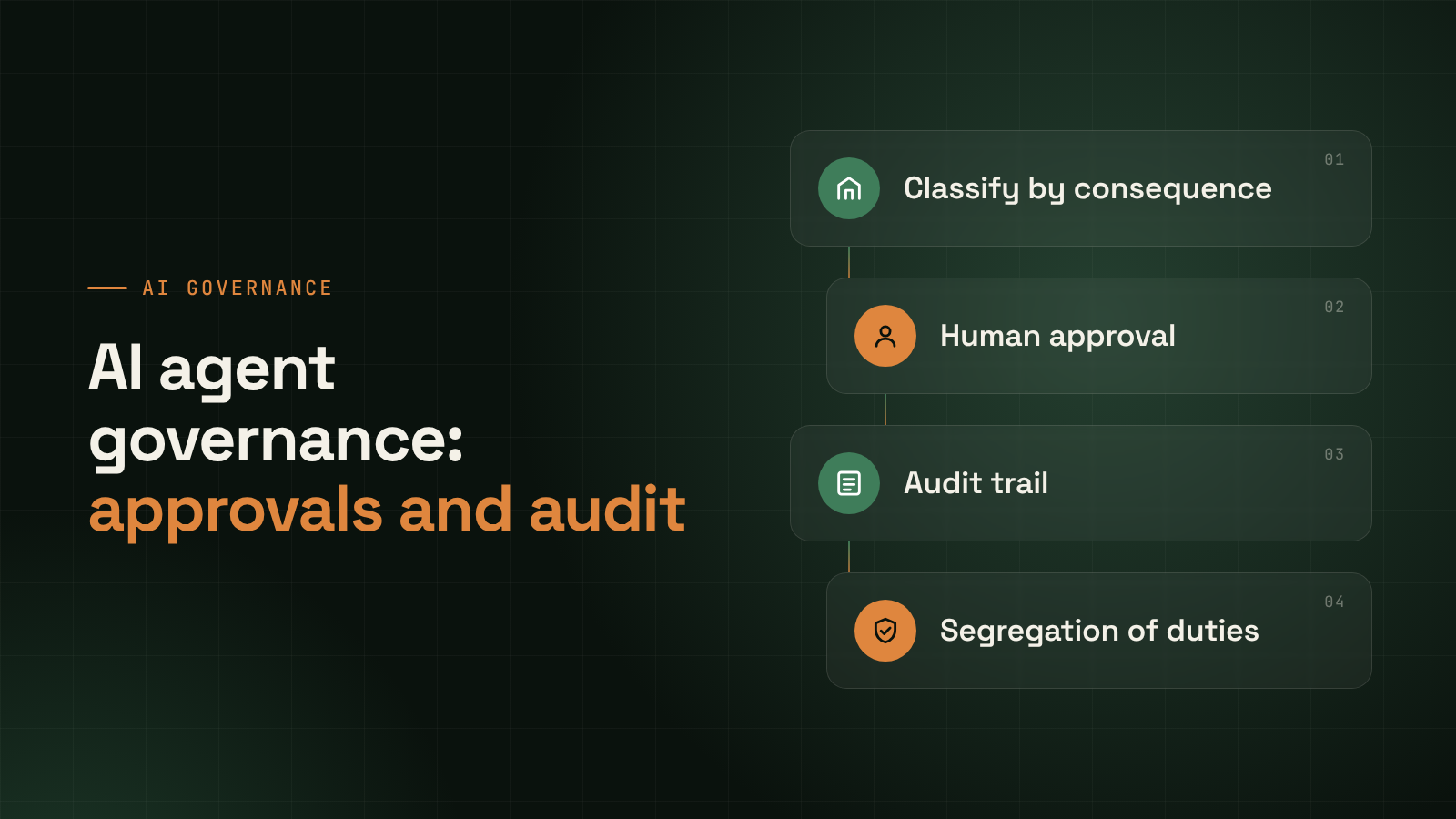
- Classify agent actions by consequence, not by technology. Reading and suggesting need light controls; posting, paying and communicating externally need approval and a full record.
- Segregation of duties still applies. An agent that prepares a payment must not also be able to approve and release it, exactly as for a person.
- Human-in-the-loop only works when the human has the evidence, the authority and the time to say no. Otherwise it is theater. Start governance before go-live, not after the first incident.
Imagine you run accounts payable at a distribution business in Rotterdam, and an internal auditor sits down across from you to ask about one invoice. It was posted into SAP, matched to a purchase order and goods receipt, and cleared for payment, all without a clerk touching it. The auditor asks who approved it, what the system compared, and whether you can show the comparison. If your answer is “the software did it”, the audit finding writes itself. It is the question every finance team will face once agents start acting on their behalf.
For this article, AI agent governance means the controls that make an agent’s actions authorized, evidenced and reviewable. It sits alongside the accounts payable agent and any other agent that touches financial records.
What is AI agent governance?
AI agent governance is the combination of permissions, approval rules, audit records and oversight roles that defines what an agent may do and proves what it did. It treats the agent like any other actor in your control environment, with a defined mandate, limits and a reviewable history.
It is not a separate compliance project. In a finance function, most of it is the internal control framework you already have, extended to a new kind of actor. The question is whether your existing controls still hold when the actor is software that can act many times faster than a person.
What do auditors actually ask?
Three things: who authorized the action, on what evidence it was taken, and how you can prove both. Everything in a governance design should be traceable to one of those three questions, because they are what a reviewer, an external auditor or a regulator will reach for first.
| Auditor’s question | What a good answer looks like | What a weak answer looks like |
|---|---|---|
| Who authorized this action? | A named person or a documented rule, with the authority level recorded | “The system did it” |
| On what evidence? | Source documents, comparison results and tolerances, linked to the record | A summary with no link to the documents |
| Can you prove it? | An immutable, time-stamped log that someone outside the process can read | Screenshots or a spreadsheet assembled after the event |
| Who could have stopped it? | A defined approver and an exception route | No one, because it ran automatically |
| What if it was wrong? | A reversal path and a record of who reversed it | An informal fix in the ledger |
How should you classify agent actions?
By consequence. Group every action an agent can take into tiers according to how hard it is to reverse and who it affects, then attach controls to the tier. Reading and drafting need light controls; posting, paying and anything external need explicit approval and a full record.
| Tier | Example actions | Control |
|---|---|---|
| Observe | Read ledgers, summarize open items, flag anomalies | Access limited to what the task needs; activity logged |
| Suggest | Propose a match, a coding, a priority order or a draft message | Suggestion recorded with its evidence; a person accepts or rejects |
| Act within limits | Post a clean three-way match within tolerance, update a status | Rules and limits documented; every action logged; exceptions routed to a person |
| Act with approval | Release a payment, change a vendor bank detail, send an external communication | Named approver with the authority; two-person rule where your policy requires it |
| Not permitted | Change its own permissions, approve its own output, alter the audit log | Technically blocked, not just discouraged |
The tiers make a governance conversation concrete. Instead of asking “is it safe?”, you ask “which tier is this action in, and does the control match?” You can start with most actions in the first two tiers and move individual actions up as you gain evidence.
What should an audit trail contain?
Enough to reconstruct the decision without asking anyone. For each action: what was done, when, in which system and document, on behalf of which rule or user, what inputs were compared, what the outcome and any tolerance were, and who approved or overrode it.
A usable audit trail has these elements:
- Identity. Which agent, which version, and which human or rule authorized it.
- Inputs. The documents and data read, linked rather than copied where possible.
- Logic. The rule, tolerance or reasoning applied, in words a reviewer can follow.
- Outcome. What was written to the ERP, or what was recommended and then declined.
- Overrides. Any human change, with the person and the reason.
- Time and sequence. Time-stamped, ordered, and protected from alteration, including by the agent itself.
If a log can only be read by an engineer, it is a debugging aid, not an audit trail. It needs to be legible to finance and audit.
Does segregation of duties still apply to agents?
Yes. The principle is that no single actor should be able to initiate, approve and execute a sensitive transaction. An agent that prepares a payment proposal must not also approve it or release it, and the agent’s credentials should not carry broader rights than the task needs.
In practice this means giving the agent its own identity in the ERP with a narrow role, not a shared or administrator login. It means separating the agent that proposes from the person who approves, and checking that the combined rights of agent and human operators do not recreate the conflict you removed. A useful test: if you described the agent as a new employee, would your current access matrix permit that combination of rights? If not, the agent should not have it either.
How do you make human-in-the-loop more than theater?
Give the human the evidence, the authority and the time to say no. An approval screen that shows only “approve” and “reject” next to a total teaches people to click through. A real approval shows the documents, the comparison and the reason the item was routed to a person.
Four tests separate real oversight from a rubber stamp:
- Evidence on the screen. The approver sees the source documents and the agent’s reasoning, not just a conclusion.
- Genuine authority. The approver can reject, and a rejection is acted on rather than escalated away.
- Sensible volume. If one person is asked to approve hundreds of items an hour, the control has failed whatever the policy says. Route only genuine exceptions to a person, and keep clean items within documented limits.
- Feedback. Rejections and overrides are recorded and reviewed, so the rules improve and rubber-stamping becomes visible.
The point of automation is that people spend attention on items needing judgment. Governance should protect that attention.
Which frameworks can you ground this in?
Two are widely referenced. The NIST AI Risk Management Framework is a voluntary framework built around four functions: Govern, Map, Measure and Manage. ISO/IEC 42001 is an international standard for an AI management system. Neither replaces your internal controls; both give you shared vocabulary.
NIST published AI RMF 1.0 on January 26, 2023 and describes it as voluntary. The framework document states that its core is composed of four functions, GOVERN, MAP, MEASURE and MANAGE, and that GOVERN is a cross-cutting function infused throughout AI risk management. NIST also published a Generative Artificial Intelligence Profile, NIST-AI-600-1, on July 26, 2024. ISO/IEC 42001:2023, published in December 2023, specifies requirements for establishing, implementing, maintaining and continually improving an AI management system within organizations that provide or use AI-based products or services.
Practically, use the four functions as a checklist: who owns the risk, where the agent can fail, how you will measure its behavior, and how you will respond. Your risk committee and auditors will recognize that structure.
When should governance start?
Before go-live. Decide the action tiers, approval authorities and log requirements while the scope is being agreed, because retrofitting them after launch means arguing about controls while the agent is already acting. It is also far cheaper to start with narrow permissions and widen them than the reverse.
A sensible sequence is to run the agent in suggest mode first, compare its proposals with human decisions, and move an action type into “act within limits” only when the evidence supports it. The AI invoice workflow guide shows this staging for payables.
What this doesn’t do
- It does not make an agent infallible. Governance limits the damage and makes errors visible and reversible. It does not guarantee there will be none.
- It does not replace your internal control framework. It extends that framework to a new actor. Policies, approval matrices and audit practice remain yours.
- It does not certify compliance. Referring to NIST AI RMF or ISO/IEC 42001 gives structure; it is not a certificate, and we do not claim alignment on your behalf.
- It does not remove the need for judgment. Someone still decides risk appetite, which tier an action belongs in, and what a tolerance should be.
Frequently asked questions
Who is accountable when an AI agent makes a mistake?
The organization that deployed it, through the named owners of the process. That is why each action tier needs a named approver or process owner. Accountability does not transfer to software, so design the controls so a person can be identified at every material step.
What should be in an AI agent audit trail?
Identity, inputs, the logic applied, the outcome, any human override, and a protected time-stamped sequence. A reviewer outside the project should be able to reconstruct the decision from the record without asking the team.
Does an agent need segregation of duties like a human user?
Yes. Give it its own narrow role in the ERP and ensure it cannot both prepare and approve a sensitive transaction. Check the combined rights of agent and human operators, not just the agent’s alone.
Do we need ISO/IEC 42001 certification to use AI agents?
No. It is a voluntary standard. Some organizations will pursue it for customer or board assurance, but a well-designed control environment, with documented limits and a proper audit trail, is the practical starting point for most finance teams.
How do you stop human approval becoming a rubber stamp?
Show the approver the evidence, give them real authority to reject, keep the volume of items to genuine exceptions, and review overrides and rejections. If approval takes a second and never changes the outcome, the control is not working.
When should we start working on governance?
Before go-live. Agree the action tiers, approvers and log requirements during scoping, and begin in suggest mode with a person reviewing everything. Widen the agent’s permissions as the evidence supports it.
Where to go next
If you are assessing how an agent would fit your control environment, start with the security and controls page, which sets out how access, approvals and logging are handled.
Three related reads:
- How to automate accounts payable, the process this governance applies to first.
- Three-way matching automation, on tolerances and exception routing.
- AI accounts payable agents and the invoice workflow, on staging an agent from suggestion to action.