Table of Contents
Key takeaways
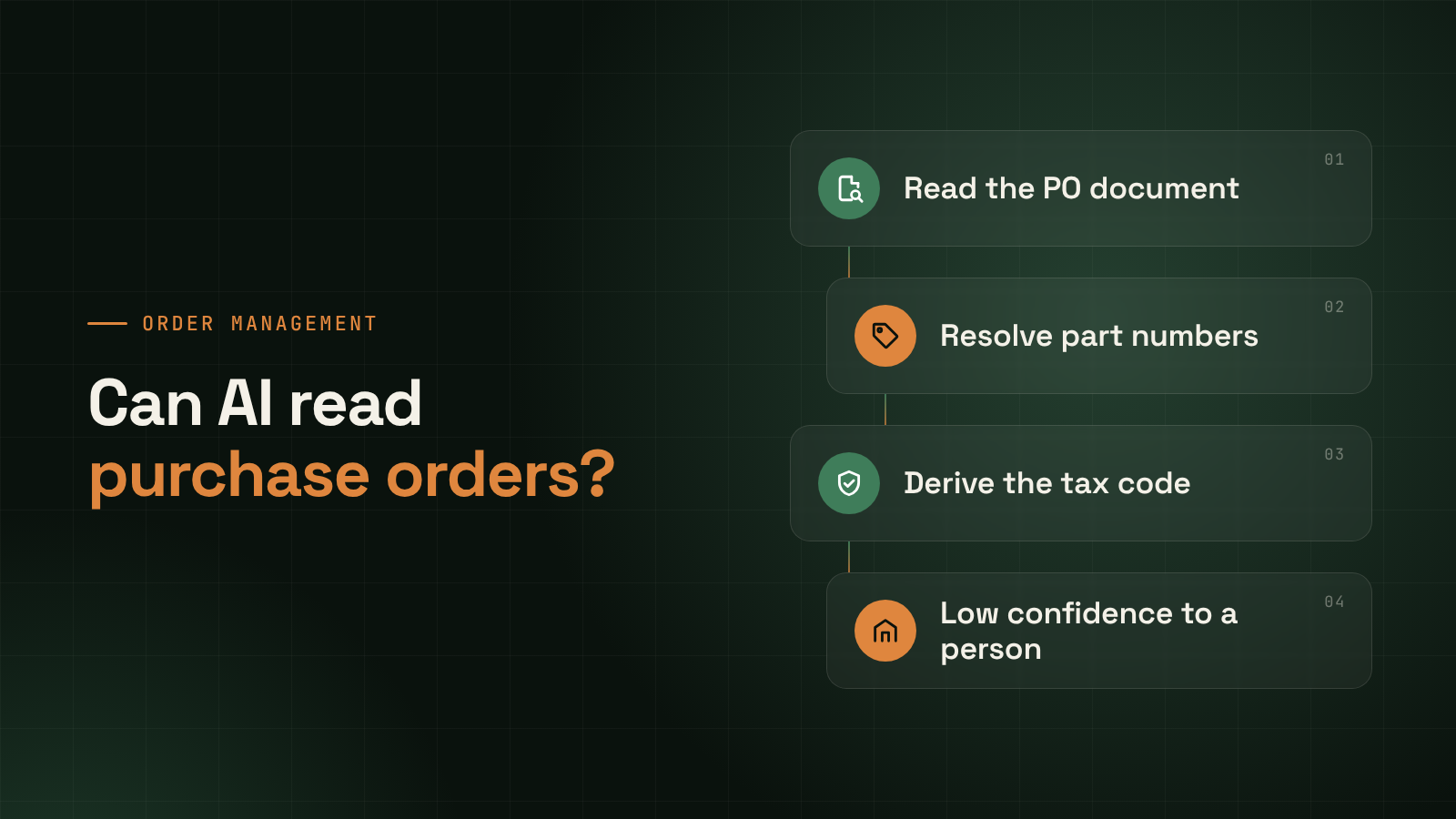
- Yes. Document AI reads customer purchase orders in almost any layout, including scans and phone photographs, and that half of the problem is largely solved.
- The failure point is resolution, not reading: turning the customer’s part number, wording and unit of measure into one specific item in your item master.
- A dependable agent resolves each line through a ranked set of signals and scores its confidence field by field, rather than returning one answer with nothing behind it.
- Tax codes are derived, not read. A customer purchase order rarely carries the code your ERP needs, and what drives that code differs by country.
- Whatever the agent cannot resolve belongs on a short exception list for a person. A quietly guessed line is worse than an open one.
Imagine you run order management at a 400-person pump manufacturer selling into four countries. Orders arrive all day as PDF attachments, scans and the occasional photograph of a signed paper order, and two people retype them into SAP. One customer writes “SEAL KIT 2IN MECH” where your item master says SK-0200-MS. Another orders in boxes when you sell in meters. Reading a customer purchase order with AI means extracting the header and line detail from whatever document arrived, then resolving each line to a real item, price and tax treatment in your own system.
The reading is what people ask about. The resolving is what decides whether the sales order is correct, and everything useful about sales order automation sits in that second half.
Can AI actually read a customer purchase order PDF?
Yes, and layout variety is no longer the obstacle it was five years ago. Current document models handle native PDFs, scans and photographs, locate the line table without a template per customer, and pull header fields from wherever they sit on the page. Accuracy falls on poor scans, handwriting and amended documents, which is where confidence scoring earns its keep.
More than the line table has to come off the page. The header carries the order number, order date, requested date, ship-to and bill-to addresses, currency, payment terms and delivery terms, scattered differently on every customer’s stationery. Terms that change the commercial meaning often sit on page two below a signature block, and handwritten amendments on scanned orders are frequently the most important thing on the document.
One check costs nothing and catches a lot: add the extracted line values and compare the result to the printed order total. If they disagree, something was misread, a line was missed or a discount went uncaptured. That single test separates documents that need a person from documents that do not.
Why is reading the document the easy part?
Because the document is complete and the mapping is not. Everything needed to understand what the customer wants is on the page. Almost nothing needed to create a sales order in your ERP is on the page, because the purchase order is written in the customer’s vocabulary and your system accepts only yours.
Consider what has to be true before a line can exist: one item code from your item master, one unit of measure your system recognizes, a price matching the quotation or price list that applies to this customer today, a tax code derived from the parties and the destination, and a date your planning can support. The customer supplied the first two in their own terms and none of the rest. It is the same division of labor as in payables, where capture is routine and matching is where the work lives, set out in OCR versus AI invoice capture.
How does an agent match a customer part number to your item master?
By working down a ranked set of signals and stopping at the first one reliable for that line, rather than running a single fuzzy text match across the whole catalog. The signals differ in trustworthiness by an order of magnitude, and a well-built agent reports which one it used so a person can audit the decision.
| Signal | What it is | How far to trust it | What breaks it |
|---|---|---|---|
| Customer item cross reference | A stored mapping of this customer’s part number to yours, held on the customer master | Highest. A deliberate, maintained decision | Exists only where somebody set it up, and nobody maintains it for new items |
| GTIN, EAN or UPC on the line | A GS1 identifier. GS1 states the GTIN “is used to uniquely identify trade items (products or services)” | High where present | Rarely used in industrial, engineered or made-to-order supply |
| Your own part number quoted back | The customer typed your code onto their order | High | Superseded codes, and codes copied from an old order |
| Your quotation or contract reference | The order cites the quotation line it is accepting | High, and it settles price at the same time | Partial orders, substitutions, quantity changes against the quoted line |
| This customer’s order history | What this customer previously ordered under this exact wording | Medium, strong for repeat business | First orders, and wording changed after a specification revision |
| Description similarity | Text matching the customer’s wording against your item descriptions | Low on its own, useful only as a tiebreaker | Near-identical variants differing by grade, length, voltage or coating |
The ranking matters more than the technology. A description match that happens to be right nine times is still the wrong basis for the tenth, because variants separated by one specification digit are exactly what a text model finds hardest and your customer notices fastest.
What about units of measure and pack size?
They belong in the same step, and they cause more credit notes than part numbers do. A customer ordering 10 boxes of an item you stock in meters has stated a quantity nobody can act on. The conversion comes from your item master, not the document, and the unit the customer priced against has to agree with the unit you will ship and invoice. When no stored conversion exists, that is an exception, not a rounding decision.
How does the agent pick the right tax code?
It derives it. The tax code is a function of who is selling, who is buying, what is being sold and where it is going, and almost none of that arrives as a usable code. The agent reads the ship-to, the bill-to and sometimes a tax registration number, then applies your own determination setup against the item’s tax classification.
Those rules differ by regime, and a company selling across borders usually runs several at once. The table summarizes what drives the decision in four places, checked on November 17, 2026. It is not tax advice and does not replace the logic configured in your ERP.
| Where | What drives the treatment on the order line | What the agent needs on file | Source |
|---|---|---|---|
| United States, New York State as a worked example | Taxable unless the customer gives a properly completed exemption certificate, which New York requires “within 90 days after the date of the purchase” | A current, valid certificate on the customer record, with its coverage and entity | NY Department of Taxation and Finance, bulletin on exemption certificates |
| European Union | An intra-EU supply is goods “dispatched or transported” by or for the supplier or customer “from one EU country to a destination in another EU country”, the customer being a business or non-taxable legal entity acting as such. Normally exempt | Ship-to country, the customer’s VAT status and registration, evidence of dispatch | European Commission, Taxation and Customs Union, exemptions with the right to deduct |
| United Kingdom, goods leaving Great Britain | Zero-rating applies to goods sent outside the UK, but only with documentary evidence of export obtained “within 3 months from the time of sale”. Do not zero-rate if delivery is to a UK address | Ship-to address, and a link from the order to the export evidence | HMRC guidance on exports, dispatches and supplying goods abroad, gov.uk |
| India | Section 7(1) of the IGST Act 2017 treats a supply as inter-State where the supplier’s location and the place of supply are in “two different States”, two Union territories, or a State and a Union territory, which decides integrated tax rather than the central plus state split | Place of supply from the ship-to, plus the customer’s GSTIN, the GST identification number every registered business holds | Central Board of Indirect Taxes and Customs, IGST Act 2017, section 7 |
The pattern is the same in all four. The customer’s document supplies facts, your master data supplies status, and the code comes from rules you own. An agent that copies a tax code off the purchase order is not saving work. It is importing the customer’s assumption about your tax position.
Doesn’t EDI already solve this?
For customers who are on it, yes, and that is usually a minority of the ledger. The X12 850 transaction set exists to carry a structured purchase order, and X12 states that it “contains the format and establishes the data contents of the Purchase Order Transaction Set (850)”. UN/EDIFACT ORDERS plays the same role elsewhere.
Two things limit it. EDI is deliberately narrow: X12 says the 850 “should not be used to convey purchase order changes or purchase order acknowledgment information”, so changes travel elsewhere or, in practice, by email. And onboarding a trading partner costs real effort, so it gets done for the largest customers and never for the long tail. Document reading is not a substitute for EDI. It reaches everyone EDI never will.
What happens when the agent is not sure?
It stops on that field and says so. Confidence belongs at field level, not document level, because an order can be perfectly readable with one ambiguous line, and holding the whole order for that line wastes the gain. Clean lines carry forward; the rest go to a person with the source document, the candidate matches and the reason each was rejected.
Start thresholds conservative and loosen them on evidence. Corrections are the other half: when a person resolves a line the agent could not, write that decision back to the customer cross reference so the line resolves itself next time. How to classify agent actions by consequence is covered in AI agent governance, approvals and audit trails, and the staging step that follows resolution, with stock and credit checks, is covered in automating sales order entry in SAP Business One.
What should you measure?
Four numbers. The share of order lines resolved without a person touching them, split by customer, because the distribution matters more than the average and the tail is where the effort should go. Time from order arrival to draft order staged, which is what customers feel. The error rate on released orders, specifically wrong item, quantity, unit or price, measured against credit notes raised. And the share of exceptions that produced a stored cross reference, because an exception that teaches the system is cheap and one that repeats every month is not.
What this doesn’t do
- It does not confirm the order to the customer. The agent drafts and stages. Acknowledging an order commits a date and a price, and that stays a human act.
- It does not fix a disordered item master. Duplicate codes, inconsistent units and dead items make resolution unreliable, and automation reproduces that confusion at speed.
- It does not decide tax treatment. It applies the rules configured in your ERP and flags what it cannot derive. Your tax advisor owns the rules.
- It does not accept a price the customer invented. Where the order price differs from the quotation or price list, the line is flagged rather than absorbed.
- It does not read intent. A note saying “same as last time but in stainless” is a conversation, not a line item, and belongs in someone’s queue.
Frequently asked questions
Can AI read customer purchase order PDFs accurately enough to use without checking?
It reads most fields on most documents reliably, but “without checking” is the wrong target. The practical design is field-level confidence scoring, where high-confidence fields pass through and low-confidence ones go to a person. Expect strong results on typed PDFs from regular customers and weaker results on poor scans, handwritten amendments and first orders.
What happens when the customer uses their own part numbers?
That is the normal case and the real work. The agent resolves through a stored customer item cross reference where one exists, then a GTIN or your own quoted part number, then what this customer has ordered before. When nothing resolves confidently the line goes to a person, and that decision should be saved so the same line resolves itself next time.
Does it work with scans, photographs and messaging apps, not just clean PDFs?
Yes, with lower confidence on harder inputs. A photograph taken at an angle in poor light produces more low-confidence fields than a native PDF, which means more exceptions rather than more errors. Orders arriving through messaging apps are read the same way, with the attachment as the document and the message as context.
Which ERP versions does this work with?
The order management agent reads from and writes to SAP S/4HANA, SAP ECC and SAP Business One, where most mid-market deployments sit. It needs read access to the item master, customer master, price lists and open quotations to resolve a line. Creating or changing a sales document is a separate permission with its own approval controls.
How does it handle multiple legal entities, currencies and tax regimes?
The purchase order supplies the facts and your configuration supplies the treatment. The selling entity follows from the bill-to and your setup, the currency comes from the order with the rate applied by your ERP policy, and the tax code is derived per entity from ship-to, customer status and item classification. Entities running different item masters need their cross references maintained separately.
Can it handle a purchase order that amends an earlier one?
Only where the amendment is explicit. A revised order citing the original number and stating what changed can be matched to the open order and the differences presented. A document that silently restates an order with a new quantity is dangerous to process automatically, and the right behavior is to flag a possible amendment rather than create a second order.
How long before this is doing useful work?
The reading works from day one. Resolution improves over the first several weeks as cross references accumulate from the exceptions your team clears. Expect your largest repeat customers to resolve well quickly, because their lines repeat, while one-off orders stay manual longer and may always carry a check.
Where to go next
To see how the order management agent reads an incoming order, resolves it against your master data and stages a draft for release, start with sales order automation, or read how it works for the shape of a deployment. Three related reads:
- Automating sales order entry in SAP Business One covers the next step, turning a resolved order into a validated draft inside SAP.
- How AI invoice processing works opens up the document reading mechanics in detail, on the payables side of the same problem.
- AI agent governance, approvals and audit trails sets out how release authority on an order should be decided.