Table of Contents
Key takeaways
WhatsApp already runs a large part of procurement. The real question is whether any record of it reaches your ERP, or whether it dies in a buyer’s phone.
A rate accepted in a chat thread can bind your company. Most countries’ law does not treat an electronic exchange as a lesser one, and that cuts both ways.
Meta’s own platform rules shape what is possible: vendors have to opt in, and outside the 24 hour window that a vendor’s message opens, you can only send template messages.
Split the work by step. Nudges, quotes and confirmations suit chat. Specifications, approvals and the purchase order itself belong in a system of record.
An agent on WhatsApp earns its place by writing back, so every quoted price, lead time and promise lands as structured data against the inquiry.
Imagine you run purchasing at a pipe fittings manufacturer in Dubai with two buyers and about four hundred active vendors. Your senior buyer’s phone holds eleven vendor groups, a few hundred unread messages, and the only copy of the rate your best forging supplier agreed on Tuesday. He takes a week off. The junior buyer re-floats the same inquiry, gets a worse number, and nobody can prove the earlier one existed. WhatsApp procurement means running the sourcing conversation, meaning inquiries, quotations, follow-ups and confirmations, over WhatsApp as a deliberate and recorded channel rather than as an untracked habit on personal handsets. The habit is not the problem. The missing record is, which is the same gap that procurement RFQ automation is built to close.
Can procurement run on WhatsApp?
Yes, for the conversational half of it: floating inquiries, chasing quotations, clarifying a specification, confirming a rate and a delivery date. It cannot hold the half that needs a controlled record, meaning the approved specification, the authorization and the purchase order. Run the conversation there, keep the commitment in your ERP.
Most mid-market companies in WhatsApp-heavy markets are already doing the first half and skipping the second. The quotation arrives as a photo of a letterhead. The negotiation happens in voice notes. The agreed price gets typed into SAP three days later from memory, if the buyer remembers at all. Nothing in that sequence is illegal or even unusual. It is just invisible to everyone except the buyer holding the phone.
The useful reframing is to stop treating WhatsApp as a shadow process to be stamped out, and start treating it as a channel with rules attached. Vendors are not going to start logging into a supplier portal because you bought one.
Why does procurement end up on WhatsApp anyway?
Because that is where the supplier is. A proprietor running a forging shop answers WhatsApp in four minutes and email in four days, if at all. The channel matches the speed of the work: send a drawing photo, get a rate, confirm a dispatch, all before lunch.
Three things reinforce it. Many of your vendors have no back office, so the owner quotes personally from a phone. Voice notes carry nuance that neither party wants to write down. And the group chat, for all its mess, keeps a transporter, a store keeper and a buyer in one place without anybody provisioning an account. A supplier portal competes with none of that, which is why portal coverage quietly collapses to your twenty largest suppliers.
What breaks when the whole buying cycle lives in a chat thread?
Nothing visible, until someone leaves, a price is disputed, or an auditor asks how a rate was arrived at. The failures are not dramatic. They are slow losses that never get attributed to the channel, because the channel is never the thing anyone measures.
| What it looks like in the thread | What it actually costs | Where it surfaces later |
|---|---|---|
| Quotations as photos and voice notes | No comparable basis across vendors, so price is judged on memory | A comparative statement built by hand, or not at all |
| Rates agreed in a one to one chat | The price exists only on one handset | Buyer exits, and the rate goes with him |
| Follow-ups whenever someone remembers | Slow vendors are mistaken for expensive vendors | Cycle time nobody can explain |
| Specification clarified mid-thread | The approved spec and the bought spec drift apart | Rejection at goods receipt |
| Order confirmed by message, PO raised later | Commitment precedes authorization | An invoice with no matching PO |
| Personal numbers, personal accounts | The company does not hold its own commercial record | A dispute with no usable evidence |
The last two rows are where finance usually enters the conversation. An invoice arriving against a commitment nobody approved is an accounts payable problem that was created weeks earlier, in a chat window, by a buyer being helpful.
Is a price agreed on WhatsApp legally binding?
Treat it as capable of binding you. In general, the law does not discount a contract simply because it was formed electronically. Many countries have e-commerce or electronic-signature rules to that effect (India’s Information Technology Act, section 10A, is one example), so a message exchange can form or vary a contract. The details differ by country, so check yours.
So the casual “ok, book it” carries weight, and so does your buyer’s “confirmed, send material.” That is not a reason to ban the channel. It is a reason to decide, deliberately, who is allowed to say those words and at what value, rather than leaving it to whoever happens to be holding the thread. Confirm the detail with your own counsel, but the practical point stands either way: if a message can commit you, the authority to send it needs the same limits as a signature on a purchase order.
What rules govern messaging vendors on WhatsApp Business?
Meta’s platform rules, before anything you design. Two of them set the shape of the whole workflow. You may only message users who have opted in to receive your messages. And when a user messages you, a 24 hour customer service window opens, during which you can send any message type; outside that window you can only send template messages.
Local data-protection and messaging-consent rules sit on top of the platform’s, so check what your jurisdiction requires before you store or process vendor chat records. That second platform rule is the one that surprises people. Your agent cannot freely chase a silent vendor at 10 pm with a chatty reminder. If the vendor has not written to you in the last 24 hours, the follow-up has to be a template. Templates are structured and pre-written, which in practice makes your reminder cadence a design decision rather than an improvization.
| Channel | How vendors actually behave | What constrains you |
|---|---|---|
| Fastest replies, especially from owner-run suppliers | Opt-in, the 24 hour service window, templates outside it | |
| Slower, but carries drawings, terms and a clean trail | Your own retention and record keeping rules | |
| Phone call | Best for a genuine negotiation, worst for evidence | Nothing automatic, so nothing is captured unless written up |
| Supplier portal | Logins used by your largest vendors only | Coverage, which fails silently across the tail |
Read the table as a split rather than a ranking. WhatsApp for reach and speed, email for the documents that have to survive, the phone for the conversations that deserve a person.
Which parts of procurement belong on WhatsApp, and which do not?
Put the back and forth there and keep the commitments out. A simple test: if the step produces a number, a date or a yes, chat is fine as long as it is captured. If the step creates an obligation or defines what you are buying, it belongs in the system of record.
| Step | Fits WhatsApp | Belongs in the ERP or a controlled document | Why |
|---|---|---|---|
| Floating an inquiry to several vendors | Yes | The requisition and item detail | Reach matters, scope must be fixed |
| Chasing a late quotation | Yes | Nothing | Pure coordination |
| Receiving a quoted rate and lead time | Yes, as the inbound | The structured quote record | The number has to be comparable |
| Clarifying a drawing or grade | Partly | The approved specification | Drift here causes rejections |
| Negotiating a rate | Yes, within a mandate | The agreed price and its trail | Someone must own the limit |
| Approving the buy | No | Approval workflow | Authority cannot live in a chat |
| Issuing the purchase order | No | The PO document | This is the commitment |
| Confirming dispatch and delivery date | Yes | The promised date against the PO | Useful for planning, not a commitment |
Nothing in that table requires an AI agent. It is a channel policy, and a company with two buyers and a clear rule will already be better off than one without. The agent earns its place when the capture becomes the bottleneck.
How does an AI procurement agent use WhatsApp without losing the record?
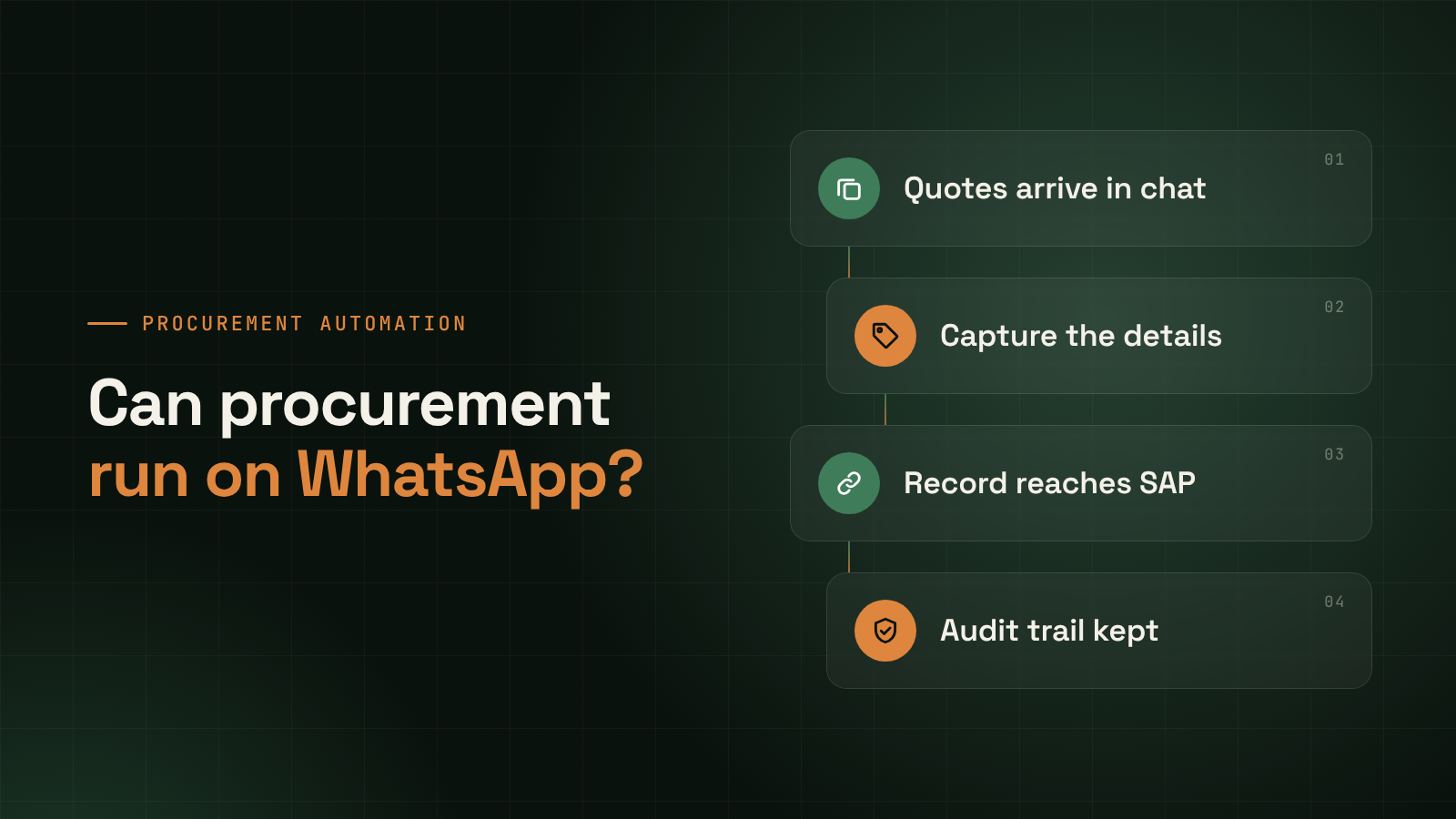
By making capture automatic rather than optional. The agent works from your company’s own business number, ties every thread to a specific inquiry line, reads each reply, and writes the commercial content back as fields: rate, quantity, unit, lead time, freight basis, validity, tax treatment. The thread stays human-readable. The data stops being trapped in it.
Three design details matter more than the conversation quality. Confidence has to be visible, so a rate read out of a blurry letterhead photo is flagged rather than silently posted. The authority limit has to be explicit, so the agent proposes and a named person awards, exactly as covered in how AI negotiates with suppliers. And the follow-up cadence has to respect both the platform rules above and the vendor’s patience, with a cap per vendor per week and one owner per conversation.
The same pattern runs in reverse on the sales side, where customer orders arrive as chat messages and PDFs and get retyped by hand. Automating sales order entry in SAP Business One describes that mirror image.
How do you move from WhatsApp as a habit to WhatsApp as a channel?
In four steps, none of which start with software. Move the traffic onto a company number. Write the one page rule that says which steps may be settled in chat. Fix the vendor master so each supplier carries a channel preference and an owner. Only then automate the capture.
Expect the first two weeks to be about data rather than conversation. Vendor masters carry duplicate records, dead numbers and no channel field at all, and no amount of good messaging compensates for not knowing which of three records is live. Tell your top suppliers before anything changes, so they hear it from you.
How do you tell whether it is working?
Measure capture and speed, not message volume. Four numbers are enough: the share of quotations that end up as structured data rather than a photo, time from inquiry to first comparable quote, the number of vendors responding at all, and the count of purchase orders raised after a commitment was already made.
That last one is the honest test. If it falls, the channel has come under control. If it does not move, you have automated the chat and left the governance problem exactly where it was.
What this doesn’t do
It does not make a chat message into a purchase order. The PO is raised in the ERP after approval. A confirmation in a thread is a conversation, not an authorization, and treating it as one is the habit this is meant to end.
It does not read what was never written. A rate agreed in a phone call stays invisible unless someone types it. Voice notes can be transcribed; a call on a personal handset cannot be recovered.
It does not bypass platform rules. Opt-in and the messaging window apply to an agent exactly as they apply to a person, so a vendor who has not opted in does not get messaged.
It does not clean your vendor master for you. Duplicate suppliers, dead numbers and missing classification flags have to be fixed first, and that work is yours.
It does not decide the award. The agent proposes a position with the reasoning attached. Your procurement head decides who gets the order.
Frequently asked questions
Is it safe to run procurement over WhatsApp at all?
It is safe when the channel carries conversation and your ERP carries commitments. The risk is not the app, it is an untracked exchange on a personal handset that nobody else can see. Move the traffic to a company number and write down which decisions may be settled in chat.
Can an AI agent message our vendors on WhatsApp automatically?
It can, within the platform’s rules. Vendors must have opted in, and once a vendor writes to you there is a 24 hour window in which open conversation is possible. Outside that window, follow-ups go out as template messages, so the reminder cadence has to be designed rather than improvised.
What happens to the messages, and can we show them to an auditor?
Threads are tied to the inquiry and the extracted values are stored as fields against it, so the audit question becomes how a rate was reached rather than whose phone it was on. Retention follows your own policy. The point of the exercise is that the company, not an individual, holds the record.
Will our vendors have to install or learn anything?
No. They keep using the WhatsApp they already have, and a reply typed on a phone works the same way it does today. That is the reason this works where supplier portals fail across the long tail of vendors.
Does the agent handle mixed language messages?
Language handling should be tested against a sample of your own threads during scoping rather than assumed from a feature list. The useful check is whether a rate quoted in a transliterated voice note is captured correctly.
Does it post the purchase order into SAP?
Raising a PO is an approval step, not a messaging step. The agent assembles the commercial position and the comparison; the authorization and the posting follow your existing controls. What changes is that the data behind the PO is already structured instead of being retyped.
How long before this is worth anything?
Six to eight weeks on a narrow category, and the first fortnight will be vendor master cleanup rather than conversation. Judge it on capture rate and inquiry to quote time, and only after the same vendors have been through two or three cycles.
Where to go next
To see how the procurement agent runs multi-vendor conversations across WhatsApp, email and voice, and where the approval gate sits, start with procurement RFQ automation. Three related reads:
Will suppliers accept negotiating with an AI? covers vendor reaction, disclosure and which suppliers to keep out of scope.
RFQ automation for procurement covers the coordination layer underneath the channel question.
AI agent governance, approvals and audit trails explains how to classify agent actions by consequence, which is how the authority limit gets set.
A note on sourcing, checked November 10, 2026: two statements come from primary sources and nothing else does. The messaging rules are taken from Meta’s WhatsApp Business Platform developer documentation on sending messages, which states that a 24 hour customer service window starts whenever a WhatsApp user messages or calls you, that any message type may be sent while it is open, that only template messages may be sent when it is not, and that you may only message users who have opted in. The contract point is stated generally, with India’s section 10A of the Information Technology Act, 2000, as the one example, read from the government-hosted text of the 2008 amendment act and summarized rather than quoted in full, so confirm the position in your own jurisdiction. The data-protection point is a general pointer, not a statement of any specific law. No adoption percentage, savings figure or cycle-time benchmark for WhatsApp-based procurement is quoted, because no first-hand source publishes one for the mid-market. Nothing here is legal advice, and the opening scenario is illustrative. The WhatsApp procurement page this article supports is not live yet, so the links point to the procurement RFQ automation page instead.