Table of Contents
Key takeaways
Imagine you run procurement at an engineering company in Monterrey with two buyers, roughly 300 active vendors and a requisition queue that never empties. You negotiate the top fifteen suppliers properly once a year. Everything else gets whatever price the quotation carries, because there is nobody left to call. AI supplier negotiation is an agent conducting rule-bound commercial back-and-forth with vendors on your behalf, within limits set in advance, returning a recommendation rather than a commitment. What it changes for a mid-market buyer is not a cleverer argument on the big contracts. It is that the long tail gets negotiated at all, which is the same coverage logic behind procurement RFQ automation.
What does it actually mean for AI to negotiate with suppliers?
The agent sends the opening position, reads the vendor’s reply, decides whether it falls inside the limits you gave, counters or concedes by rules you wrote, and stops at agreement or at the walk-away point. It never invents authority. Everything it may offer was decided before the conversation started.
Strip away the word negotiation and what is left is a bounded decision loop. A buyer runs the same loop, with judgment where the agent has rules. That is why the agent earns its place on items a buyer would never reach, not on the ones a buyer handles best.
What can the agent actually negotiate on?
Price is the obvious lever and usually the weakest alone. A vendor holding a thin margin cannot move on unit price but can often move on freight, packing, lead time or minimum order size. A negotiation with several levers has somewhere to go when the first one is stuck.
| Lever | What the agent can trade | Where it gets constrained |
|---|---|---|
| Unit price | A target and a reserve per item, anchored on your last price paid and the spread across this round’s quotes | A price per unit means nothing when the unit of measure differs between quotes |
| Volume and commitment | A larger lot, a quarterly call-off, or a rate held for a period, against a better rate | Someone must be willing to commit the volume, which is a planning decision |
| Freight and packing | Who pays, on which basis, whether delivery is included | Needs the delivery basis stated on every quote, or the comparison is false |
| Lead time | A firm date in exchange for a standard grade or a split delivery | Production or site sets the date, so the constraint comes from outside procurement |
| Payment terms | Days, advance percentage, retention | Often legally bounded for small suppliers. See below |
| Warranty and spares | Extended cover, or spares included at the same rate | Only where your technical team has approved the equivalence |
The honest version is that a mid-market agent is not out-arguing anybody. It applies your price history, the live spread across quotes and a concession rule consistently, across a volume of purchases no team has the hours to cover.
How does a negotiation actually run, step by step?
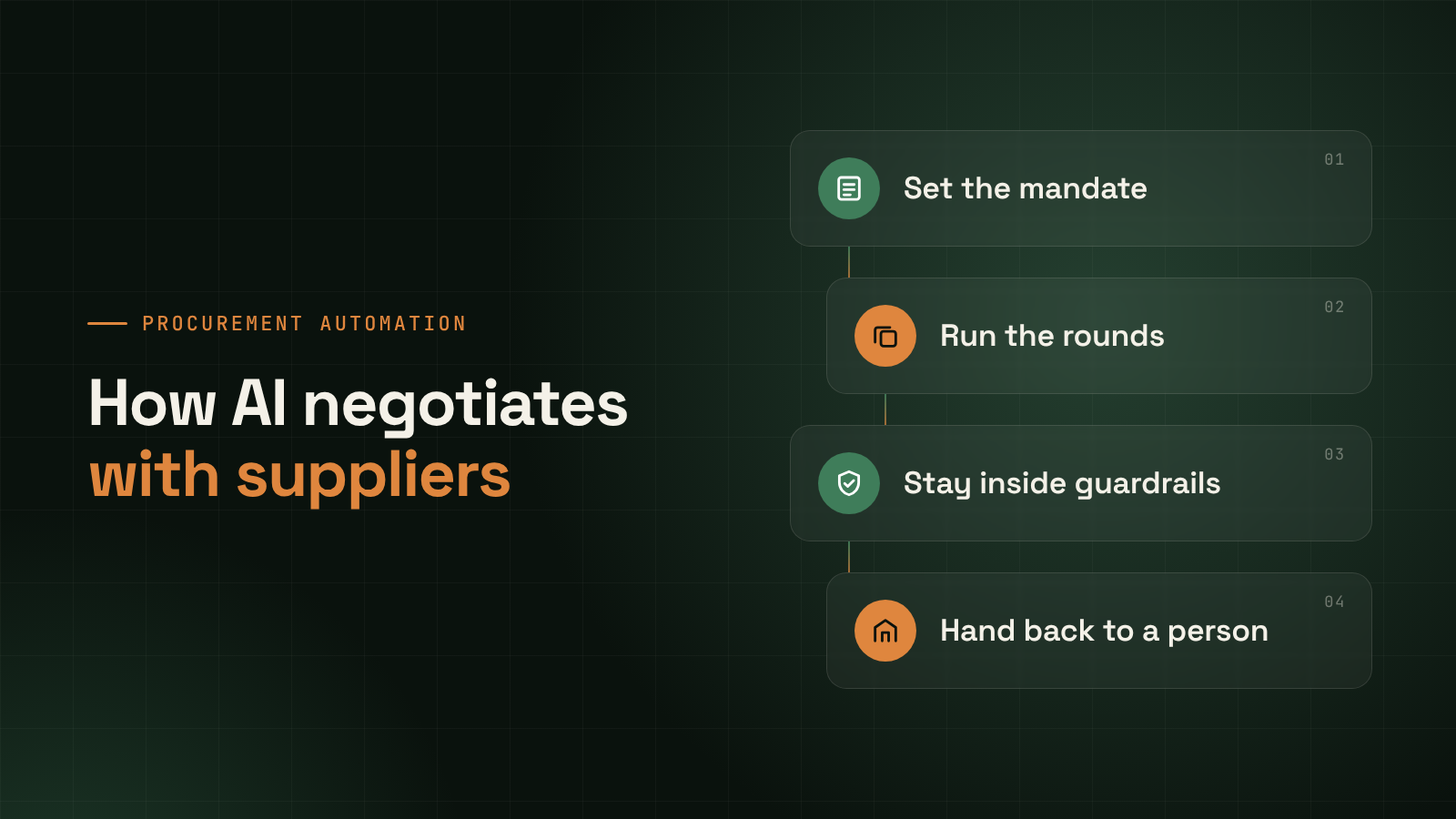
It opens with your position, works through a fixed number of rounds, logs every exchange, and stops at agreement, at the reserve price, or at the round limit. A buyer can read the trail at any point and take the conversation back at any point.
| Stage | What the agent does | What a person does |
|---|---|---|
| Set the mandate | Reads the requisition, item history and quotes, then proposes a target, a reserve and the levers in play | Approves or edits the mandate before anything goes out |
| Open | Sends the opening position to each shortlisted vendor, on the channel that vendor actually uses | Nothing, unless the vendor is flagged strategic |
| Read and classify | Interprets the reply: a counter, a condition, a question, a refusal, or something unrelated | Handles whatever the agent flags as unclear |
| Counter | Applies the concession rule: how far to move, against what in return, in which order | Watches the trail, intervenes mid-round if needed |
| Stop | Closes at agreement, at the reserve, or at the round limit, whichever comes first | Reads the recommendation |
| Recommend | Produces a comparison on a normalized basis, full exchange attached | Awards, or sends it back for another round |
Two details decide whether this works. Channel is the first: a vendor who answers WhatsApp in four minutes and email in four days has to be negotiated on WhatsApp, or the agent simply records them as unresponsive. The item master is the second. If the same bearing sits under three codes, the agent is comparing prices that are not comparable, and that is a data problem to fix before any negotiation runs.
How does the agent know what a good outcome looks like?
From the mandate, not from a general sense of a fair price. The mandate carries four numbers and one rule: the opening ask, the target, the reserve, the authority limit above which a human signs, and the concession rule governing how it moves between them.
The reserve matters most. It is the point past which the agent stops rather than accepting, and it should come from something real: your last price paid for the same item, the best competing quote in the round, or a landed cost calculation. A reserve pulled out of the air produces an agent that either caves instantly or walks away from a reasonable offer.
The authority limit is the governance half. An agent closing a $500 consumables order at reserve is a different risk from one touching capital spend, and that split belongs in writing before go-live. The general model for classifying agent actions by consequence is in AI agent governance, approvals, audit trails and human-in-the-loop controls.
Which purchases are worth negotiating this way?
Repeat, specified, multi-vendor purchases. The further a purchase sits from those three words, the less an agent adds.
| Purchase type | Fit | Why |
|---|---|---|
| Consumables, fasteners, packaging, standard spares | Strong | Specification settled, several vendors can supply, volume too high to negotiate line by line |
| Annual rate contracts and call-offs | Strong | Clear mandate, clean comparison, predictable cycle |
| Freight and transport lanes | Good | Priced per lane and per trip, quoted by several vendors, renegotiated often |
| Subcontracted job work | Mixed | Depends on whether the scope is written tightly enough to compare two quotes at all |
| Capital equipment | Weak | Low frequency, high consequence, decided on technical judgment and relationship |
| Single-source and proprietary items | Weak | With no alternative there is nothing to negotiate against, and pushing anyway reads as noise |
The agent earns its keep on purchases too small to be worth a buyer’s afternoon and too numerous to ignore in aggregate, while your buyers keep the capital items and the relationships.
What stops it offering payment terms you cannot legally give?
A hard rule in the mandate, backed by vendor classification. Payment terms are the one lever where a wrong concession can create a liability rather than a cost, so the agent should not be free to trade them where local rules limit what you can agree.
Many countries regulate B2B payment terms, especially for small suppliers. The EU Late Payment Directive sets a 60-day default for business-to-business payments, the UK has statutory late payment interest, and India applies a 45-day rule with compound interest for micro and small suppliers. Check your own jurisdiction. A long term agreed with a vendor the rules protect is therefore not a working capital win. It is an exposure with a clock on it, and your payables cycle has to be able to meet whatever was agreed. One country’s version of that link between the rule and invoice booking speed is covered in the MSME 45-day payment rule and your AP cycle time. In practice the vendor master has to carry the classification, and where it is missing or stale the safe default is to leave terms untouched.
How is this different from an e-auction or an RFQ tool?
An RFQ tool collects quotes and stops. An e-auction makes vendors bid against each other in a window, which works when there are enough interchangeable bidders and a specification nobody argues about. Negotiation is the case in between: three or four real vendors, a specification with conditions attached, and gains that come from trading levers rather than from bid pressure.
Most mid-market buying sits in that middle case. There are rarely twelve bidders for a job work item, and an auction with three participants, two of whom you intend to keep regardless, is theater. The RFQ-to-PO coordination underneath is a separate problem, covered in RFQ automation for procurement.
How do you know it is working?
Coverage first: the share of purchase value that went through any negotiation at all. It moves first and it is the honest measure of what changed, because the alternative on most of those lines was no negotiation.
Then price realized against your own last price paid for the same item, unit and delivery basis. Not against a list price, and not against a market benchmark, because no first-hand source publishes one for mid-market category pricing. Then requisition-to-PO cycle time, which tells you whether negotiation is adding days the plant cannot afford. Then vendor response rate by channel, which usually says more about your vendor master than about the agent.
What this doesn’t do
It does not award business. The agent reaches a position and documents it. Splitting an order, developing a vendor, or paying more for a relationship stay with your procurement head.
It does not commit the company. No purchase order is raised and no quantity confirmed without the approval step you configured.
It does not judge technical equivalence. A different grade, brand or make at a lower price is an engineering call. The agent flags it and stops.
It does not fix a bad item master. Duplicate codes, mixed units of measure and missing specifications make every comparison unreliable, and an agent reproduces that faster than a human would.
It does not rescue a single-source position. Where one vendor exists and no alternative does, the real lever is qualifying a second source, which is a sourcing project, not a conversation.
Frequently asked questions
Does the AI agree a price without us approving it?
Only inside limits you set in advance, and only where you allow it. A common starting configuration is that nothing closes without approval for the first few weeks, then low-value repeat items at or under reserve close automatically while everything else comes back for a signature. The limit is a configuration, so it can be tightened the day something looks wrong.
Do suppliers know they are dealing with an AI?
They should, and the agent should say so. Disclosure costs nothing commercially and removes the worst outcome, which is a vendor finding out later and feeling handled. What vendors usually notice first is not the technology but that someone finally replies to their quotation the same day.
Will this damage relationships with vendors we have used for twenty years?
It depends which vendors you point it at. Strategic and long-standing suppliers belong outside the agent’s scope or marked for human handling, which is a flag in the vendor master. Tail vendors who currently get no conversation at all tend to experience more contact, not less.
What does it need from our SAP system?
Read access to the item master, vendor master, purchase history and open requisitions, plus whatever price history you hold. Writing back is a separate decision with its own controls, because reading data is low consequence and creating or changing a purchase document is not.
Can it negotiate over WhatsApp?
Channel coverage is the point, since in many markets, including the Middle East, Southeast Asia, Latin America and India, vendor communication genuinely runs on WhatsApp and phone calls rather than a supplier portal nobody logs into. Language support should be confirmed against your actual vendor base during scoping rather than assumed, and message templates stay under your review either way.
How much saving should we expect?
No honest answer exists as a single percentage, and anyone quoting one across categories is guessing. Measure against your own last price paid, per item, over the first ninety days, on the categories you pointed the agent at. Expect the first visible change to be coverage rather than price. Vendor master cleanup and item code deduplication usually take longer than configuring the negotiation itself, so allow for that before judging results.
Where to go next
To see how the procurement agent runs multi-vendor conversations across email, WhatsApp and voice, and where the human gate sits in each, start with procurement RFQ automation. Three related reads:
RFQ automation for procurement covers the coordination layer that gets quotes in before any negotiation can start.
AI agent governance, approvals and audit trails sets out how to classify agent actions by consequence, which is how the authority limit gets decided.
The MSME 45-day payment rule and your AP cycle time explains why payment terms carry a statutory clock.
A note on sourcing, checked October 1, 2026: the single statutory statement here, that a buyer owes compound interest with monthly rests at three times the bank rate notified by the RBI where payment is not made within 45 days of acceptance of the goods or services, is quoted from the Ministry of MSME’s MSME Samadhaan portal (samadhaan.msme.gov.in), which attributes it to Section 16 of the MSMED Act, 2006.