Table of Contents
Key takeaways
- SAP Business One already ships a Dunning Wizard, which SAP’s own training material describes as running through all the customers, checking all outstanding A/R invoices and transactions that represent debt, then printing, sending or emailing reminder letters.
- Each customer carries a dunning term, each term can define multiple levels with timing, a fee and optional interest, and service invoices for those charges post automatically during the run.
- What the wizard does not do is anything after the letter leaves: read the reply, record a promise to pay, open a dispute, or decide who gets escalated.
- SAP Collections Management, with its worklist, collection strategy, promises to pay and dispute cases, belongs to SAP’s larger ERP line, not to Business One.
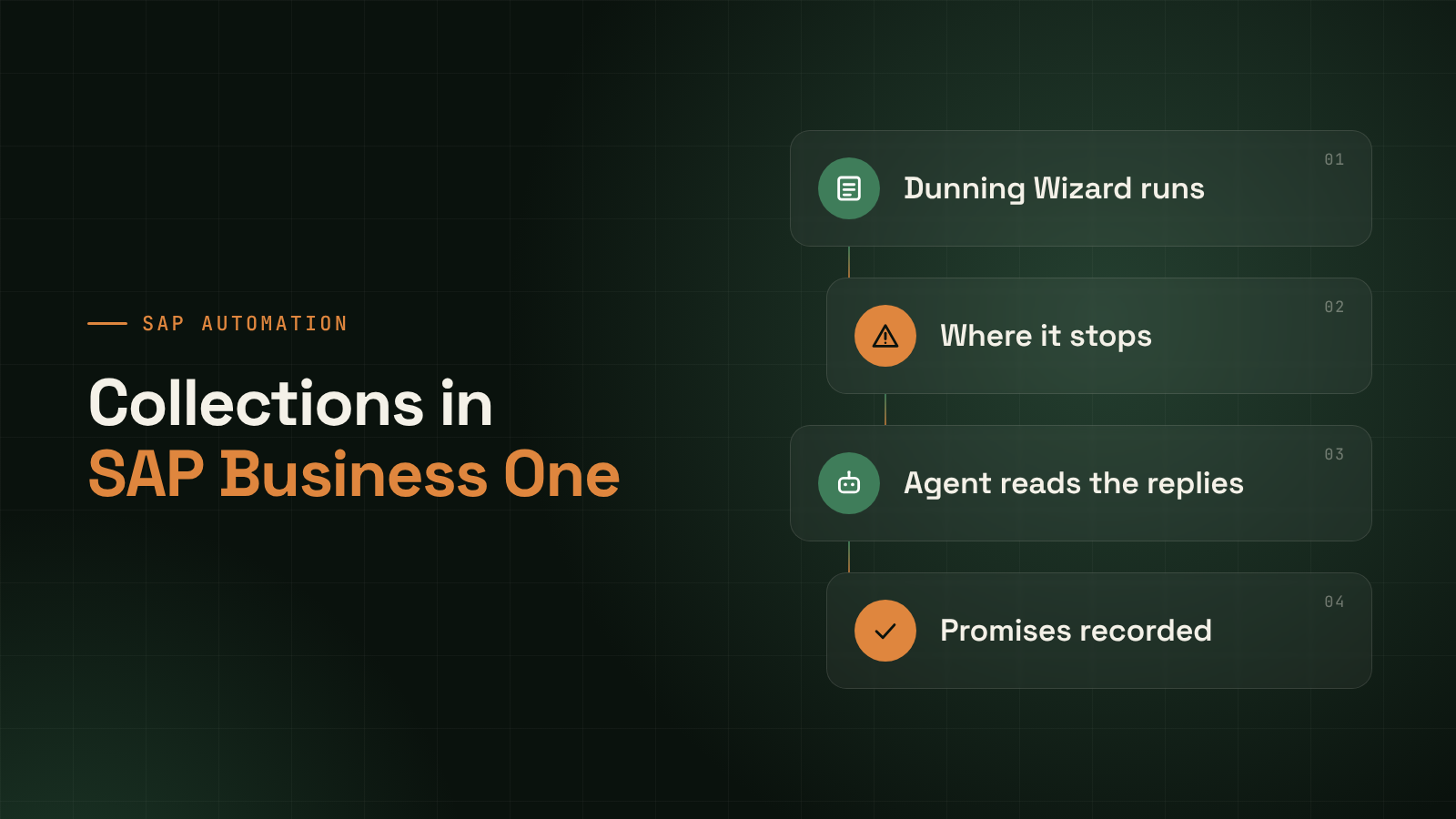
- Automating collections here is therefore two jobs: configure the dunning that already exists, then automate the conversation it starts.
Imagine you run finance at an auto components manufacturer in Toronto with around 240 active customers on SAP Business One. Dunning was configured two years ago. Letters go out, and the overdue ledger has not improved, because every reply lands in a shared inbox where someone reads it, forgets to note the payment date the customer gave, and chases the same account again a week later. Automating collections in SAP Business One means two things: setting up the dunning the system already provides, and automating the loop that follows it, where replies are read, commitments are recorded and exceptions are escalated. The second half is where the cash is, and it is what accounts receivable automation is built around.
What does automating collections actually mean here?
It means moving three things off human memory: the trigger that decides who gets contacted today, the contact itself, and the record of what came back. SAP Business One handles the first two reasonably well once configured. The third sits almost entirely outside the system in most mid-market installations, which turns a buying question into a diagnostic one. Teams that automate the contact and leave response handling in an inbox report the same result: more letters, the same days sales outstanding.
What does the SAP Business One Dunning Wizard already do?
It runs a dunning cycle, not a single reminder. SAP’s training material describes the wizard as going through all the customers, checking all outstanding A/R invoices and transactions that represent debt, then letting you print, send or email the reminder letters it produces. You reach it from Sales A/R, and the levels and charges come from the dunning term assigned to each customer.
| Element | What SAP Business One provides |
|---|---|
| Dunning term | Assigned per customer under Administration, Setup, Business Partners, Dunning Terms, with a default for new customers set on the BP tab in General Settings |
| Dunning levels | Multiple levels per term, with SAP’s stated best practice being that each level is more severe than the last |
| Level settings | Timing, a fee, and whether interest is charged, defined per level, with interest entered as an annual rate |
| Charges posting | An Automatic Posting setting controls whether the run posts interest and fees, interest only, fees only or neither, with service invoices created automatically for them during the run |
| History | Only the last dunning level is tracked, on the Accounting tab of the business partner master data |
| The aging view | The Customer Receivables Aging report shows all open, unreconciled customer transactions, grouped by interval periods from an aging date you set |
That is a real capability. If dunning terms have never been configured, or every customer sits on one generic term, your first automation project is not an AI one. It is an afternoon with your SAP partner.
Where does the Dunning Wizard stop short?
At the moment the letter leaves. The wizard works out who is overdue, applies a level, charges a fee and delivers a document. Everything that decides whether money arrives happens next, in a reply, a call or a WhatsApp message, and none of that comes back into SAP Business One by itself.
Four gaps account for most of the stall. The first is that a dunning level is driven by time, not behavior: a customer who always pays at day 55 and one whose balance has grown every quarter reach level 2 identically, when the policy you would actually apply treats them differently. That argument is the subject of how do you build a collections policy that runs itself.
The second is that nothing reads the response. “We have scheduled this in the November 20 run” is the most valuable sentence in collections, and no field in the dunning run holds it, so there is no queue to chase on November 21.
The third is disputes. A customer who replies that three invoices were short-shipped is not a dunning candidate, but the wizard cannot know that, so the next level fires on schedule and the relationship pays for it. The fourth is quieter: fees and interest get enabled because the screen offers them, the service invoices land on the customer’s ledger, and someone credits them back later.
Is SAP Collections Management the answer for a Business One shop?
No, because it is not part of SAP Business One. SAP Collections Management is the receivables module in SAP’s larger ERP line, and it is usually what people mean by collections “in SAP”: a prioritized worklist of the most urgent customers, a collection strategy behind that priority, documented customer contacts, promises to pay assigned to exactly one invoice, dispute cases raised against one or more invoices, and resubmissions.
That operating model is the right one. It is simply not available at the Business One tier, and no mid-market company changes ERP to get a collections worklist. So the practical route is to reproduce the model around Business One.
| Capability | Business One, native | SAP Collections Management | A collections agent on Business One |
|---|---|---|---|
| Decides who to contact | Dunning terms and levels, by days overdue | Collection strategy producing a prioritized worklist | Your policy rules, by exposure and payment behavior |
| Produces the contact | Dunning letters, printed, sent or emailed | Worklist-driven contact by a specialist | Drafted in approved wording, sent under your approval rule |
| Records the conversation | Not held in the dunning run | Documented customer contact | Written back to the account with the outcome |
| Captures a commitment | No equivalent field | Promise to pay, against one invoice | Promise read from the reply, dated, queued |
| Handles a dispute | Not addressed | Dispute case against one or more invoices | Detected in the reply, routed to an owner with a clock |
| Escalation | The next dunning level, on time | Resubmission and strategy rules | Your escalation ladder, by role and value |
What does an agent actually do with your SAP Business One data?
It reads open receivables from Business One each morning, decides who is due contact under your rules, drafts the message, sends it under whatever approval you set, then reads what comes back and writes the outcome to the account. Four manual jobs disappear: pulling the aging and deciding who to chase, typing the follow-up, remembering a promised date, and noticing when that promise breaks. The daily mechanics, including replies the agent cannot interpret, are in how does an AI collections agent work, and the commitment queue it builds is in how do you track promises to pay.
One design point matters for SAP shops. Reading a receivable is safe. Writing a promise date or a dispute flag changes what your team sees, so it belongs under the write-back discipline set out in can AI post invoices directly into SAP.
In what order should you turn this on?
Native first, agent second. Anything the dunning run can do deterministically should be done there, because a configured rule is cheaper to audit than an inferred one.
| Stage | What you do | Where it lives | What you get |
|---|---|---|---|
| 1 | Clean the aging: credit notes posted, unapplied receipts allocated, disputes taken out | SAP Business One | An overdue number not inflated by cash you already received |
| 2 | Write the policy: scope, segmentation, cadence, channel, authority, stop rule | One page, not software | A rule a person or an agent follows identically |
| 3 | Configure dunning terms and levels to match that cadence, fees and interest off unless enforced | SAP Business One | Contact that fires on time without anyone remembering |
| 4 | Add reply reading, promise capture and dispute routing | The collections agent, on Business One data | The half of the process that lived in an inbox |
| 5 | Add escalation by role and value, and report coverage weekly | Agent plus your review meeting | Early sight of accounts heading for write-off |
Stage 1 is the one people skip and the one that makes the rest honest. Chasing a ledger full of unallocated receipts produces angry customers and a credibility problem no software fixes. If cash application is the real bottleneck, start with SAP Business One bank reconciliation.
How do you know it is working?
Coverage first: the share of overdue value with a logged contact in the last fourteen days. It moves within weeks and is the only early number that shows the process is running rather than configured. Then promise-kept rate, then disputes logged with an owner and a date.
Days sales outstanding comes last, because it is an average needing a quarter of history to roll off before it visibly moves. Why that headline metric misleads on its own is covered in what is DSO and how do you reduce it.
What this doesn’t do
- It does not replace the Dunning Wizard. Dunning terms, levels, fees and the service invoices they generate stay in SAP Business One. An agent works around that, not instead of it.
- It does not give you SAP Collections Management. The worklist, strategy and dispute case objects are features of a different SAP product. What an agent reproduces is the operating model, not the module.
- It does not decide commercial outcomes. Waiving interest, extending time, applying a credit hold and stopping dispatch stay with your team, by role and by value, under the access and approval controls described on security.
- It does not resolve disputes. It detects one in a reply, routes it with the evidence and starts a clock. Someone still has to investigate and issue the credit note.
- It does not fix a late invoicing cycle. If invoices reach customers days after dispatch, or without the purchase order number their payables team requires, collections is chasing a problem created upstream.
Frequently asked questions
Does SAP Business One have built-in collections automation?
It has dunning, which is part of collections rather than all of it. The Dunning Wizard checks outstanding A/R invoices and transactions representing debt and produces reminder letters you can print, send or email, at levels defined in each customer’s dunning term. It does not read replies, record payment promises or manage disputes.
What is the difference between dunning and collections?
Dunning is the scheduled sending of escalating reminders based on how overdue an invoice is. Collections is the whole process: deciding who to chase from exposure and behavior, making contact, handling what comes back, recording commitments, routing disputes and escalating. Business One automates the first well and leaves the rest to your team.
Can we use SAP Collections Management with SAP Business One?
No. The prioritized worklist, collection strategies, promises to pay and dispute cases belong to SAP’s larger ERP line, not to Business One. The sensible route for a mid-market B1 company is to build the same operating model around Business One rather than change ERP for it.
Will automated collections emails go out without us approving them?
That is a configuration choice, and approval on everything is the right starting point. A typical settled state is automatic for early reminders under a value threshold, with approval required for anything escalated, anything to a strategic account, and anything carrying a charge.
Do we have to use dunning fees and interest?
No, and most mid-market teams should not. The settings exist and the wizard will post service invoices for them, but a charge you do not intend to enforce creates a disputed line on the customer’s ledger and a credit note on yours. Enable them only where your commercial terms support it and someone has decided to collect.
How long does it take to see a difference?
Contact coverage usually moves within three to four weeks, because the trigger stops depending on memory. Promise-kept rate becomes readable after a full cadence cycle. Days sales outstanding needs a quarter before the change shows through the averaging, so it is the wrong number to judge month one by.
Where to go next
To see how the collections agent reads your SAP Business One receivables, applies the ladder you wrote and records what customers commit to, start with accounts receivable automation. Four related reads:
- How does an AI collections agent work walks the daily loop, including replies the agent cannot interpret.
- How do you build a collections policy that runs itself covers the six decisions to make before configuring anything.
- Cutting DSO with AI receivables agents shows how to segment an overdue ledger behaviorally rather than by aging bucket.
- SAP Business One bank reconciliation covers the cash application side, which has to be clean before collections can be credible.
A note on sourcing, checked November 5, 2026: every statement about the Dunning Wizard comes from SAP’s own training material on handling accounting in SAP Business One (learning.sap.com), covering what the wizard checks, the letter output, how dunning terms and levels are set up and defaulted, the Automatic Posting setting, the service invoices created for interest and fees, the last dunning level on the Accounting tab of the business partner master data, and the Customer Receivables Aging report. The SAP Collections Management capabilities, the prioritized worklist, collection strategy, documented contact, promises to pay assigned to exactly one invoice, dispute cases and resubmissions, come from SAP’s training material on dispute and collections management (learning.sap.com), in the S/4HANA receivables management path. SAP’s online help pages blocked automated retrieval on the day of writing, so nothing is cited from help.sap.com. No DSO or collections benchmark is quoted, because no first-hand source publishes one for mid-market trade receivables. The customer count and the opening scenario are illustrative. Functionality varies by SAP Business One version and localization, so confirm against your own installation. The SAP Business One AR automation page this article supports is not live yet, so the links point to the accounts receivable automation page instead.