Table of Contents
Key takeaways
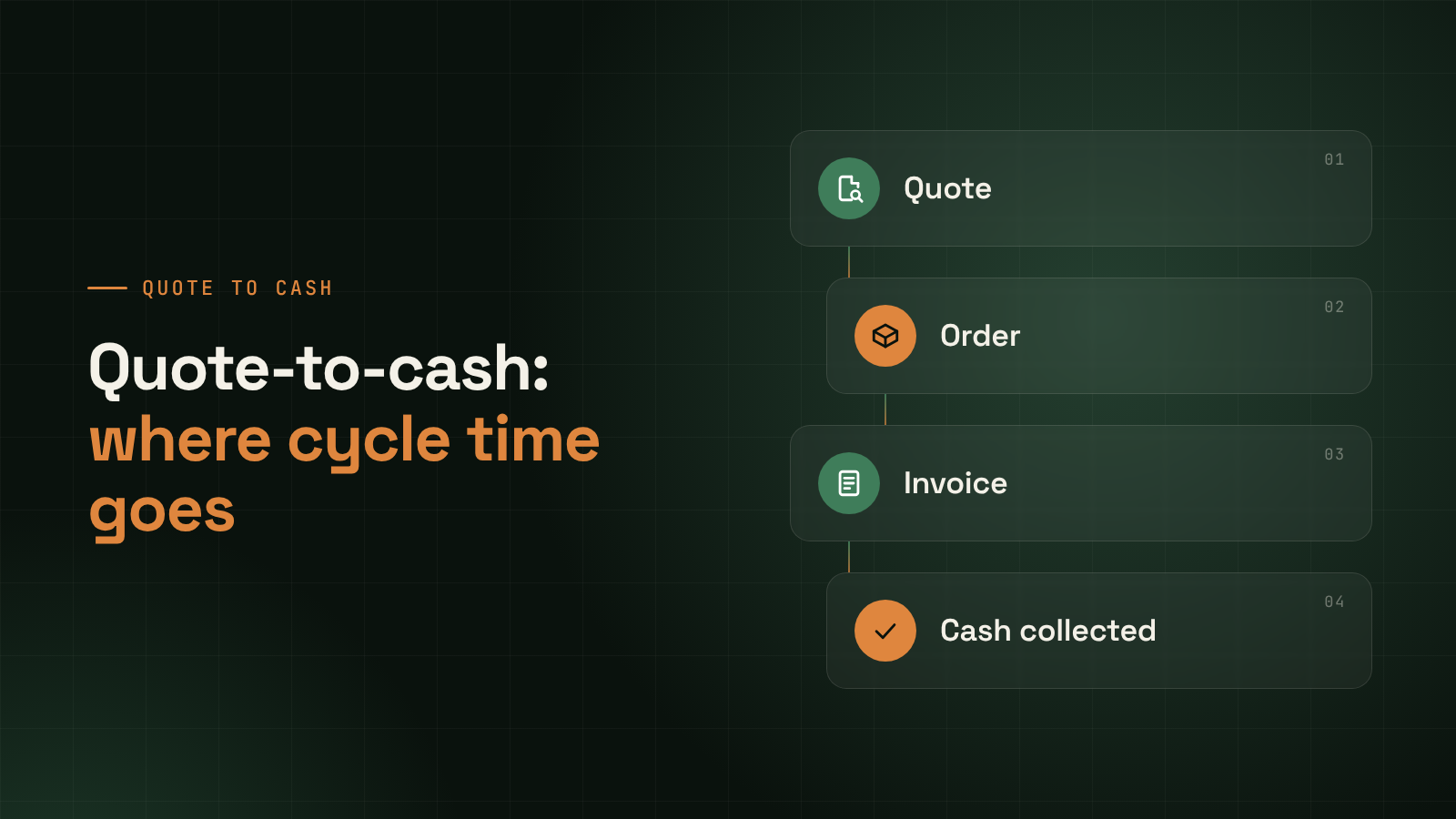
- Quote-to-cash is the full path from a customer inquiry to cash received: quote, order, fulfillment, invoice and collection. Quote-to-cash automation uses software and agents to shorten that path and cut the errors along it.
- Most cycle time is waiting, not working. A quote can take two hours to prepare and four days to be approved, picked up and sent.
- Measure the gaps between stages, not the effort inside them. The handoff is where days disappear.
- Agents remove time best at handoffs that rely on re-keying, chasing or checking, such as turning an inquiry into a priced quote or an order into a verified sales order.
- Agents do not set prices, grant discounts outside policy or decide credit risk. Those stay with named people.
Imagine you run sales operations at an industrial supply company in Toronto. An inquiry lands by email on Monday morning. The quote is built from a spreadsheet by lunchtime, waits for a margin check until Wednesday, goes out on Thursday, and is accepted the following Tuesday. Then the order is re-keyed into SAP, stock is checked by phone, and the invoice goes out nine days after dispatch because the delivery proof arrived late. A few hours of real work, spread across more than three weeks. If that shape feels familiar, the delay is not in the work. It is in the waiting.
This article shows where those weeks go and which stages an agent can shorten. The quoting agent page covers the front end of this chain in more detail.
What is quote-to-cash automation?
Quote-to-cash is the sequence of steps from configuring and pricing a quote to collecting payment and recognising the revenue. Quote-to-cash automation connects those steps so that data moves between them without being re-entered or chased. This post measures the cycle from the customer’s inquiry, because that is where the first delay starts.
Quote-to-cash automation applies software and AI agents to the connected steps from customer inquiry to cash received, so that data flows between quote, order, fulfillment, invoice and collection without manual re-entry. The aim is shorter cycle time, fewer errors and earlier, more predictable cash.
The important word is “connected”. Automating a single step, such as generating a PDF quote faster, leaves the delays between steps intact. The gains come from removing the handoffs where work sits idle.
Why measure the waiting and not the working?
In our experience, elapsed time in quote-to-cash is mostly waiting rather than working: the quote may take hours to prepare and days to clear approval. Measuring each gap shows which is which in your own process.
Because the working time inside each step is usually small and the waiting time between steps is usually large. Timing the touch minutes shows an efficient process; timing the elapsed days shows where the customer and your cash are actually held up.
Measure elapsed time between defined events: inquiry received, quote sent, quote accepted, order confirmed in SAP, goods dispatched, invoice issued, cash received. Then separate each gap into work time and wait time. Waiting has recognizable causes: an approval sitting in someone’s inbox, a missing piece of information, a re-keying queue, a check that needs a phone call. Each of those is a candidate for automation, and each is cheaper to find than to guess at.
| Stage gap | Typical waiting causes | Candidate fix |
|---|---|---|
| Inquiry to quote sent | Finding the right product and price, margin sign-off, formatting | Draft quote from product, price and customer data; route only out-of-policy items for approval |
| Quote sent to accepted | Customer decision, no follow-up | Timed follow-up with the quote context; this is partly outside your control |
| Accepted to order confirmed | Re-keying the customer’s purchase order, checking terms | Read the order document, match it to the quote, flag differences |
| Order to dispatch | Stock and credit checks, partial availability | Automated availability and credit status read, exceptions to a named person |
| Dispatch to invoice | Waiting for delivery confirmation or paperwork | Invoice trigger from the delivery record |
| Invoice to cash | Disputes, missing purchase order references, no early chasing | Clean invoice at source, early reminders, dispute routing |
Where does time go in the quote stage?
Mostly into finding information and getting approval. Building the quote is quick once the right product, price list and customer terms are in front of the person; locating them across email, spreadsheets and SAP is slow, and a margin check that waits on one manager is slower still.
An agent helps by assembling the draft from the inquiry: identifying the products requested, pulling the price list and customer-specific terms from SAP, and flagging anything that falls outside policy. Routine quotes within agreed margins can go out quickly; unusual ones go to the approver with the reasons attached. The speed-up comes from approving exceptions rather than every quote.
Where does time go between the order and the invoice?
In re-keying and chasing. A customer’s purchase order arrives as a PDF or email, someone types it into SAP, then checks stock and credit, then waits for dispatch confirmation before invoicing. Each step depends on a person noticing that the last one finished.
Agents shorten this by reading the incoming order, comparing it with the accepted quote, and flagging price, quantity or terms differences before the order is confirmed. Our guide to sales order automation in SAP Business One covers the order stage in depth. At the other end, invoicing from the delivery record rather than from a person’s reminder removes the days that dispatch paperwork sits unprocessed.
Where does time go after the invoice is issued?
Into disputes and slow follow-up. An invoice with a wrong price, missing purchase order reference or unmatched quantity is paid late or not at all, and the clock keeps running while someone works out why. Quote and order quality at the start is the cheapest collections control.
If the quote, order and invoice share one consistent record, the invoice is less likely to be disputed. Collections then becomes a matter of timely reminders and prioritized follow-up, which is the subject of cutting DSO with AI receivables agents. The earlier stages matter because errors there become receivables problems later.
Which stages benefit most from an agent?
Those with high handoff volume and rule-based checking. Drafting quotes, reading and checking incoming orders, and flagging invoice exceptions suit agents well. Pricing strategy, discount approval and credit decisions suit people.
| Stage | Agent handles well | Stays with people |
|---|---|---|
| Quote | Drafting from inquiry, price and terms lookup, policy flags | Pricing strategy, non-standard discounts, bid decisions |
| Order | Reading customer orders, matching to the quote, flagging differences | Resolving disputed terms, accepting variations |
| Fulfillment | Reading stock and credit status, raising exceptions | Allocation priorities, customer negotiation on delays |
| Invoice | Triggering from delivery data, checking references | Settling pricing disputes, credit notes |
| Collection | Reminder timing, prioritizing by amount and age | Relationship calls, payment plans, write-offs |
How do you prioritize what to automate first?
Start with the gap that has the longest wait and the most volume. Measure two or three months of elapsed times for your own process, rank the gaps, and pick the one where waiting is longest and cause is rule-based. That is usually the inquiry-to-quote or order-entry gap.
Avoid starting with the stage that is merely the most visible. A faster quote that then waits three days for order entry shifts the queue without shortening it. Also check master data first: wrong customer terms, stale price lists and inconsistent product codes will undermine every automated step. A short pilot on one product line or one customer segment gives you a baseline and an honest before-and-after comparison.
How do you know the cycle is actually shorter?
Re-measure the same elapsed-time gaps after the pilot, for the same product line and customer segment, and compare them with your baseline. Look at the median and at the slowest tenth of cases, because an average can hide a long tail of stuck quotes and orders.
Also track error rates: orders corrected after confirmation, invoices disputed for price or reference errors, and credit notes raised. A faster cycle that produces more corrections has only moved the delay.
What this doesn’t do
- It does not set your prices or approve out-of-policy discounts. Policy is set by you; the agent applies it and routes exceptions.
- It does not make customers decide faster. The quote-to-acceptance gap is partly outside your control. Good follow-up helps, but it does not guarantee a response.
- It does not make credit decisions. It can read credit status and flag a breach, but accepting the risk stays with your credit authority.
- It does not repair bad master data. Wrong terms, price lists and product codes need fixing at source.
- It does not guarantee a specific cycle-time reduction. We do not quote one, because it depends on where your waiting time currently sits.
Frequently asked questions
What is the difference between quote-to-cash and order-to-cash?
Quote-to-cash is the sequence of steps from configuring and pricing a quote to collecting payment and recognising the revenue. Quote-to-cash automation connects those steps so that data moves between them without being re-entered or chased. This post measures the cycle from the customer’s inquiry, because that is where the first delay starts.
Can quote-to-cash be automated inside SAP Business One?
Yes, in the sense that the product, price, customer, stock and invoice records all live in SAP, so an agent can read from them and write drafts or documents back. The extent depends on your configuration, which should be confirmed in a pilot.
Where does quote-to-cash usually lose the most time?
In the gaps between steps rather than inside them: waiting for a margin check, a customer decision, a stock confirmation, or delivery proof before invoicing. Time each gap separately, split it into work and wait, and start with the longest wait that follows a fixed rule.
Does automation mean we lose control over pricing and discounts?
No. The agent applies your pricing policy and routes anything outside it to a named approver with the reasons. Control is usually tighter, because every exception is recorded rather than agreed informally by email.
How long before we see results?
A pilot on one product line or customer segment can show before-and-after elapsed times within a few weeks, but the figure depends on your volumes and data quality. We would rather you measure your own baseline than rely on a general number.
Will it replace the sales coordination or order desk team?
No. It removes re-keying and chasing, so the team spends more time on exceptions, customer questions and follow-up. Judgment, relationships and approvals remain with people.
Where to go next
If your quotes spend longer waiting than being worked on, the place to start is the front of the chain. The quoting agent page explains how inquiries are turned into policy-checked draft quotes in SAP.
Three related reads:
- Sales order automation in SAP Business One, on the order stage.
- Cutting DSO with AI receivables agents, on the collection stage.
- AI cash flow forecasting, on how a shorter cycle shows up in cash.