Table of Contents
GRN invoice matching checks a supplier invoice against the purchase order and the goods receipt note before you book it for payment. This guide explains why that check fails so often in practice, which mismatches are worth separating, and what an AP agent can and cannot resolve on its own.
Key Takeaways
- GRN invoice matching is the comparison of a supplier invoice against the purchase order and the goods receipt note recorded at your gate or stores. It is the same discipline global vendors call “goods receipt matching”: the vocabulary differs, the control does not.
- Most failed matches in mid-market businesses are not pricing disputes. They are timing problems: the material is in the yard, the GRN is not in the system yet, and the invoice has already arrived.
- Unit of measure is the second biggest cause. A PO in kilograms, an invoice in metric tons and a GRN in bags will fail a strict quantity check even when every document is correct.
- Tolerance bands only help if they are set per category. One global percentage is either too tight for commodities or too loose for everything else.
- An agent can match, explain and propose. It should not approve a price variance, waive a short receipt or release payment: those stay with the people who already hold that authority.
Search for “GRN invoice matching” and most of what comes back is written for somebody else. Many global accounts payable vendors write “goods receipt” or “receiving report”, because that is the term in their home markets and in their product UI. In many other markets, including the UK, the Middle East, Southeast Asia and South Asia, the finance leader typing the query says GRN, their stores team says GRN, and the mismatch report sitting on their desk is titled GRN-wise pending.
That gap is not just a vocabulary curiosity. It is a reasonable signal that the content was not written with your process in mind: the one where material arrives before paperwork, where the security gate entry and the stores receipt are two different moments, and where a transporter’s delay quietly becomes an accounts payable problem three weeks later.
This article covers what GRN invoice matching actually involves, why it fails, and where automation genuinely helps rather than relocating the same work.
What is GRN invoice matching?
GRN invoice matching is a three-way check: the invoice quantity and rate must agree with the purchase order and with the goods receipt note, within your tolerance, before the payable is booked. It prevents you from paying for goods that were ordered but never received. Global software often calls the same control goods receipt matching.
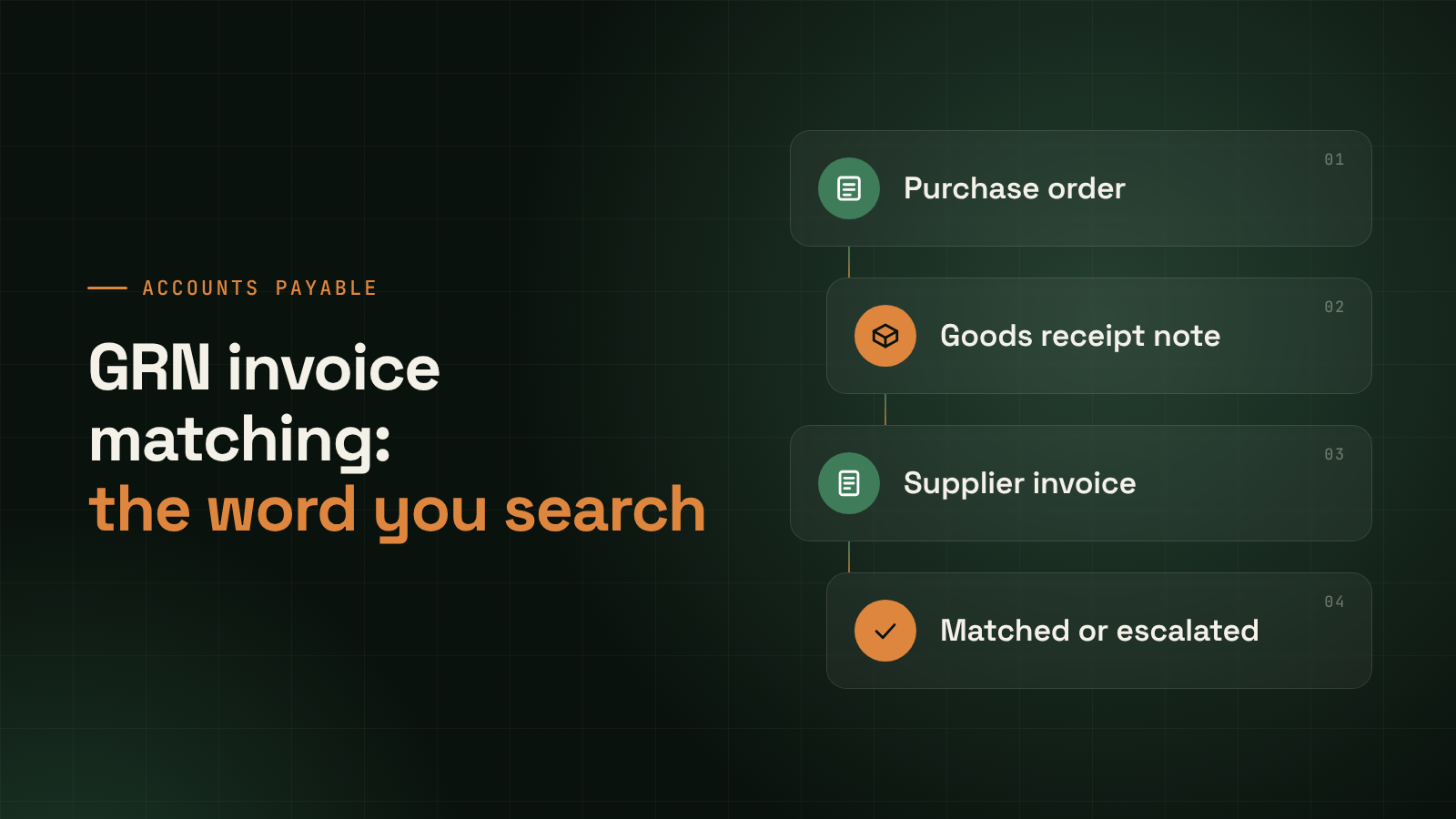
GRN invoice matching compares three documents before a payable is booked: the purchase order, the goods receipt note raised when material is received, and the supplier’s invoice. Quantity and rate must agree across all three within an agreed tolerance. It is the control that stops you paying for goods you did not receive.
In practice it answers three questions in sequence. Did we order this, at this rate? Did we receive it, in this quantity? Is the supplier billing us for what we ordered and received, and nothing more?
Only when all three hold should the invoice post. When one does not, the invoice becomes an exception, and what happens to exceptions is the real subject of any honest discussion about AP automation.
GRN Invoice Matching: Why It Fails and How to Fix It
Because the GRN is usually the late document. Material reaches the plant, goes into the yard or stores, and is physically consumed well before anyone posts the receipt in the ERP. The invoice, meanwhile, travels by email and arrives within a day or two. The system sees an invoice with no receipt to match, and blocks it correctly.
Nothing is wrong with the purchase. The paperwork is simply out of order, and it stays out of order because the people who raise GRNs are stores staff with a queue of trucks, not finance staff with a month-end deadline.
A few patterns repeat across manufacturing and construction sites in particular:
- Gate entry is not a GRN. The security register records that a vehicle arrived. The stores receipt, with quantity and quality check, happens later: sometimes days later for material that needs testing.
- Partial deliveries against one PO. Three trucks on three dates against a single line. Each has its own GRN, the supplier may bill once for all three or once per truck, and the matching logic has to cope with both.
- Rejections and short receipts. Quantity accepted is lower than quantity delivered. The supplier invoiced what they despatched.
- Service and subcontract lines. Job work and conversion charges have no physical receipt in the ordinary sense, and whether a service entry exists varies by how the PO was raised.
- Material received against no PO at all. Common with urgent site requirements, and it converts a matching problem into a procurement governance problem.
None of these are exotic. They are the ordinary texture of a mid-market operation, and they explain why the AP team’s day is spent chasing stores rather than reading invoices.
Which mismatches are worth separating?
Most failed matches come from eight recurring causes, and each has a different owner: a missing GRN sits with stores, a unit-of-measure difference with master data, a rate variance with procurement, and a tax difference with finance. Sorting exceptions by cause, not lumping them together, is what makes the queue shrink.
Lumping everything into “invoice on hold” is why exception queues never shrink. The mismatches below fail for different reasons, need different people and resolve on different timescales, so they should be counted and routed separately.
| Mismatch | What is actually different | Who resolves it | Usual cause |
|---|---|---|---|
| GRN not posted | Invoice exists, receipt does not | Stores / site team | Timing, not a dispute |
| Quantity short | GRN quantity below invoice quantity | Stores, then procurement | Short supply, rejection, transit loss |
| Quantity over | Invoice quantity above PO balance | Procurement | Over-delivery or PO not amended |
| Unit of measure | Same quantity, different unit | Master data owner | PO in KG, invoice in MT, GRN in bags |
| Rate variance | Invoice rate above PO rate | Procurement / buyer | Price revision not reflected in the PO |
| Freight and incidentals | Charges on the invoice, not on the PO | Procurement / finance | Terms agreed verbally, never documented |
| Tax treatment | Tax code, rate or split differs from master | Finance / indirect tax | Place of supply, stale master data |
| Duplicate | Same supplier, amount and reference seen before | AP lead | Reissued copy, or a scan and an email of one invoice |
The practical value of this table is not the taxonomy. It is that each row has an owner. A matching program that routes every exception to accounts payable has not reduced work, it has concentrated it.
How does automated GRN invoice matching work?
An agent reads the invoice, resolves the supplier, PO and line items against your ERP master data, pulls the open GRN quantities for that PO, and compares the three documents line by line within the tolerances you have defined. Where everything agrees, it posts. Where it does not, it raises a specific exception with its reasoning attached.
The useful detail sits in the words “resolves” and “specific”.
Resolution is the hard part, not reading. A steel supplier bills MS Plate 10mm IS2062 Gr.B, 2.4 MT; your item master holds RM-PLT-10-2062B; your PO is in kilograms. Matching 2.4 against 2,500 fails unless the system converts through your unit of measure table first. The same applies to packaging units, where a GRN in bags has to reconcile to a PO in metric tons using a conversion factor that lives in your material master and is sometimes wrong.
Specificity decides whether the exception queue is usable. “Invoice 7741 blocked” tells your AP lead nothing. “Invoice 7741, line 2: invoiced 2,400 KG against GRN 50012345 of 2,350 KG accepted, 50 KG rejected on quality: short receipt, needs supplier credit note or stores confirmation” tells them what to do and who to ask. An agent that cannot write the second sentence has not actually done the matching; it has done the blocking.
Tolerance design matters more than most buyers expect. A single global tolerance of, say, a small percentage is simultaneously too tight for commodity purchases where weighbridge variance is normal, and too loose for engineered items where any variance is a genuine error. Tolerances belong per material category, and ideally per supplier for the handful where it matters.
What this does not do
Worth stating plainly, because matching automation is routinely oversold.
It does not create the GRN. If stores have not posted the receipt, no agent can match against it. What an agent can do is notice the pattern early, chase the site for the pending receipt, and show finance a live list of invoices waiting on GRNs rather than a surprise at month end. That is a real improvement and it is not the same as solving the problem.
It does not approve a variance. A rate difference, a short receipt or an unbilled freight charge is a commercial decision. The agent presents the difference and the evidence; a buyer or finance approver decides, inside your existing delegation of authority.
It does not release payment. Posting a payable and authorizing money to leave the business are separate acts. The second stays with a person, every time.
Duplicate vendor codes, three entries for the same plate, missing unit conversions and stale supplier tax IDs all surface as exceptions. Automation makes master data quality visible; it does not substitute for it. Teams that clean the material and vendor masters first see the exception rate fall much faster.
It does not reach a touchless rate of 100%, and nobody should promise it will. A sensible expectation is that the routine, correct invoices clear without a human, and the genuine problems reach the right person with the working shown. That is the gain.
Frequently asked questions
What does GRN stand for in accounts payable?
GRN stands for goods receipt note: the document raised when material is physically received and accepted, recording quantity, date and condition. In accounts payable it is the evidence that goods actually arrived, which is why an invoice is matched against it before the payable is booked. Global software usually calls the same record a goods receipt.
Is GRN matching the same as two-way matching?
No. A two-way match compares the invoice against the purchase order only: it confirms you ordered the item at that rate, but not that you received it. Adding the goods receipt note makes it a three-way match, which is what protects you against paying for undelivered or short-delivered material.
Can invoices be matched automatically if GRNs are posted late?
They can be matched automatically once the GRN exists; nothing can match against a receipt that has not been recorded. The practical benefit of automation here is visibility and chasing: the invoice is parked against the expected receipt, the site team is prompted, and finance sees the pending list continuously instead of discovering it at close.
Will automated matching work with messy master data?
It will work, with a higher exception rate until the data improves. Duplicate vendors, inconsistent item descriptions and missing unit-of-measure conversions are the usual causes of avoidable exceptions. Most of the early benefit in a deployment comes from fixing the handful of master data problems that generate the majority of mismatches.
Does the agent post the matched invoice into SAP?
Yes, under a service user with defined posting rights, inside your existing approval limits. If that user cannot post above a value, neither can the agent. Payment release is deliberately excluded, that remains a human authorization in your approval matrix.
How are tax differences handled during matching?
Tax checks run alongside the quantity and rate comparison: the supplier tax ID against your vendor master, the applied tax code and rate against the material master, and the tax treatment against the place of supply. Where a supplier is covered by an e-invoicing mandate, the invoice identifier can give you header data a tax authority or network has already authenticated. Differences are raised as exceptions for finance, not silently corrected.
Does this replace the accounts payable team?
It changes what they do rather than removing them. Keying, matching and chasing shrink. Exception judgment, supplier relationships, master data quality and controls do not, and those are the parts of the job that actually need experience. The realistic claim is redeployed effort, not removed headcount.
What is the difference between two-way, three-way and four-way matching?
Two-way compares the PO and the invoice. Three-way adds the GRN, which confirms the goods arrived. Four-way adds an inspection or quality acceptance record. Use the lightest level your risk and the document type justify.
How should you set matching tolerances?
Set them by category and value, not as one global number. For example, a team might allow a small rate variance on routine items and none on high-value ones, and accept quantity differences only on partial receipts. These are policy choices for your finance team, not regulatory limits.
Is a GRN required to claim input tax credit?
Tax regimes such as VAT and GST generally expect you to have actually received the goods or services before claiming input credit, and a GRN is the normal evidence of that. Treat it as supporting evidence for audits, and confirm the exact requirements for your jurisdiction with your tax adviser.
Can matching work when master data is messy?
Yes, but expect more exceptions, mainly from unit-of-measure and item-code differences. Fixing a short list of master data issues first usually reduces exceptions faster than adjusting tolerances.
Where to go next
For the full picture of PO, GRN and invoice matching, including what rules engines leave behind and how exceptions are routed, start with three-way matching automation.
Related reading:
- AI accounts payable agents: what actually changes in your invoice workflow: the end-to-end AP workflow and the steps that stay with your team.
- How AI invoice processing actually works, step by step: document reading, field resolution and confidence scoring, before matching begins.
- OCR vs AI invoice capture: why templates break on the long tail: why capture quality decides how much reaches the matching stage cleanly.