Table of Contents
Key takeaways
- No. A cash flow agent forecasts and recommends. It holds no banking credentials, creates no payment instruction and cannot release funds.
- The boundary is enforced by what the agent can technically reach, not by a policy document or a setting someone could switch on later.
- Payment release is the highest-consequence action in a finance function, which is why banking controls in most countries already assume a named person authenticates it.
- A recommendation to delay a supplier by nine days is a relationship decision, so it goes to a human even though it moves no money.
- The question to ask a vendor is not “will it pay automatically” but “show me the credential scope and the authorization object list.”
Imagine you run treasury and payables at a mid-market auto components company in Monterrey on SAP. A cash flow agent looks useful: the Monday rebuild disappears, goods received but not invoiced finally shows up as real outflow, and week six stops surprising you. Then your audit committee asks one question and the evaluation stalls. If this thing knows cash is short on Thursday, can it decide to hold a vendor payment on its own? A cash flow agent is software that reads your ERP, forecasts your cash position and flags shortfalls before they land. It holds no banking credentials and releases no money. The useful part here is not the answer, which is no, but the reason for it and how you verify it rather than take it on faith.
Does cash flow AI make payments automatically?
No. A cash flow agent produces a forecast, a variance explanation and a ranked set of options when a week looks short. Every one of those outputs is information. Creating a payment proposal, approving it, releasing it to the bank and authenticating at the bank portal all remain human acts performed in your systems by named people with their own credentials.
That is a design decision, not a limitation waiting to be lifted in version two. The agent sits on the read side of your finance stack. It sees the whole picture of what you owe and what you are owed, which is precisely why it should not also act on it. What the agent reads and produces is set out on cash flow management software.
What does the agent actually do when a week looks short?
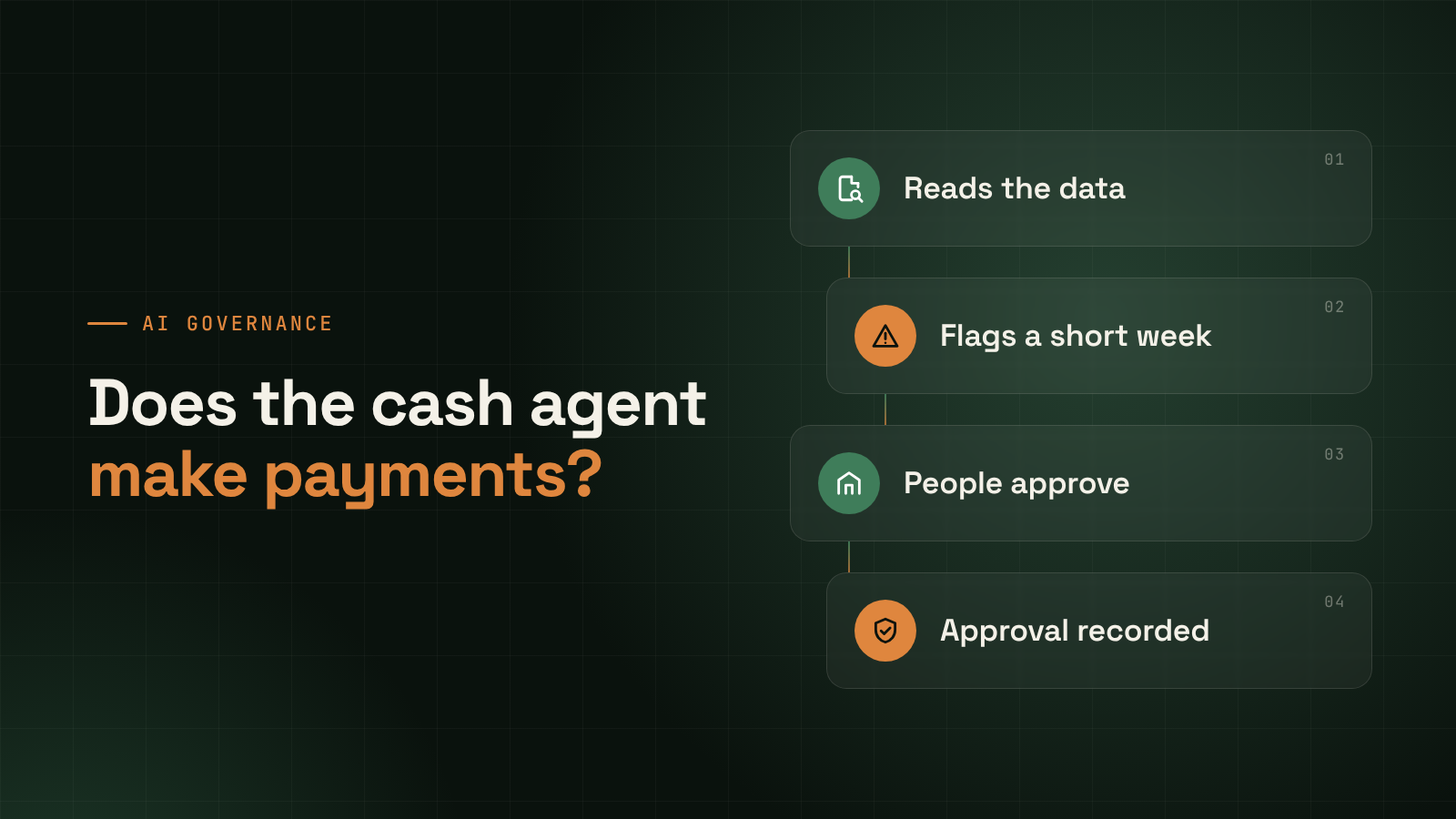
It makes the shortfall visible early, quantifies it, and lays out the levers with their cost attached. A typical output names the gap, the week, the largest movable outflows, which receipts are most likely to land late, and what each option does to the next three weeks. It stops where someone has to choose.
| Action | Who does it | Where it happens |
|---|---|---|
| Detect that week six is short by a stated amount | Cash flow agent | Agent, reading SAP |
| Explain which assumptions moved since last week | Cash flow agent | Agent |
| List which supplier payments could move without breaching terms | Cash flow agent | Agent |
| Decide which supplier gets delayed | Finance head or CFO | A conversation, then the ERP |
| Build the payment proposal | AP team | SAP payment run |
| Approve and release the proposal | Approver with authority | SAP, per the approval matrix |
| Authenticate the transfer at the bank | Authorized signatory | Bank portal or host-to-host channel |
Everything in the top half is observation. Everything below it carries consequence, and consequence is what decides where the human gate goes.
Where exactly is the line drawn?
At the point where an action changes something outside the agent. Reading data, computing a forecast, classifying variance and drafting a recommendation change nothing. Creating a document in SAP, messaging a supplier or instructing a bank all change something, and each sits behind its own gate.
The cash flow agent is unusual in the portfolio in that it crosses none of those lines. The accounts payable agent writes documents into SAP under controlled conditions, which is why AI accounts payable agents describes a posting threshold and an exception path. The cash flow agent has no equivalent. It reads and it reports. The framework for classifying agent actions by consequence is set out in AI agent governance.
Why does payment release have to stay a human act?
Payment release stays human for three reasons. It cannot be undone. Segregation of duties requires that the person who identifies a need is not the person who authorises the transfer. And your own approval matrix and bank mandate name who may release funds. Payment rules in many countries show the same pattern: they add confirmation steps where money moves, as the example below shows.
Consider how banks and regulators treat even routine, pre-agreed automation. In many countries, strong customer authentication rules, dual authorization on corporate banking portals and bank-side confirmation steps (such as payee verification or positive pay style checks on cheques) all push the same way: above a modest ceiling, a person authenticates, and the issuer re-confirms a payment’s details through a second channel before money moves. The specifics differ by country and by bank, so check what your own bank and regulator require.
The pattern is consistent. Payment infrastructure keeps adding confirmation steps around the moment money moves. A finance agent that removed one would be the only thing in the chain pulling the other way.
Is a payment recommendation itself a decision?
Partly, which is why it is treated as one. Delaying a supplier by nine days to protect a wage run is arithmetic on a spreadsheet and a relationship decision in the real world. The agent can say the delay is possible within terms and what it costs. It cannot know this supplier is the only source for a part on next month’s production plan.
So recommendations are written to be argued with. Each carries the assumption behind it, the counterparty history it rests on and the effect on the following weeks. A recommendation that arrives as a bare instruction invites a finance team to accept it blindly or ignore it entirely, and both failures come from the same missing reasoning.
How do you verify the boundary instead of trusting it?
By checking credentials and authorizations rather than reading a product page. The checks below settle it, and all of them can be done in an afternoon during a proof of concept.
| What to check | What a read-only cash flow agent looks like | What should worry you |
|---|---|---|
| Banking credentials | None held, none requested, no bank portal access in any environment | Any request for payment channel access “for later” |
| SAP authorization | A service user restricted to display authorizations on the relevant objects | Create or change authority on payment documents |
| Payment proposal access | Cannot create, edit or release a payment proposal | Ability to build a proposal “for the team to approve” |
| Outbound messaging | Does not contact suppliers or banks | Supplier notification capability bundled in |
| Audit record | Every recommendation logged with inputs and timestamp | Recommendations that leave no trace |
The second row matters most and is most often glossed over. A vendor saying the agent “only posts after approval” is describing software behavior. A display-only authorization set describes something the software could not do if it tried. Ask for the authorization object list, not the behavior description.
What does the audit trail record?
Each forecast run, the ledger state it read, the recommendation it produced, and what a person did with it. When an auditor asks why a supplier was paid in week seven rather than week five, the answer is a named approver and a dated approval in SAP, with the agent’s recommendation attached as supporting evidence, not as the authorization.
That ordering matters for how the evidence reads later. The agent’s output is an input to a human decision, the way a sales forecast is an input to a production plan. It is never the authorization. An agent that logged “payment deferred by system recommendation” with no human name against it would be creating an audit problem rather than solving one.
How is a cash flow agent different from a bank standing instruction?
A bank standing instruction moves money on a schedule and amount someone approved in advance. A cash flow agent moves no money and approves nothing; it tells you early that a payment week is short, so a person can decide.
A standing instruction is an authorization you have already given, with an amount, a beneficiary and a frequency fixed in advance. It executes without you because you decided earlier that it should. A cash flow agent authorizes nothing and executes nothing. The comparison is worth drawing because buyers sometimes assume the agent is a smarter auto-debit, and it is not that category of thing.
| Bank standing instruction | ERP payment run | Cash flow agent | |
|---|---|---|---|
| Who authorizes | You, once, in advance | Approver, per proposal | Nobody. It does not authorize |
| What moves money | The bank, on schedule | The released proposal | Nothing |
| Amount known in advance | Yes, fixed or capped | No, built per run | Not applicable |
| Can it be surprised by a shortfall | Yes, it executes regardless | No, approver sees the position | It is the thing that warns you |
| Audit evidence | The original mandate | Proposal, approval, release | Recommendation plus a human decision |
The middle column is where the agent earns its place: that approver now knows on Monday what used to surface on Thursday.
What this doesn’t do
- It does not release, schedule or instruct any payment. No banking credentials, no payment channel access, no payment proposal creation, in any environment including demonstrations.
- It does not decide which supplier waits. It shows what is movable within terms and what each option costs. Choosing is a CFO’s call with reasons the ledger cannot see.
- It does not contact suppliers or customers. Collection follow-up belongs to the collections agent, which has its own approval design and escalation gates.
- It does not override your approval matrix. If a payment needs two approvers today, it needs two approvers after the agent is live. The agent has no route into that matrix.
- It does not guarantee the shortfall is real, or fix what caused it. A forecast is a prediction with error bars that widen the further out you look, and chronic shortfalls usually trace to collection discipline, terms or working capital structure. Seeing them earlier helps. It is not the same as solving them.
Frequently asked questions
Does a cash flow agent have access to our bank accounts?
It reads bank balances and statement lines from your ERP, where they already sit after your normal statement import. It does not connect to your bank portal, holds no banking credentials and has no payment channel access. If a vendor asks for bank portal access during an evaluation, that is a different kind of product.
Can we switch on automatic payments later if we want to?
Not within this design. The agent runs on display-level authorizations and no payment credentials, so automatic release is not a setting someone could enable. Releasing payments would need different software, a different control review and a different conversation with your bank.
Who is accountable if we follow a recommendation and it turns out wrong?
The person who approved the decision, exactly as today. The agent’s recommendation sits in the record as supporting evidence alongside the assumptions it rested on, which usually makes the review easier rather than harder. Accountability does not move to the software because the software did not authorize anything.
Does it work with SAP’s own payment approval workflow?
It sits outside it. Your payment run, approval matrix and release strategy in SAP S/4HANA or SAP Business One stay exactly as configured. The agent reads the resulting data and forecasts from it, so going live changes nothing about how a payment gets approved.
What about tax payments such as VAT, sales tax and payroll taxes, does a cash flow handle those?
Yes, the cash flow agent forecasts tax outflows such as VAT, sales tax and payroll taxes on their statutory dates so those weeks are not understated. It does not calculate the liability, prepare returns or make any payment. It forecasts them on their statutory dates so that the weeks they fall in are not understated, because those outflows do not move with supplier terms and tend to cluster. It does not compute your liability, does not prepare returns and does not make the payment. Your tax team and your filing process are untouched.
Does this replace our treasury or AP function?
No. It removes the assembly work: the exports, the pivots and the weekly rebuild. What is left is variance explanation and decisions, which is the part of the job that needed the time. Headcount questions in mid-market finance teams usually turn on collections and payables volume, not forecasting effort.
Where to go next
How the agent is scoped, what it can reach and what it is prevented from doing sits on security, the current home for control detail while a dedicated trust and governance page is built.
Three related reads:
- AI agent governance: approvals, audit trails and human-in-the-loop controls sets out how agent actions are classified by consequence across the whole portfolio.
- How does AI cash flow forecasting work covers the mechanics behind the recommendations described here.
- Why cash flow forecasts are wrong by week four explains the drift that makes an early shortfall warning worth having.
A note on sourcing, checked October 27, 2026: this post makes no quantitative regulatory claims. The description of bank authentication and confirmation steps is deliberately general, because rules differ by country and bank, and it should be read as the direction of travel in payment controls, not as a rule binding your payables process. No figure is quoted for fraud losses, forecast accuracy or time saved, because no first-hand source supports one. Everything else describes Corpogents’ own cash flow agent design and standard SAP behavior; the opening scenario is hypothetical, not a customer.