Table of Contents
Key takeaways
AI cash flow forecasting replaces assumed inputs with observed ones. The arithmetic of a 13-week model stays as it was.
Three mechanics matter, in order: forecasting receipts from how each customer actually pays, surfacing commitments that are not invoices yet, and explaining variance every week.
Most of the work is statistical pattern reading on your own ledger, not a language model predicting numbers. Language models do the document reading at the edges.
A customer with fewer than roughly a dozen settled invoices has no pattern worth trusting, and an honest system says so instead of guessing.
Accuracy is a property of the horizon, not of the product. A single accuracy percentage for a 13-week forecast tells you nothing.
AI cash flow forecasting predicts future cash from patterns in a company’s own transaction history, refreshed as the ledger changes, instead of from contractual due dates. The 13-week model arithmetic stays the same; what changes is that its inputs are observed, not assumed.
Imagine you run the finance function at a mid-market engineering company in Rotterdam on SAP. Every Monday an analyst exports four reports, rebuilds a 13-week model and circulates it. By Thursday a dealer who was meant to pay on day 45 has not, a supplier has finally invoiced for material received three weeks ago, and the file in everyone’s inbox describes a company that no longer exists. AI cash flow forecasting is the practice of predicting future cash position from patterns in your own transaction history rather than from contractual due dates, and refreshing that prediction as the ledger moves. The mechanics are worth understanding, because the phrase covers both something useful and a good deal of nonsense.
How does AI cash flow forecasting work, end to end?
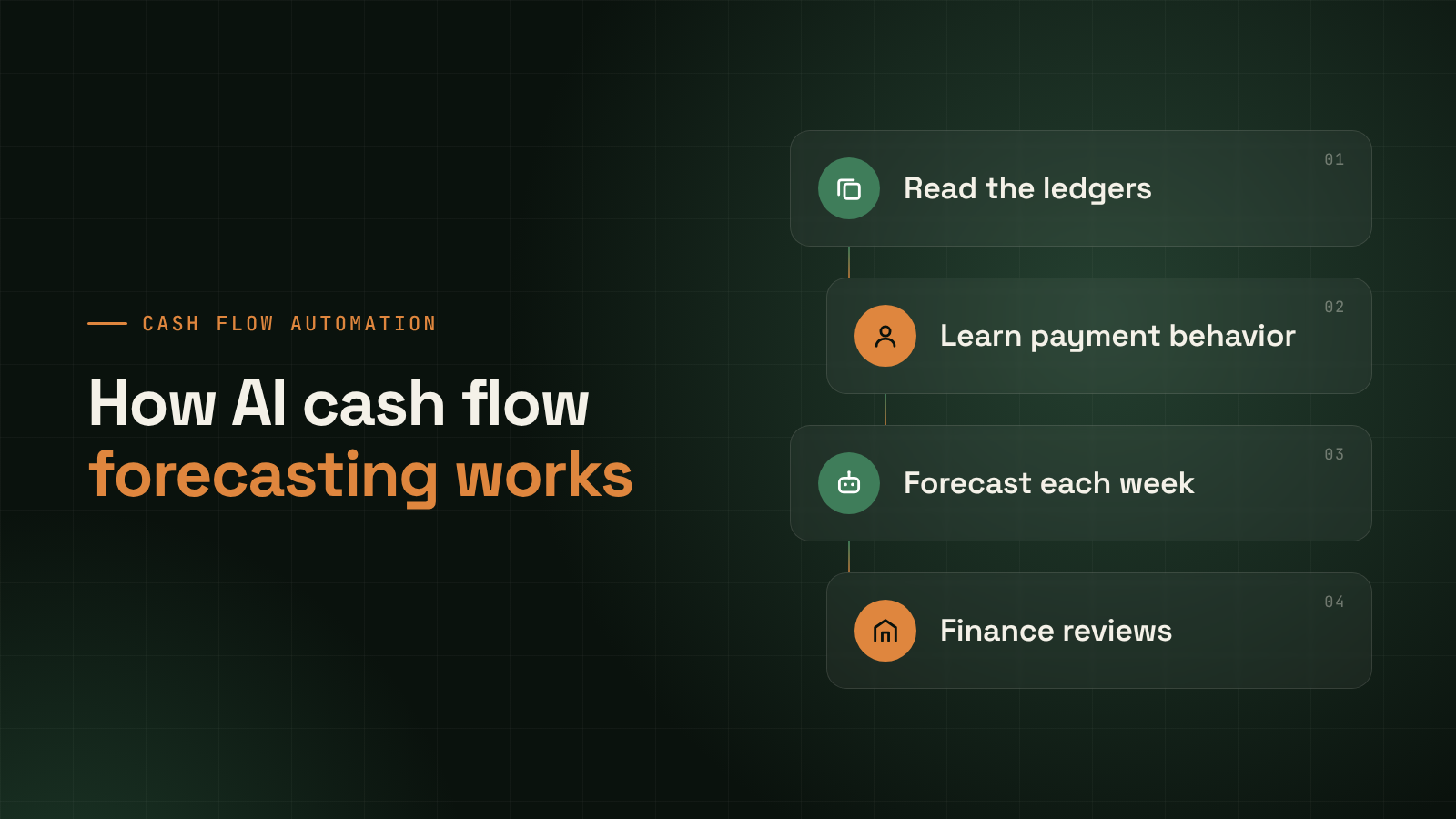
It runs as a pipeline: read the ledger directly, classify every open item, predict a date and an amount for each one from historical behavior, assemble the weekly position, then compare last week’s prediction against what happened and feed the difference back. No step is exotic. The value is that all five run continuously rather than once a week by hand.
| Stage | What happens | What it replaces |
|---|---|---|
| Read | Open receivables, payables, goods receipts, purchase orders, payment history and bank balances are read from SAP directly | Four exports and a pivot table |
| Classify | Each open item is typed: booked obligation, received but not invoiced, committed but not delivered, statutory, recurring | A column someone tags by hand, inconsistently |
| Predict | A date and an amount are estimated per item from that counterparty’s own record | The due date and the invoice face value |
| Assemble | Items are placed into weekly buckets with an opening balance and a running position | The Monday rebuild |
| Explain | Last week’s forecast is compared with actuals and each miss is classified by cause | Nothing, usually |
The fifth stage is the one teams skip and the one that compounds. A forecast that cannot tell you why it was wrong last week will be wrong the same way next week.
What data does it actually learn from?
Your own ERP, almost entirely. Settled invoices with their clearing dates, deduction history, goods receipts with and without matching invoices, open purchase orders, payment runs, recurring postings and bank statement lines. The core prediction needs no industry benchmark and no external dataset.
That sets the floor on what any system of this kind can do. Wrong payment terms on the customer master, purchase orders left open months after delivery, credit notes sitting unapplied: the predictions inherit all of it.
In PwC’s 2025 Global Treasury Survey of 350 treasurers, published 25 June 2025, 76% named poor data quality as a forecasting challenge and 53% named a lack of effective tools. The sample is global treasury teams, not mid-market finance teams, so it shows where forecasting is hard, not what accuracy to expect.
How does it forecast when a customer will actually pay?
By measuring the gap between due date and clearing date across that customer’s settled invoices and using the median of that distribution rather than the terms. The same history gives the amount: what share of face value actually arrived after withholding tax, rate differences, shortage claims and round-off. Date and amount are both predictions, and both come from the same record.
The median matters more than it sounds. One invoice settled nine months late after a dispute drags an average into a number that describes no real payment, which is why a plain average of days-to-pay often makes a forecast worse.
| Due-date forecast | Behavior-based forecast | |
|---|---|---|
| Timing of a 45-day invoice | Week of day 45, always | Week of day 45 plus that customer’s median lag |
| Amount expected | Full invoice value | Value net of the deductions that customer habitually takes |
| New customer, two invoices | Treated like a 15-year dealer | Flagged as insufficient history, left on terms |
| A customer who has started slipping | Invisible until the receivable ages | Visible as a shift in recent payment lag |
| Partial payments | Not modeled | Modeled as the split that customer typically makes |
Two refinements make this usable rather than merely clever. Recent behavior is weighted more heavily than old, because a dealer who paid well for three years and has slipped twice this quarter is telling you something. And customers with enough history to predict are kept separate from those without, instead of a confident number for both.
How does it see commitments a spreadsheet cannot?
By reading document types that never reach the payables ledger. Goods received and not yet invoiced is the big one: the stock is in, the liability exists, and the vendor line shows nothing until the supplier raises an invoice. Open purchase orders and approved requisitions are the second. Both are cash with a date attached.
On a manufacturing ledger with a long goods receipt to invoice lag, this is usually the largest single correction available, and it is data access rather than prediction. Each uninvoiced receipt is dated by that supplier’s historical invoicing lag plus their payment terms, and labeled so a reader can see how much outflow is contractual and how much is still reversible. GRN invoice matching covers the matching side of that lag.
Statutory outflows get separate treatment. Tax payments such as VAT, sales tax and payroll tax do not move with supplier terms, they fall on fixed dates, and they cluster. A model that blends them into ordinary payables understates exactly the weeks that are tightest.
What kind of AI is this, actually?
Mostly supervised statistical learning over your transaction history, with language models doing a narrow job at the edges. The distinction is worth drawing, because “AI forecast” is used for three different things and only two belong near a cash position.
| Technique | What it does here | What it should never do |
|---|---|---|
| Rules and tolerances | Classify items, apply terms, place statutory dates, enforce thresholds | Pretend to be prediction |
| Statistical learning on your ledger | Predict payment timing, deduction share, supplier invoicing lag, recurring outflows | Predict events with no history behind them |
| Language models | Read an invoice, a remittance advice or an email to extract a date or an amount | Produce the forecast number itself |
The third row deserves firmness. A language model is a poor instrument for arithmetic on a ledger and an excellent one for turning an unstructured document into a structured field. Reading with one and predicting with the other is the correct division of labor, not a compromise. The same principle governs how AI reconciliation matching works.
How does it explain variance each week?
By keeping the previous forecast, comparing it line by line against what cleared, and classifying every difference as timing, amount or an item that was never in the model. Three or four cycles of that is usually enough to show a team that its error is not noise but one or two repeating biases.
Each resolved variance is evidence: a customer whose median lag has moved, a supplier who now invoices faster, a statutory outflow that landed in a different week.
After three or four weekly cycles, the variance log usually shows one or two repeating biases, such as a customer who pays later than its history suggests. Correcting those is how the forecast improves.
One that does not is a spreadsheet with a faster engine. A practical test for any vendor demo: ask to see last week’s forecast beside this week’s actuals, with the misses named. If that view does not exist, the learning loop does not either.
How accurate is AI cash flow forecasting?
There is no single accuracy figure for a 13-week forecast, because error grows with the horizon. Measure it by storing each week’s forecast, comparing it with what actually cleared, and reporting two numbers: bias (are you consistently early or late?) and error (how far off, in either direction). Track receipts and payments separately. An illustrative starting tolerance: within 5% in week one, within 10% in weeks two to four, within 20% in weeks five to eight.
For context, in PwC’s survey, treasurers who collect forecasting data manually rated their satisfaction with forecasting 2.9 out of 5, against 3.3 for integrated or system-based approaches. That is a satisfaction rating, not a measure of accuracy, and the survey does not show that automation caused the difference.
What does it take to run this on SAP?
Direct read access to the right objects and a reasonable master data position: open receivables and payables, goods receipts, purchase orders, cleared payment history, bank accounts and recurring postings. How to forecast cash flow from SAP Business One covers the practical path for SAP Business One shops. Expect the early weeks to go on data hygiene rather than modeling: terms that disagree with practice, purchase orders left open after delivery, duplicate customer records. None of it is glamorous and all of it determines the output.
What this doesn’t do
It does not make or release payments. A forecast informs a payment run and never triggers one. Release stays a human act with an approver’s name against it.
It does not predict what has no history. A first order from a new customer, a litigation settlement or a new credit line have no pattern to learn from and are entered by hand.
It does not compute or file taxes. Statutory outflows are placed on the calendar at the amounts your returns indicate. The liability and the filing stay with your team.
It does not fix master data. Wrong terms, stale purchase orders and duplicate records degrade the forecast as they degrade everything else built on that ledger.
It does not remove judgment. Delaying a supplier to protect a wage run is a CFO’s call. The forecast shows what each option costs and stops there.
Frequently asked questions
What is AI cash flow forecasting in simple terms?
It is forecasting your future bank position from patterns in your own transaction history rather than from contractual due dates. Instead of assuming a customer on 45-day terms pays on day 45, it looks at when that customer has actually paid across their settled invoices. The same logic applies to supplier invoicing lags.
Is this just a machine learning model guessing numbers?
No. The prediction layer is statistical learning over your own ledger, closer to measured behavior than to guesswork, wrapped in rules for anything contractual such as statutory dates and terms. Language models are used only to read unstructured documents, never to produce forecast figures.
How much payment history does it need before the forecast is useful?
The structural improvements, such as pulling uninvoiced goods receipts and open commitments into the model, work from day one because that data is already in SAP. Behavior-based timing needs roughly a dozen settled invoices per customer, so it sharpens over the first few cycles. Customers below that threshold stay on terms.
Does it read our SAP system directly, or do we upload spreadsheets?
It reads SAP S/4HANA or SAP Business One directly: open receivables and payables, goods receipts, purchase orders, payment history and bank balances. Items that exist nowhere in the ERP, such as a sanctioned facility, are entered once and carried forward.
Does it handle taxes such as VAT and withholding tax?
Statutory outflows are forecast on their own dates rather than blended into supplier terms, and customer receipts are forecast net of any withholding tax each customer habitually deducts. It forecasts those amounts for cash planning. It does not compute your tax liability and it does not file returns.
Will it start a payment run if cash looks short?
No. It can show that a week is short and what each option costs, including which payments could move without breaching terms. Deciding and releasing stay with your team, and the approval is recorded.
Does this replace our finance team?
No, it removes assembly work such as exports, pivots and the weekly rebuild, leaving variance explanation and decisions to your team.
Where to go next
What the cash flow agent reads from your ledger, and what a daily cash position looks like once it does, sits on cash flow management software.
Three related reads:
Why cash flow forecasts are wrong by week four sets out the drift these mechanics are designed to correct.
How to forecast cash flow from SAP Business One covers the native cash flow report, what it sees and what it misses.
How does AI reconciliation matching work applies the same split between rules, statistical matching and document reading on the reconciliation side.
A note on sourcing, checked September 28, 2026: both survey figures come from PwC’s 2025 Global Treasury Survey of 350 treasurers, verified at PwC’s own publication on the day of writing: poor data quality as the leading forecasting challenge at 76%, lack of effective tools at 53%, and forecasting satisfaction averaging 2.9 out of 5 for manual processes against 3.3 out of 5 for integrated or system-based forecasting.