Table of Contents
Key takeaways
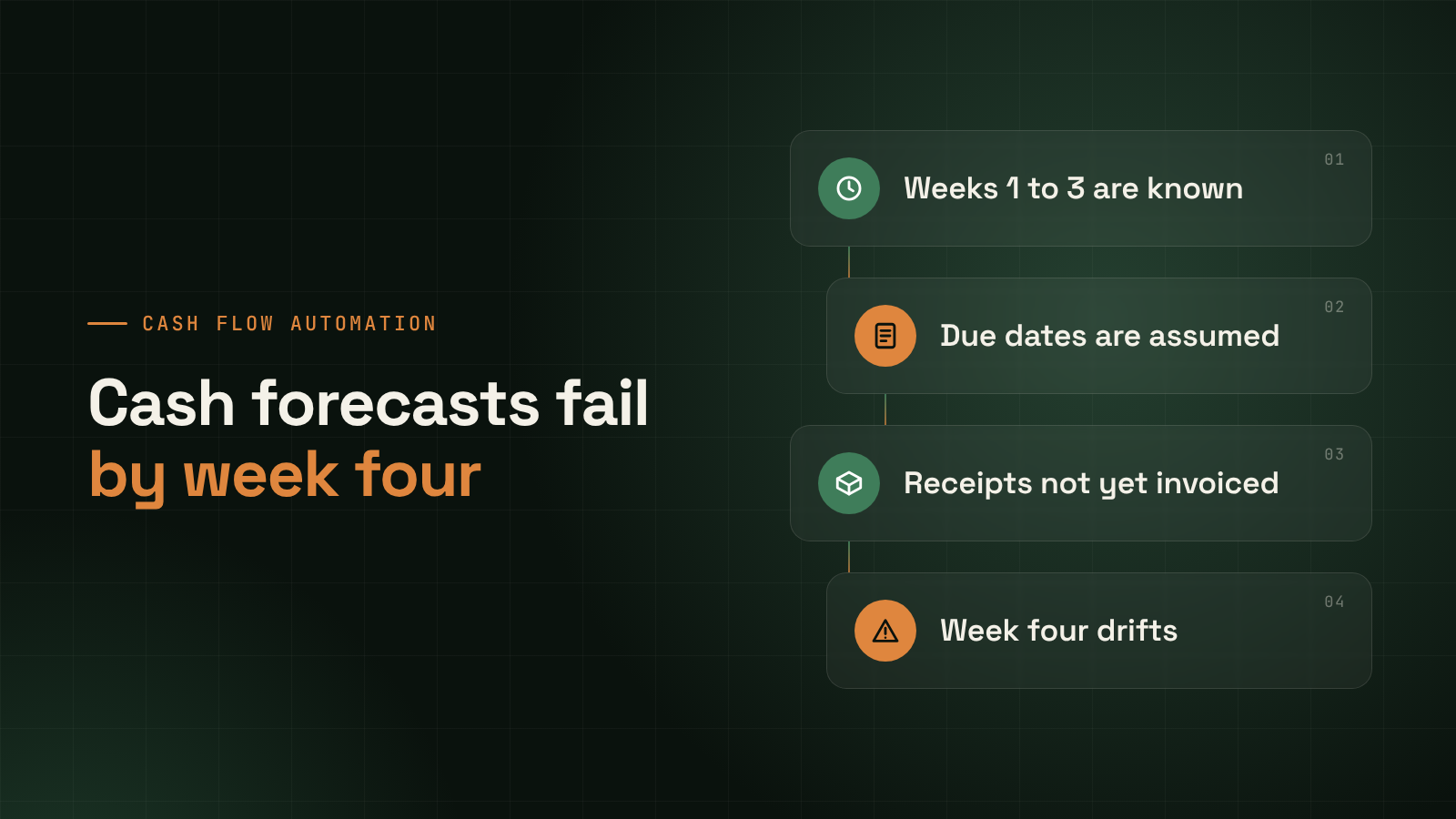
Most 13-week forecasts are accurate for two or three weeks and unreliable after that. The break is structural, not a sign of sloppy work.
Receipts are forecast from invoice due dates; customers pay on their own behavior. The gap between the two compounds week by week.
Payables are forecast from supplier terms, but the liability that hits week five was created by a goods receipt nobody has invoiced yet.
Open purchase orders and approved indents are real commitments and are usually invisible in the forecast until they become invoices.
Better arithmetic will not fix this. Better inputs will, which is the only honest case for automating any part of it.
A 13-week cash flow forecast usually drifts from the bank balance after the first few weeks because it is built on invoice due dates and standard terms, not on how customers actually pay, when suppliers’ goods are received, or which purchase orders are already committed. The fix is better inputs, not more careful arithmetic.
Imagine you run finance at a growing distribution business in Ohio and build a 13-week forecast on a Monday. By the following Monday, week one has landed roughly where it should. Week two is close. By the time the rolling forecast reaches what was originally week four, the line and the bank balance have parted company, often by enough to change a decision about a payment run.
The usual explanation is that someone should have been more careful. That explanation is wrong, and it is worth replacing, because it leads teams to spend more hours on a spreadsheet that will drift anyway.
Why does cash flow forecasting accuracy fall apart after week four?
Because the first three weeks are mostly known and week four onwards is mostly assumed. Near-term cash is made of cleared instruments, confirmed receipts and a payment run already approved. Beyond that the forecast runs on due dates, standard terms and last quarter’s pattern: three assumptions that each carry their own error, and that compound.
That is the whole mechanism. The rest of this article is where each assumption breaks.
Where does the drift actually come from?
Four things cause most of the drift: how customers actually pay versus their due dates, liabilities that start at goods receipt rather than at invoice, committed purchase orders and approvals that are not yet in the forecast, and a forecast that is rebuilt once a week instead of updating as transactions post. In our experience the first causes the largest error, though the order varies by business.
A customer on 45-day terms is entered in the forecast at day 45. If that dealer has in fact paid on day 58 for the last eleven invoices, the forecast is not wrong by a little, it is systematically early, every line, every month. The due date is a contractual fact. The payment date is a behavioral one, and only the second is useful for forecasting. Add the deductions that arrive with the payment, withholding tax, a rate claim, a shortage, and the amount is wrong too.
Payables are forecast from terms, not from commitments already incurred. The invoice booked in SAP today is visible. The goods received last Thursday against an open PO, not yet invoiced by the supplier, is a liability that already exists and will land in the forecast horizon, but it appears only when the invoice reaches the AP desk. On a manufacturing ledger with a long GRN-to-invoice lag, that is a meaningful quantum of outflow hiding behind an inbox.
Commitments are not in the model at all. An approved purchase requisition, an awarded RFQ, a PO raised but not yet delivered: each is a decision already made that will become cash. Most spreadsheet forecasts have no row for them, so the forecast reads as healthier than the business is.
The forecast is a document, not a process. It is rebuilt on a Monday from exports taken on a Friday, by one person, and it is not touched again until the next cycle. Everything that happens in between, a large receipt, a blocked despatch, a payment run deferred, is simply absent until the next rebuild. The document is stale before it is circulated.
| What the forecast assumes | What actually happens |
|---|---|
| Customer pays on the due date | Customer pays on their historical rhythm, often later |
| Receipt equals invoice value | Receipt is net of withholding tax, claims and short payments |
| Payables begin at invoice booking | The liability began at goods receipt, days or weeks earlier |
| Open POs are not cash yet | They are committed cash with a delivery date attached |
| Statutory outflows are routine | Sales tax, VAT and payroll tax payments cluster on fixed dates and dominate those weeks |
| One forecast per cycle is enough | The position changes daily; the model does not |
How accurate should a forecast be?
There is no universal accuracy target, so set one per forecast horizon and write it down. An illustrative starting point: within 5% on receipts and payments in week one, within 10% in weeks two to four, within 20% in weeks five to eight, and directional only after that. Replace these with figures drawn from your own last 13 weeks of variance, agree them with the CFO, and measure them weekly.
The discipline that matters more than the tolerance is variance analysis: each week, compare the forecast to what happened and classify the difference by cause: timing, amount, or something that was never in the model. Three or four weeks of that is usually enough to show a team that its error is not random noise but one or two repeating biases, which can be corrected.
Is this a problem everywhere, or just here?
Surveys of treasurers show the problem is common. In Deloitte’s 2024 Global Treasury Survey (213 respondents, September 2024), 48% ranked improving cash flow forecasting among their top three priorities, 18% rated their forecasting above average or best in class, and 38% rated it below average or in need of development. In
PwC’s 2025 Global Treasury Survey (350 treasurers), the leading forecasting challenges were poor data quality (76%), lack of effective tools (53%) and limited incentives for business units to contribute (46%); 52% of companies with $1 billion to $10 billion in revenue still collect and consolidate forecasting data manually. Both are self-assessments by treasury teams, not measurements of forecast error.
Both surveys cover large corporates with treasury functions, not mid-market companies running SAP Business One with a four-person finance team. Treat them as evidence that the problem is structural rather than local, not as a benchmark for your own accuracy. We have no first-hand survey of mid-market forecast accuracy to quote, and would rather say so than borrow a number from a vendor blog.
What actually improves cash flow forecasting accuracy?
Changing the inputs, in this order:
Forecast receipts from payment behavior. Replace the due date with the customer’s own observed rhythm, and carry the historical deduction pattern with it. This is arithmetic on data already in your ERP; it is the single largest correction available to most teams.
Pull the liability forward to goods receipt. Anything received and not invoiced is a known outflow with an estimated date. It belongs in the forecast on the receipt, not on the invoice.
Put commitments in the model. Open POs and approved requisitions, with expected delivery and terms, as a separate and clearly labeled line.
Make it continuous. A forecast that refreshes as transactions post, and flags the variance when something moves, is a different instrument from a Monday spreadsheet, even with identical math.
This is the work the cash flow agent does: it reads the receivables, payables, goods receipts and open commitments sitting in SAP, forecasts receipts from each customer’s actual payment history rather than their terms, refreshes as the ledger moves, and explains each week’s variance against what it previously projected. It is not a better model. It is the same model with inputs that are no longer stale.
What this doesn’t do
It does not make payments. A forecast informs a payment run; it never triggers one. Release stays a human act with an approver’s name on it.
It does not predict what has no pattern. A first order from a new customer, a one-off litigation settlement, a promoter infusion: none of these has a history to learn from. They have to be entered.
It does not fix bad master data. Wrong payment terms, duplicate customer records and POs left open after delivery degrade the forecast exactly as they degrade everything else built on that ledger.
It does not remove judgment. Deciding to delay a supplier payment to protect a wage run is a CFO’s call. The agent shows the consequence; it does not make the choice.
It does not replace the 13-week discipline. It replaces the manual assembly of it.
Frequently asked questions
Why is a forecast accurate for two weeks but useless by week six?
Because near-term cash is mostly known (cleared items, confirmed receipts, an approved payment run) while later weeks rest on due dates, standard terms and last quarter’s pattern, and each assumption adds its own error. The point where it becomes unreliable varies by business; track your own variance by week to find it.
What is a realistic 13-week accuracy target?
There is no single target. Set a tolerance per horizon (for example, tighter in week one than week eight), measure receipts and payments separately against a stored snapshot each week, and classify every gap as timing, amount or an item that was never modelled.
Does it use our SAP data, or do we upload spreadsheets?
It reads directly from SAP S/4HANA or SAP Business One: open receivables and payables, goods receipts, purchase orders and payment history. Items that live outside the ERP, such as a sanctioned facility or a planned capital outflow, are entered once and carried forward.
Does it account for taxes?
Statutory outflows such as sales tax, VAT or payroll taxes are forecast on their own schedule rather than treated as ordinary payables, and customer receipts are forecast net of any withholding tax each customer habitually deducts, based on what they have actually deducted historically. It forecasts these amounts; it does not compute your tax liability or file anything.
Will it start a payment run if cash is short?
No. It can show you that a week is short and what the options cost, including which payments could move without breaching terms. Deciding and releasing stay with your team, and the approval is recorded.
How long before the forecast is better than our spreadsheet?
The structural corrections, pulling goods receipts forward and adding open commitments, improve the picture immediately, because that data is already in SAP. Behavior-based receipt timing needs enough payment history per customer to be meaningful, so it sharpens over the first few cycles rather than on day one.
Does this replace our finance team?
No. It removes the assembly work, the exports, the pivots, the Monday rebuild, and leaves the team with the variance explanation and the decisions. In most mid-market finance functions the constraint is not analysis skill; it is that the analyst spends three days a month building the file.
Where to go next
The full picture sits on cash flow management software: how the cash flow agent reads receivables, payables, goods receipts and commitments inside SAP, and what the daily cash position looks like once it does.
Three related reads:
The MSME 45-day payment rule and your AP cycle time: why invoice booking speed now has a cash timing consequence, not just a process one.
How to automate accounts payable: a mid-market guide: the payables side of the same data, and why a GRN-to-invoice lag distorts more than the AP metrics.
Accounts receivable automation: collections and promise-to-pay, which is where forecast receipt dates either become real or do not.
A note on sourcing, the survey figures above are quoted from two first-hand sources and verified at the original publication on the date of writing, Deloitte’s 2024 Global Treasury Survey (48% top-three priority; 18% above average or best in class; 38% below average or requiring development) and PwC’s 2025 Global Treasury Survey of 350 treasurers (poor data quality 76%, lack of effective tools 53%, limited incentives 46%; 52% manual data collection among companies with $1 to 10 billion revenue).