Table of Contents
Key takeaways
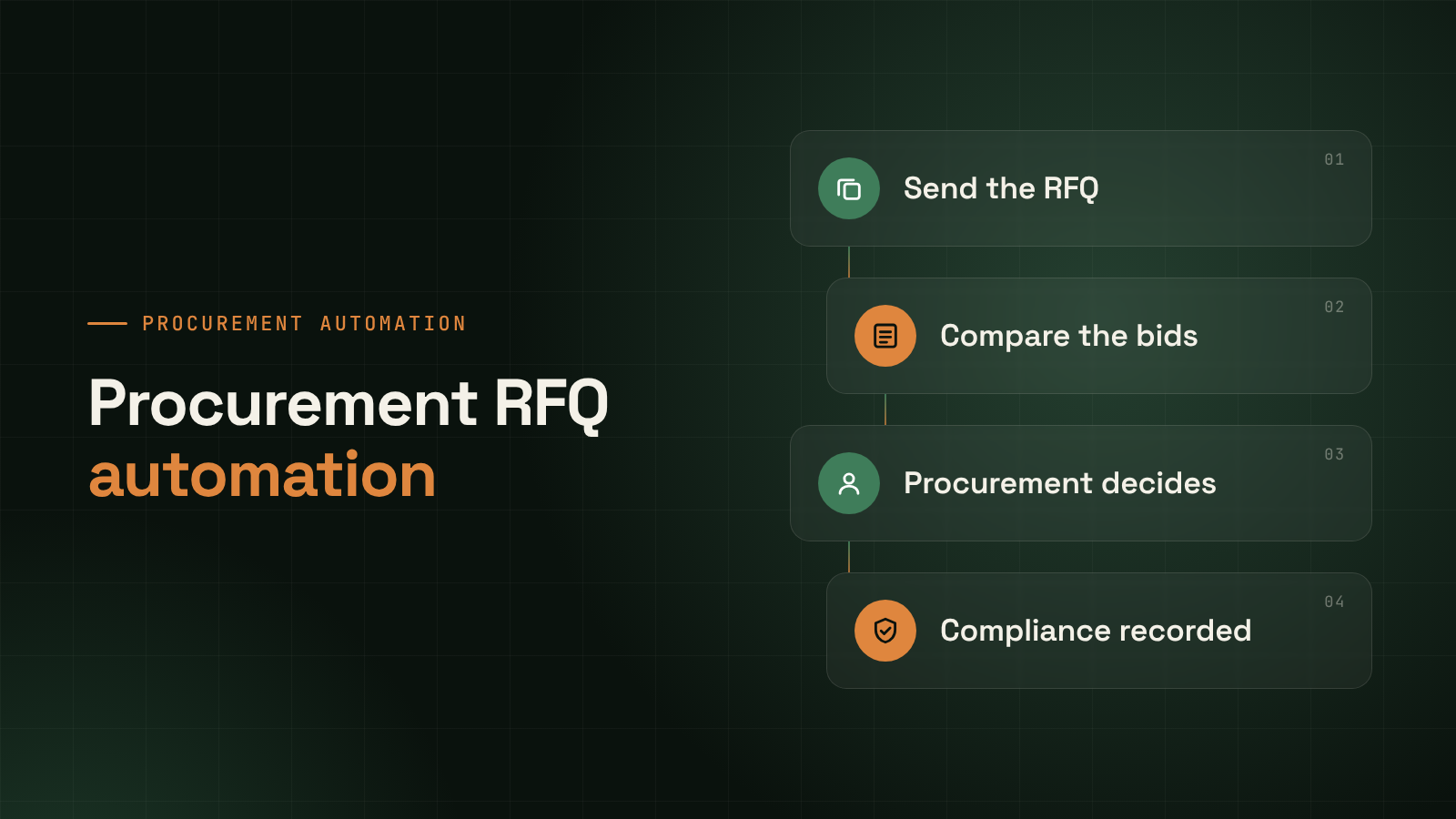
- RFQ automation uses software and agents to prepare, send, chase, collect and compare supplier quotations for defined requirements, then hand a structured comparison to a buyer for decision.
- Most of the elapsed time in a sourcing cycle is clerical: assembling supplier lists, sending requests, chasing responses and normalizing replies into a comparable format.
- An agent handles that clerical layer well. Award decisions, negotiation strategy and supplier relationships stay with procurement.
- Compliance improves as a by-product, because every request, reply and decision is recorded in one place rather than scattered across inboxes.
- Done properly, automation shortens the cycle without moving the decision away from the people accountable for it.
Imagine you head procurement at a construction materials company in Melbourne and need quotations for a repeat order of fabricated steel. You pick five suppliers, email each a spreadsheet, and spend the following week chasing replies by phone and WhatsApp. Two quotes come back as PDFs, one as a pasted email, and two with different units and delivery terms. It takes another two days to put them side by side. A week is gone before any real decision-making starts, and that lost week is exactly what RFQ automation targets.
An RFQ, or request for quotation, is a formal request to suppliers for a price and terms on a defined specification and quantity. The procurement agent automates the mechanics around it inside SAP.
What is RFQ automation?
An RFQ is a buyer’s request to its vendors for a price and terms on a defined specification and quantity. RFQ automation hands the repeatable mechanics, such as sending the request, chasing replies and comparing vendor quotations, to software or an agent, while the buyer keeps the award.
It is different from e-sourcing portals that wait for suppliers to log in. In many mid-market supply chains, suppliers respond by email, WhatsApp or phone (WhatsApp is a major business channel in the Middle East, Southeast Asia, Latin America, India and parts of Europe), so an effective approach must meet them there and convert replies into structured data.
Where do the weeks go in a sourcing cycle?
Mostly into clerical work and waiting. Preparing the request, finding the right suppliers, chasing late replies and reformatting quotes take far more elapsed time than evaluating them. The decision itself is usually the quickest part of the cycle.
| Stage | What takes the time | Nature of the delay |
|---|---|---|
| Requirement to request | Clarifying specification, quantity and delivery date | Information gaps |
| Supplier selection | Hunting for the right approved suppliers | Lookup effort |
| Issuing the request | Preparing and sending separate versions to each supplier | Repetitive work |
| Collecting replies | Chasing suppliers, receiving mixed formats | Waiting and follow-up |
| Normalizing quotes | Aligning units, taxes, freight and payment terms | Re-keying |
| Comparison and award | Evaluating, negotiating, approving | Judgment, which should take time |
| Purchase order | Creating the PO from the winning quote | Re-keying |
Notice that only one row is judgment. The rest is the layer an agent can take on.
What does a procurement agent handle well?
The mechanical, rule-based and repetitive parts. It selects suppliers from the approved list for the item category, issues the request in consistent form, chases non-responders on a set schedule, reads replies from different formats, and builds a normalized comparison.
| Task | How the agent handles it |
|---|---|
| Supplier shortlisting | Applies the approved-vendor list and category rules from SAP |
| Issuing requests | Sends a consistent request by email or message, to each supplier |
| Chasing | Follows up at defined intervals, recording each attempt |
| Reading replies | Extracts price, quantity, delivery and terms from PDFs, emails and messages |
| Normalizing | Aligns units, currencies, tax treatment and freight for comparison |
| Flagging | Highlights missing fields, outliers and deviations from specification |
| Drafting the PO | Prepares the purchase order from the selected quote for buyer approval |
Because it reads open requisitions and vendor records inside SAP, the agent works from the same data your buyers use. For how the order side connects, see our piece on GRN and invoice matching, which explains why a clean purchase order helps everything downstream.
What stays with procurement?
Judgment and relationships. Choosing which suppliers to invite beyond the approved list, deciding whether the lowest price is the best value, negotiating, approving exceptions and managing supplier relationships all remain with buyers. The agent supports those decisions with better-prepared information.
| Stays with procurement | Why |
|---|---|
| Award decision | Price is one factor; quality, reliability and risk are others |
| Negotiation strategy | Depends on relationship, volume and market conditions |
| Adding or removing suppliers | Vendor onboarding and risk assessment are policy decisions |
| Specification changes | Requires technical and commercial judgment |
| Approving exceptions | Needs an accountable human with authority |
| Strategic sourcing | Category strategy sits above any single RFQ |
The decision to award remains a human decision. The agent presents the comparison; the buyer owns the outcome.
How does compliance become a by-product?
Because every step is recorded as it happens. When requests, replies, chasers and decisions run through one workflow, the audit trail is a natural output rather than something reconstructed afterward from emails and chats.
For each RFQ you can show which suppliers were invited and why, when each was invited, what each replied, what was normalized and how, who approved the award and on what basis. That helps internal audit, supports fair-treatment of suppliers and makes repeat purchases easier to defend. It also supports the wider control approach described in AI agent governance: defined actions, named approvers and a record that someone outside the team can read.
How do you keep control while shortening the cycle?
Put the controls in the workflow, not around it. Use approved vendor lists, require approval above value thresholds, make the award a recorded human action, and review deviations. Speed then comes from removing clerical delay, not from skipping checks.
Four practical controls help. First, an approved supplier list by category, so shortlisting is rule-based. Second, value thresholds above which a second approver is required. Third, an exceptions log for single-source or non-standard awards, with reasons. Fourth, periodic review of how often buyers override the agent’s comparison, which shows where rules need adjusting. These are ordinary procurement controls; the difference is that they are applied consistently.
Which RFQs are the best candidates?
Repeat purchases with clear specifications. Standard categories such as consumables, packaging, fasteners, steel sections and maintenance items suit automation well, because specifications are stable and comparison is straightforward.
Highly technical or bespoke purchases, complex tenders and strategic single-source relationships are poor starting points. They need more buyer judgment and more specification dialogue than an agent should handle alone. A sensible approach is to begin with a category where you issue the same kind of RFQ frequently, measure elapsed time from requirement to award before and after, and widen from there.
How do you know the automation is working?
Measure elapsed time from approved requirement to awarded purchase order, the share of invited suppliers who reply, and how often buyers override the comparison. Track them for the same category before and after, so the comparison is honest.
Also review the exceptions log. If single-source awards or late additions to the supplier list rise sharply, the approved list may be too narrow or the process is being bypassed. Either is useful to know.
What this doesn’t do
- It does not decide the award. The agent compares; the buyer chooses, negotiates and approves.
- It does not onboard or vet new suppliers. Vendor risk assessment and approval stay with procurement and finance.
- It does not write specifications. Technical requirements come from the requesting department.
- It does not guarantee more responses. Suppliers decide whether to reply. Consistent requests and timely chasing help, but do not compel.
- It does not guarantee a specific saving or cycle-time cut. We do not quote one, because results depend on your categories and supplier behavior.
Frequently asked questions
What is the difference between an RFQ, an RFP and an RFI?
Use an RFQ when you know exactly what you need and suppliers would meet the specification in the same way. Use an RFI to learn what suppliers can do, and an RFP when you want to evaluate each supplier’s approach as well as its price. An RFI asks suppliers for information about their capabilities. An RFQ asks for price and terms on a defined specification. An RFP invites proposals for a solution to a problem, where the approach itself is being evaluated.
Can RFQ automation work with suppliers who reply by email and WhatsApp?
Yes. The agent sends requests and reads replies in the channels suppliers already use, then converts them into a structured comparison. That matters where suppliers do not use a portal.
Does the agent create purchase orders in SAP?
It prepares the purchase order from the selected quote and presents it for buyer approval. Whether it can post directly depends on your approval policy and configuration, and we would normally keep a person in the loop for posting.
Does RFQ automation replace the procurement team?
No. It removes clerical work such as chasing and reformatting, so buyers can spend more time on negotiation, supplier relationships and strategy. The award decision remains theirs.
How does automation affect supplier relationships?
Consistent, timely requests and clear specifications usually help, since suppliers know what is asked and when. Buyers still own the relationship, and any sensitive conversation should stay with them.
How do we audit an automated RFQ?
Each RFQ carries a record of invited suppliers, requests, replies, chasers, the comparison and the approval. An auditor can reconstruct the process without asking the team, which is easier than piecing it together from inboxes.
Where to go next
If sourcing cycles are slowed by chasing and reformatting, the place to start is a single repeat category. The procurement agent page explains how RFQs are issued, chased and compared inside SAP.
Three related reads:
- GRN and invoice matching, on what happens after the purchase order.
- How to automate accounts payable, on the payables process that follows procurement.
- AI agent governance, on approvals and audit trails.