Table of Contents
Key takeaways
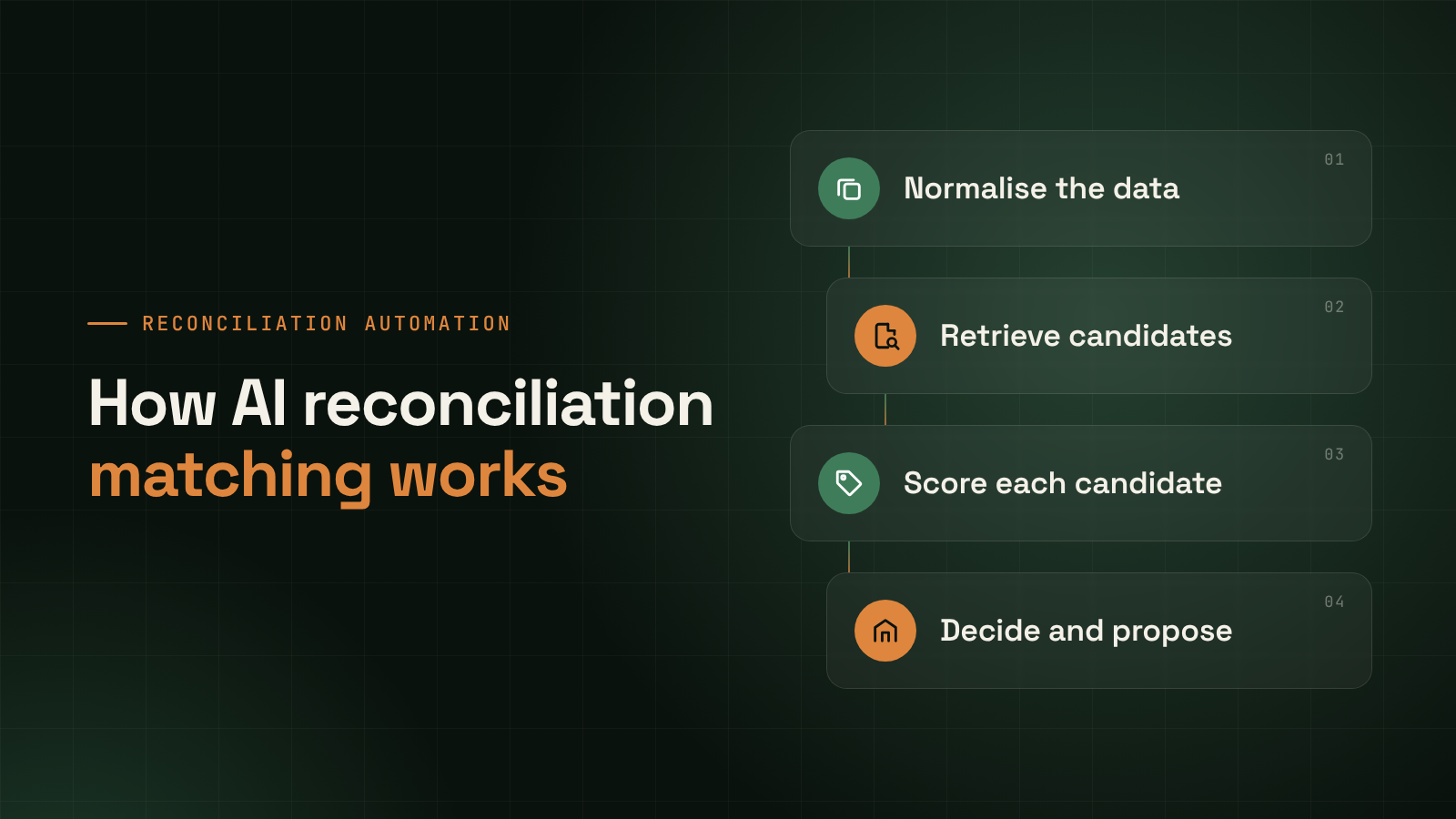
- Matching is four steps, not one: normalize the data, retrieve plausible candidates, score each candidate, then decide what to do with the score.
- Rules match on equality. AI matching scores similarity across several fields at once, which is what lets it survive a truncated payer name or a transposed invoice number.
- Tolerance bands are a business decision, not a technical one. Someone in finance has to say what a defensible difference looks like in currency units and in days.
- The output that matters is a confidence score with its reasoning attached, which field agreed, which did not, and by how much. A match you cannot explain is a match you cannot sign.
- One-to-many allocation is the step that actually saves the hours. Most rule engines compare one line to one open item and stop there.
Ask a vendor how their reconciliation works and you will usually get the word “AI” and a percentage. Neither tells a controller anything useful. What you need to know before you trust a proposed match is narrower: what did it compare, how close did it have to be, and what happens when it is not sure?
This article answers that. It is deliberately mechanical.
How does AI reconciliation matching work, step by step?
In four stages. The system normalizes both sides into comparable fields; retrieves a shortlist of plausible counterparts rather than scanning everything; scores each candidate across amount, date, reference and party name; then applies a threshold that decides whether the match is proposed, queued for review or left alone. Nothing posts on the strength of a score alone.
Each stage does a specific job, and the failures at each are different.
A bank narration, a vendor statement line and a tax authority portal row describe the same event in three vocabularies. Normalization pulls structured fields out of unstructured text: amount, value date, counterparty, any document number buried in a narration string, and the tax components where they are stated separately. Nothing downstream can be better than this step: an amount read from the wrong column poisons every comparison that follows.
Candidate retrieval. Comparing every statement line to every open item is wasteful and, on a large ledger, actively harmful: the more candidates you score, the more chances you give a coincidence to look like a match. Retrieval narrows to a plausible set first: the same counterparty or a near name, a date window, an amount range wide enough to allow for deduction.
Scoring. Each candidate gets a score per field, and the field scores combine into one number. Amount similarity is arithmetic. Date proximity is arithmetic. Reference and name similarity are not: they need string-distance measures that tolerate a missing prefix, an extra suffix, a swapped digit or a shortened legal name.
Decision. The score meets a threshold, or it does not. High confidence becomes a proposed match. The middle band becomes a review queue with the evidence attached. Low confidence is left for a human to look at with fresh eyes rather than nudged toward a wrong answer.
What is fuzzy matching, and why does it matter here?
Fuzzy matching compares how similar two values are rather than whether they are identical. “Northfield Ind Ltd” and “NORTHFIELD INDUSTRIES LIMITED” are not equal, so a rule returns nothing. A similarity measure returns a high score. The same logic handles invoice numbers that lost a prefix in transit.
This is the single largest practical difference between a rule engine and a matching agent, and it is worth being precise about the limits. Fuzzy matching makes near-misses visible; it does not make them correct. Two sister concerns with near-identical names score alike. Sequential invoice numbers differ by one character and so score alike too. Similarity is evidence, and on its own it is weak evidence, which is why it is combined with amount and date rather than trusted alone.
| Deterministic rules | AI matching | |
|---|---|---|
| Compares | Exact values, with fixed tolerances | Similarity across several fields at once |
| Party name | Must match the stored string | Scored against known aliases and past behavior |
| Reference buried in free text | Not available to compare | Extracted first, then scored |
| One payment, several invoices | One line to one item | Allocation proposed across open items |
| Output | Cleared or not cleared | A score, the contributing fields, and a recommendation |
| Behavior when unsure | Falls into the exception list | Queued for review with its reasoning shown |
| Audit position | Easy to explain, inflexible | Needs the reasoning recorded to stay explainable |
Note the last row. Deterministic matching has a real advantage an agent never takes away: it is trivially explainable. That is why the sensible sequence is rules first, agent second: clear everything the rules can clear, and let the agent work the residue.
What are tolerance bands, and who should set them?
A tolerance band is the difference you are willing to accept before a match stops being a match: in currency units, in percentage, and in days. It is a finance decision. The system should hold several bands, not one: a small absolute tolerance for rounding, a wider one for bank charges, and a separate treatment for deductions that are expected rather than tolerated.
The mistake we see most often is a single global tolerance set generously enough to clear the awkward cases. That does clear them. It also quietly clears genuine short payments, and the difference surfaces months later as a receivable nobody can explain.
Three bands usually earn their keep:
- Rounding and small currency differences. Small, absolute, and safe to clear automatically once agreed.
- Known cost deductions: bank charges, forex differences on an inward remittance. Expected, usually within a predictable range, and better posted to a named account than absorbed.
- Deductions with a reason, tax withheld by a customer, a quality or rate claim, a shortage. These should never be absorbed by a tolerance. The right behavior is to allocate the receipt in full against the invoice and isolate the deduction with its reason, so someone can chase or accept it deliberately.
Why propose a match instead of posting it?
Because the cost of the two mistakes is not symmetrical. An unmatched item costs a few minutes of review. A wrongly cleared one hides inside a reconciled balance, survives the month-end close, and is usually found by an auditor or by a customer disputing a statement: at which point it has to be reversed, re-explained and traced through everything built on top of it.
So the agent’s deliverable is a proposal: this receipt, against these three invoices, in these amounts, because the amount reconciles to the open total less a deduction consistent with this customer’s withholding pattern, the value date sits two days after the due date, and the narration carries a partial name matching this account. A person approves it, and the posting into SAP carries the approver’s identity.
That also gives you the thing auditors actually ask for. They rarely ask whether the matching was accurate. They ask who authorized the entry, on what basis, and whether the basis was recorded at the time.
Does it learn from corrections?
Yes, and narrowly. When a reviewer rejects a proposed match and allocates differently, that correction becomes evidence about your ledger: this payer’s name appears this way, this customer withholds tax at this rate, this dealer pays in a particular rhythm. Scoring improves on your data, not on anyone else’s.
What it does not do is loosen its own thresholds because it has been right a few times. Confidence improves as the evidence improves; the band at which a human reviews stays where your finance team put it.
What this doesn’t do
- It does not clear items by itself. It proposes; approval is a human act, and the audit trail records who performed it.
- It does not decide tax treatment. Identifying a gap as a likely withholding-tax deduction is a flag for your team, not a determination, and it does not substitute for the certificate.
- It does not resolve disputes. It can tell you a customer has short-paid and suggest the probable reason. Whether you accept a claim is a commercial decision.
- It does not repair master data. Duplicate customer records and inconsistent vendor naming degrade similarity scoring exactly as they degrade rule matching.
- It does not replace deterministic rules. Anything your ERP can clear on an exact match should keep clearing there.
- It is not a reason to delay a better data feed. A structured statement from your bank or a clean remittance advice from a customer beats any amount of inference.
Frequently asked questions
How is this different from the matching rules already in our ERP?
ERP rules test equality within fixed tolerances: the amount matches, the reference matches on the stored characters, the date falls inside the window. AI matching scores similarity across those fields together, so a line with a truncated name and no document number can still be ranked against the right open item. The rules clear the clean cases; the agent works on what is left.
How accurate is it?
Accuracy depends on your data, so treat any single headline number with suspicion, including ours. The useful question is how it behaves at the margin: how often it proposes a wrong match with high confidence, and how often it sends something to review that could have cleared. Ask any vendor to show you both, measured on your own ledger during a pilot rather than quoted from a brochure.
Does it post entries into SAP?
It posts into SAP S/4HANA or SAP Business One after a person approves the proposal. The proposal, the evidence behind it, the approver and the timestamp are all retained, so the entry can be traced back to its basis later.
Can it handle one payment settling several invoices?
That is the case it is built for. It proposes an allocation across the open items that reconcile to the receipt, including any short-paid portion isolated with a reason, rather than forcing a single line-to-line pairing.
Does it work for tax reconciliation as well as bank reconciliation?
The same matching machinery applies, with different fields. On the tax side, for example India’s GST, it compares the purchase register against the data available in the portal return, matching on tax registration number, document number, date and tax values. Comparable matching of purchase ledgers against supplier-reported or e-invoice data arises under VAT and e-invoicing regimes elsewhere. The mismatch patterns differ, but normalize-retrieve-score-decide does not.
How long does it take before the matching is useful?
It is useful immediately on lines carrying an explicit reference, because those are deterministic. Narration-only receipts improve as it accumulates your own payment history, so the curve is a function of your transaction volume rather than a fixed number of weeks.
Does it replace our reconciliation team?
No. It changes what they spend the day on: reviewing proposals with the evidence in front of them instead of searching for candidates by hand. The judgment calls, the disputed deductions and the approvals stay with your team.
Where to go next
The full picture sits on ledger and tax reconciliation, which covers how this matching works across bank, vendor and tax ledgers inside SAP, and what the exception workflow looks like day to day.
Three related reads:
- Bank reconciliation in SAP Business One: where it stops short: what the native matching rules do, stated precisely, and where they run out.
- GST reconciliation: the complete guide for Indian finance teams: the same discipline applied to the statutory side, using India’s GST as the worked example.
- Can AI post invoices directly into SAP?: posting authority, the human gate and what the audit trail records.