Table of Contents
Key takeaways
- Automating accounts payable is a sequencing problem, not a software problem. The order you do things in decides whether it works.
- Three things have to be in order before any tool helps: the vendor master, goods receipt discipline, and a written approval matrix. Nothing automates cleanly around a broken one.
- Automate capture and matching first, because they are high-volume and low-judgment. Approvals and exception resolution come later, and payment release does not come at all.
- Measure booking latency, clean-match rate and rework, not headcount. Teams that model this as a staffing saving usually abandon the business case in the first quarter.
- The honest ceiling is the share of your invoices that can match cleanly against a PO and a goods receipt. Find that number early; it governs everything else.
Most accounts payable teams in mid-market businesses, from Ohio to Rotterdam to Dubai, are not slow because the people are slow. They are slow because an invoice arrives as a PDF in a shared mailbox, gets retyped into SAP, waits for a goods receipt that was posted in a weekly batch, and then sits in someone’s inbox for approval while month-end closes around it.
Automation helps with exactly two of those four problems, and it helps enormously. It does nothing at all for the other two until you fix them yourself. This guide is the sequence, in the order a finance head should actually run it.
How do you automate accounts payable?
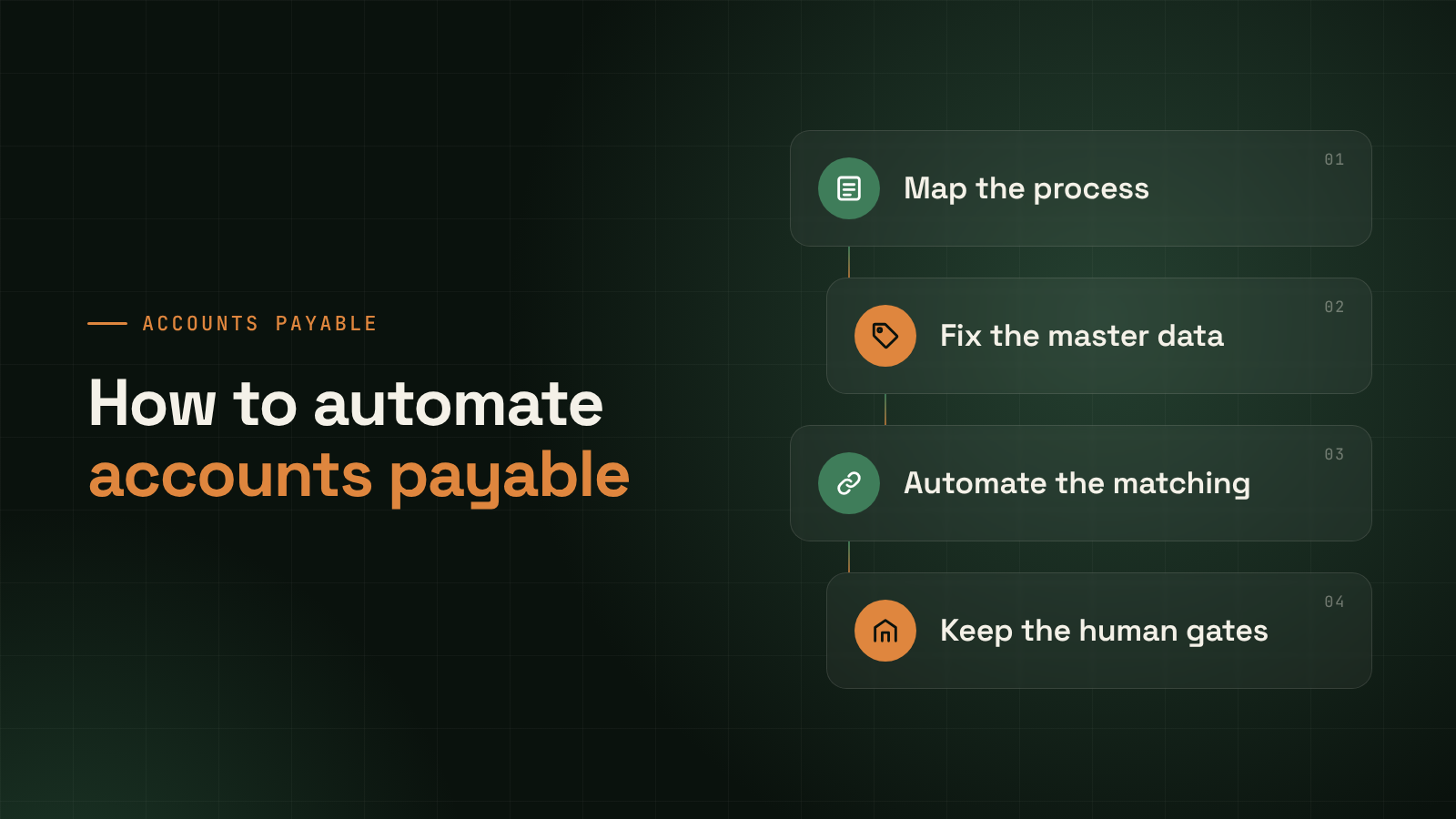
Work in four stages. First fix the data the process depends on: vendor master, goods receipt practice, approval matrix. Then automate capture, so invoices stop being retyped. Then automate matching against the purchase order and goods receipt. Then route only the exceptions to people. Payment release stays manual throughout.
That order is not arbitrary. Each stage depends on the one before it: matching is meaningless if the goods receipt was not posted, and exception routing is noise if everything is an exception because the vendor master is dirty.
What does your AP process look like before you change anything?
Eight steps, of which three are judgment and five are handling. The handling steps are where the hours go and where automation applies. Map yours honestly before you buy anything: most teams find at least one step nobody formally owns.
| Step | Who does it today | What usually goes wrong |
|---|---|---|
| Invoice arrives | Shared mailbox, courier, WhatsApp, vendor portal | No single intake point, so nothing can be measured |
| Read and key the invoice | AP executive | Retyping, transposition, inconsistent tax coding |
| Find the PO | AP executive | PO number missing or wrong on the vendor’s document |
| Find the goods receipt | AP executive, stores | GRN posted late or in a batch, so the invoice waits |
| Match the three documents | AP executive | Quantity, rate and tax differences treated inconsistently |
| Resolve differences | AP lead, buyer, stores | No written tolerance policy, so each case is argued afresh |
| Approve | Approvers by value band | Email approvals with no audit trail |
| Book and schedule payment | AP executive, controller | Booking happens late, so aging reports mislead |
The first thing this map usually reveals is that cycle time is not spread evenly. Two steps, finding the goods receipt and resolving differences, account for most of the delay, and only one of them is a data-entry problem.
What has to be in place before you start?
Four prerequisites, all of them yours rather than a vendor’s. They are unglamorous and they are the difference between a program that lands in a quarter and one that stalls in user acceptance testing.
- A clean vendor master. Duplicate vendors, missing tax registration numbers and stale registration details break matching and compliance reporting in the same stroke. This is the single most common reason a go-live slips.
- Goods receipt discipline. If stores post receipts weekly, three-way matching cannot run daily, no matter what the software claims. Decide whether receipts move to daily posting before you decide anything else.
- A written approval matrix. Value bands, cost-center owners, plant heads, delegation during leave. If it only exists in people’s heads, it cannot be configured.
- A tolerance policy you actually agree on. What quantity and rate difference passes without a human? Most teams have never written this down and discover during testing that finance, procurement and stores each assumed something different.
Which parts should you automate first?
Capture and matching, in that order. They are high-volume, low-judgment and measurable, which makes them both the easiest to automate and the easiest to prove. Everything downstream of them is judgment work that should be routed to people faster rather than removed.
| AP step | Automate? | Why | Prerequisite |
|---|---|---|---|
| Intake and capture | First | High volume, no judgment, immediately measurable | One defined intake channel |
| PO and vendor resolution | First | Deterministic lookup against ERP master data | Clean vendor master |
| Three-way matching | Second | The largest single time sink, and rule-governed | GRN posted on time |
| Exception routing | Second | Routing is automatable even when the fix is not | Written tolerance policy |
| Exception resolution | No | Requires commercial judgment and a conversation | n/a |
| Approval | Later | Automate the routing and the audit trail, not the decision | Approval matrix in writing |
| Payment release | Never | Authorization is a human act under your banking controls | n/a |
The distinction that matters in every row is between handling a document and deciding something about it. Handling automates well. Deciding does not, and an agent that claims otherwise is quietly moving your authorization limits.
How should you sequence the program?
In three phases over roughly a quarter, not one go-live. Each phase should produce a number you can show a board before the next one starts. If a phase cannot be measured, it has been scoped wrong.
| Phase | What ships | How you know it worked |
|---|---|---|
| Phase 1: intake and capture | Single intake channel; invoices read and fields proposed, a person confirms | Hours per invoice on keying; share of invoices captured without retyping |
| Phase 2: matching and exceptions | PO and goods receipt matching with your tolerance bands; exceptions routed by reason | Clean-match rate; average age of an open exception |
| Phase 3: posting and audit trail | Fully matched invoices posted into SAP with a complete record of what was read and matched | Booking latency; proportion posted without manual touch |
Run the old process alongside the new one for a cycle or two in phases one and two. It costs real hours and it is worth every one of them, because it is the only way to find out what your genuine clean-match rate is rather than what a demo suggested.
What should you measure?
Four numbers, none of which is headcount. Booking latency, clean-match rate, exception aging and rework volume tell you whether the process improved. Headcount tells you whether someone left, which is a different question and usually an unrelated one.
- Booking latency: days from invoice receipt to posting in the ERP. The number that compliance exposure and aging accuracy both depend on.
- Clean-match rate: share of invoices matching PO and goods receipt within tolerance with no human touch. Your real ceiling.
- Exception aging: how long open exceptions sit, by reason code. This is where cycle time actually hides.
- Rework: duplicates caught, price variances found after payment, invoices booked twice or corrected. Falls earlier than most teams expect.
Resist the pull toward cost per invoice as a headline. It is a comparison metric for benchmarking vendors, not a management metric, and it can fall while your cycle time gets worse.
What this doesn’t do
The accounts payable agent works autonomously inside a boundary, and the boundary should be stated plainly rather than discovered later.
- It does not release payment. Payment stays a human act under your existing banking authorizations. An agent that could pay would be a control failure, not a feature.
- It does not resolve exceptions. It identifies them, explains why they failed and routes them to the right person faster. The commercial conversation with the supplier is still yours.
- It does not fix the vendor master or goods receipt practice. Both are prerequisites, and both stay your responsibility.
- It does not replace the AP team. The work changes from typing to exception handling and supplier queries. Plan for redeployment, not reduction.
- It does not remove your tax and compliance obligations. It gives you better evidence and faster booking; your filings and your advisors remain where they were.
Frequently asked questions
How long does it take to automate accounts payable in a mid-market business?
Plan in phases rather than a single date. Capture and matching usually stabilize within a quarter when the vendor master and goods receipt practice are already in order. When they are not, the cleanup sets the timeline, and that work sits with your team, not the vendor’s.
Do we need to change our ERP to automate AP?
No. The point of an agent is that it works inside the SAP you already run, reading master data and posting back with an audit trail. If a proposal requires replacing or heavily re-implementing the ERP, you are being sold a platform migration with AP attached to it.
Does the agent post invoices into SAP by itself?
Fully matched invoices within your tolerance bands can post into SAP automatically, with a record of what was read, what it matched against and which rule cleared it. Anything outside tolerance stops and goes to a person. The posting rules are configured by you, not assumed by the agent.
What happens to our AP team?
The volume of keying falls and the volume of exception handling rises. In practice teams redeploy rather than shrink, taking on vendor query resolution and master data ownership: the work that was always being squeezed out by typing.
How accurate is it, really?
Accuracy varies by field and by document quality, and any single headline percentage should be treated skeptically. The number worth asking a vendor for is the clean-match rate on a sample of your own invoices, measured during parallel running, rather than a figure from someone else’s ledger.
Will it handle our local tax treatment and compliance reporting?
It reads and matches the tax detail on the invoice (VAT, sales tax or similar, depending on where you operate) and preserves it through to posting, which improves the evidence behind your filings. It is not a tax engine and it does not file anything. Treat it as better input to your existing compliance process, confirmed with your own advisors.
Where to go next
This article is the hub for everything we publish on payables. The next step from here is accounts payable automation: the operating model, what stays with your team, and where the human gates sit.
Three related reads:
- How AI invoice processing actually works, step by step: the mechanics behind the capture stage in phase one.
- GRN invoice matching: why goods receipt discipline decides your clean-match rate.
- How much does AP automation cost in India?: the cost structure and how to size the business case before anyone quotes you.
- The MSME 45-day payment rule and your AP cycle time: the compliance pressure, for entities operating in India, that makes booking latency matter.