Table of Contents
Key takeaways
- The MSMED Act caps the agreed credit period for a registered micro or small supplier at 45 days from acceptance. Where nothing is agreed in writing, the limit is the “appointed day”, 15 days from acceptance.
- Miss it and two things happen: compound interest at three times the RBI bank rate, with monthly rests, and, under the Income-tax Act, 2025, a deduction that is allowed only in the year the money is actually paid.
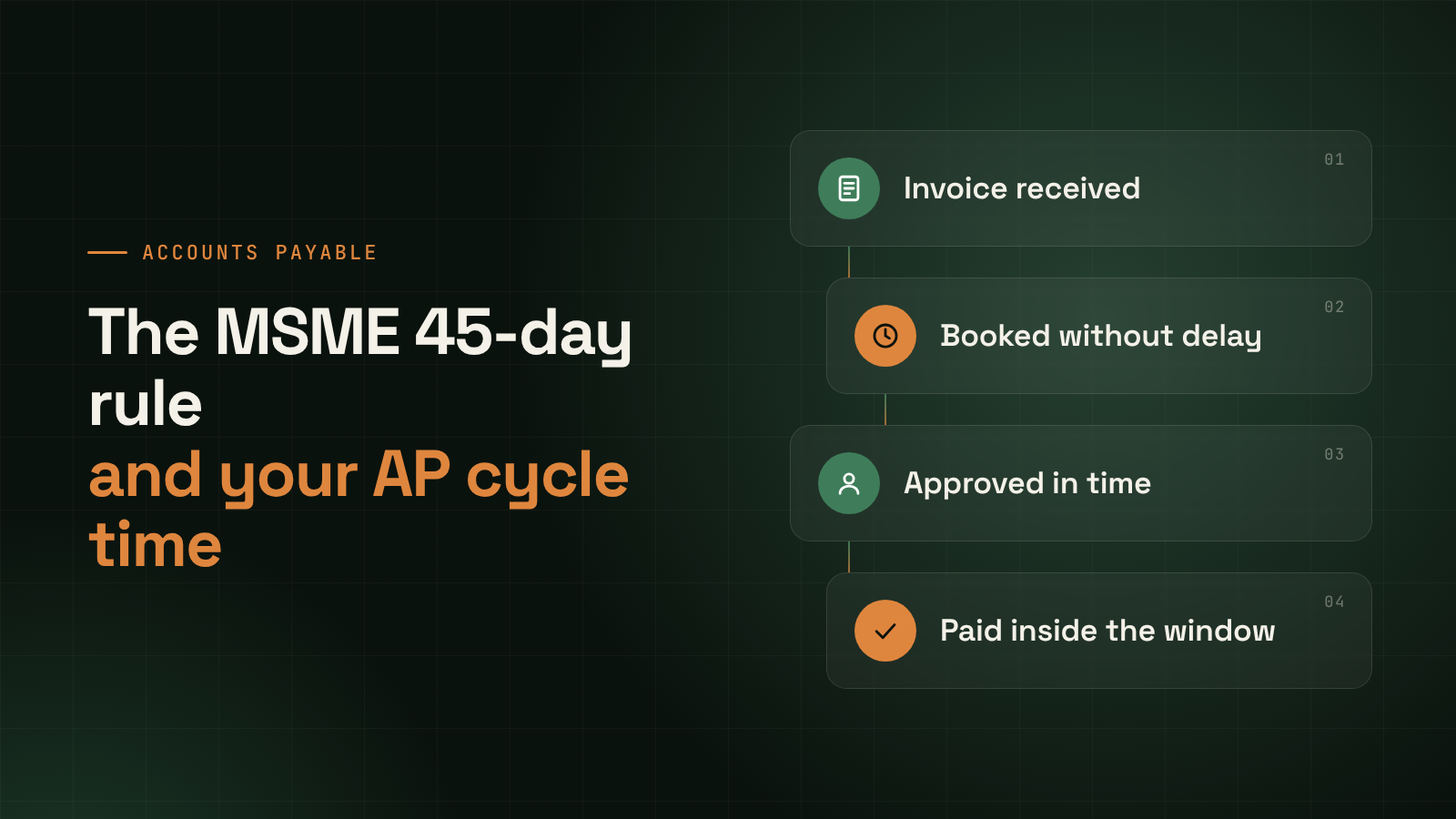
- The payment term is a treasury decision. The cycle time, how long an invoice sits before it is booked and approved, belongs to accounts payable, and it is usually where the 45 days go.
- MSME 45 day payment rule compliance automation is not about paying faster. It is about booking faster, flagging earlier, and being able to prove the clock was watched.
This post covers an India-specific rule. If you sell into, buy from or run entities in India, the MSME 45-day payment rule decides how long you can safely take to pay small suppliers there, and it is enforced through interest and tax. If you operate elsewhere, the details will differ, but teams in many countries face the same pattern under their own late-payment, VAT and e-invoicing regimes: the days are lost in booking and approval, not in the payment run. A short comparison near the end covers that.
Under section 15 of the MSMED Act, a buyer must pay a registered micro or small supplier within the period agreed in writing, which cannot exceed 45 days from the day of acceptance (or deemed acceptance), or within 15 days if there is no written agreement. Medium enterprises are not covered.
Your CFO is not worried about the 45-day rule because the company refuses to pay suppliers. It is worried because an invoice that arrives on the 3rd of the month can still be unbooked on the 25th, and nobody inside the business can say so until the audit.
That gap, between the day a supplier’s goods were accepted and the day the invoice entered your ERP, is where this rule bites. It is an accounts payable cycle-time problem wearing a compliance costume.
What is the MSME 45-day payment rule?
Section 15 of the Micro, Small and Medium Enterprises Development Act, 2006 requires a buyer to pay a supplier by the date agreed in writing, and states that the agreed period “shall in no case exceed forty-five days from the day of acceptance or the day of deemed acceptance.” Where there is no written agreement, payment is due by the appointed day, 15 days from acceptance.
Two details decide how this lands. First, the clock starts at acceptance, not at invoice receipt, and not at booking. Deemed acceptance is the day of delivery unless the buyer objects in writing within fifteen days. The days are already running while the invoice sits in a shared inbox.
Second, it covers only registered micro and small enterprises. Under the classification in force from April 1, 2025, a micro enterprise has investment up to about $0.28 million (₹2.5 crore) and turnover up to about $1.1 million (₹10 crore); a small enterprise, about $2.8 million (₹25 crore) and about $11 million (₹100 crore). Medium enterprises sit outside the payment protection.
What does it cost to miss the deadline?
Three costs, and only one of them is interest. Section 16 of the MSMED Act makes a late buyer liable for compound interest with monthly rests at three times the bank rate notified by the Reserve Bank, and section 23 says that interest is not allowed as a deduction in computing income.
The RBI bank rate was 5.75% on October 9, 2026, which puts the statutory rate at 17.25% per annum, compounded monthly. As a worked example of the formula, not a benchmark: if you pay an invoice of about $11,000 (₹10 lakh) 40 days beyond the deadline, it attracts roughly $215 (about ₹19,000) of interest, and none of it is deductible.
The third cost is the tax one, and it is the reason finance directors started caring in 2024. Under the Income-tax Act, 2025, in force from 1 April 2026, section 37(2)(g) allows a deduction for a sum payable to a micro or small enterprise beyond the section 15 time limit only in the year it is actually paid. Section 37(3) extends the usual “pay by the return due date” grace to the other clauses of section 37, but not to clause (g). This is the provision that sat at section 43B(h) of the 1961 Act, carried forward without the softening everyone hoped for.
In most AP processes the payment run is measured, but the days between acceptance and booking are not, and that is where a 45-day window is usually spent.
| Consequence | Legal basis | When it bites |
|---|---|---|
| Compound interest, monthly rests, 3× RBI bank rate | MSMED Act s.16 | From the appointed day or the day after the agreed date |
| That interest is not deductible | MSMED Act s.23 | Same year it accrues |
| Deduction deferred to the year of actual payment | Income-tax Act, 2025, s.37(2)(g) | At assessment, with no return-due-date grace under s.37(3) |
| Disclosure of unpaid principal and interest in the annual accounts | MSMED Act s.22 | At audit |
Where do the 45 days actually go?
Rarely in treasury. In most SAP-run mid-market businesses, the payment run is the last and fastest step. The days disappear earlier, in handoffs nobody measures, because nothing in the process is timestamped against the acceptance date.
| Stage | Typical ownership | Measured today? |
|---|---|---|
| Goods accepted, GRN posted | Stores / plant | Yes: it is in the ERP |
| Invoice reaches finance (email, courier, WhatsApp) | AP inbox | No |
| Invoice read, coded, entered | AP executive | Rarely |
| Matched to PO and GRN; exceptions raised | AP executive | Only as a backlog count |
| Exception chased with plant or supplier | AP + requisitioner | No |
| Approval routed and obtained | Approvers | Sometimes |
| Payment proposal and release | Treasury | Yes |
Every row marked “no” is a stretch of calendar that is invisible until someone reconstructs it manually. A team cannot shorten what it cannot see, which is why the honest first project is measurement, not automation.
How does MSME 45 day payment rule compliance automation change the math?
It changes the input, not the deadline. An accounts payable agent reads the invoice on arrival, resolves it to the purchase order and goods receipt, posts the clean ones into SAP, and starts a clock on each one against the acceptance date, so day 30 becomes an alert rather than a discovery at year-end.
Four things move:
- Booking latency falls to the time it takes a document to be read and matched, and aging is measured from acceptance rather than entry date.
- Exceptions surface on day two, not day twenty: a price variance is raised while there is still a month of runway.
- Vendor master flags become usable. Udyam status and enterprise category drive the clock, instead of being fields nobody maintains.
- The section 22 disclosure becomes a report rather than a fortnight of spreadsheet work at year end.
The honest version: compliance automation does not buy you more than 45 days. It gives most of those 45 days back for the decision, instead of spending them on data entry.
What this does not do
A clear boundary, because the rule carries real liability and nobody should buy a false sense of safety.
- It does not release payment. Payment is a human act, under existing authorization limits. The agent books, matches and flags; the payment run stays with your team.
- It does not determine who is a micro or small enterprise. It reads what your vendor master says. If a supplier’s Udyam registration is stale, missing, or was never collected, the clock will not start. Cleaning the vendor master is a prerequisite, not an output.
- It does not resolve a genuine dispute. A short delivery is still a conversation between your plant and the supplier. The agent makes the dispute visible early and keeps the date trail; it does not decide who is right.
- It does not give you a legal opinion. Whether a specific payment falls foul of section 15, and how it is treated at assessment, is a question for your auditor. The system’s job is to make sure the facts are available and dated.
What should finance actually measure?
Four numbers, monthly, in this order. They show whether the exposure is shrinking before any tax or interest consequence appears.
- Acceptance-to-booking days for micro and small suppliers specifically.
- Share of invoices booked within 15 days of acceptance: the safe default where no written term exists.
- Open exceptions aged over 20 days: the invoices that quietly become section 37(2)(g) items.
- Vendor master completeness: active suppliers with a recorded Udyam number and category. Everything above is unreliable until this is high.
How does this compare outside India?
The MSME rule is specific to India, but the underlying pattern is not. Many countries regulate how long a business can take to pay its suppliers, and the days are usually lost in the same place: between delivery and booking, not in the payment run.
In the EU, a late payment directive sets a default payment period for business-to-business invoices, and member states apply their own detail on top. The UK has statutory late payment interest for commercial debts. Several other countries have prompt-payment rules, some aimed specifically at small suppliers. Whether interest is automatic, whether it can be waived by contract, and whether it affects tax treatment all vary, so check your own jurisdiction rather than assuming it works like India.
Tax adds a second parallel. VAT and similar systems tie input credit to a valid supplier invoice, so slow or wrong booking can delay recovery. E-invoicing mandates, which keep spreading, give tax authorities a near real-time view of invoice dates, which makes cycle time easier for others to see.
The practical lesson travels well. Timestamp every invoice from delivery or acceptance, measure acceptance-to-booking days by supplier category, and flag exceptions while there is still runway. The legal clock differs by country. The measurement problem does not.
Frequently asked questions
Does the 45-day rule apply to all our suppliers?
No. It protects suppliers registered as micro or small enterprises under the MSMED Act. Medium enterprises are outside the payment protection, and an unregistered supplier cannot claim under it. This is why the Udyam number on the vendor master is the single most important field in the whole exercise.
Does the clock start when we receive the invoice?
No, and this is the most common mistake. It runs from the day of acceptance or deemed acceptance of the goods or services, in practice, delivery, unless the buyer objects in writing within fifteen days. An invoice that reaches finance a fortnight after delivery has already used a third of the window.
We pay on time but book late. Is that a problem?
It is a risk rather than a breach. If the money leaves within the limit, section 15 is satisfied. But late booking means you cannot prove it on demand, cannot see which invoices are approaching the deadline, and cannot produce the section 22 disclosure without reconstruction.
Can an AI agent post these invoices into SAP by itself?
Clean, fully matched invoices can post into SAP with a full audit trail of what was read and matched. Anything with a price, quantity or tax mismatch goes to a person instead, and payment release is never automated.
How long before this shows up in our numbers?
Booking latency is the first thing to move, because it depends only on capture and matching. The compliance reporting benefit, a defensible, dated view of micro and small supplier aging, arrives only once the vendor master is complete, and that is usually the longer pole.
Does this apply outside India?
The MSME rule itself applies to payments to registered micro and small suppliers in India. Other countries have their own late-payment and tax rules, and the cycle-time measurement approach carries over. See the comparison section above and check your own jurisdiction.
Where to go next
If you are sizing this as a program, start with accounts payable automation: the operating model, what stays with your team, and where the human gates sit.
Three related reads:
- How AI invoice processing actually works, step by step: the mechanics behind the booking-latency number above.
- GRN invoice matching: why the goods receipt, not the invoice, is where the AP clock really starts.
- Can AI post invoices directly into SAP?: what posts automatically, what waits, and what the audit trail records.