Table of Contents
Key takeaways
- Three-way matching automation compares the purchase order, the goods receipt and the supplier invoice by software, line by line, and posts the invoice only when all three agree within tolerances you have set.
- Most failed matches are not disputes. They are documents arriving in the wrong order, units that do not convert, or master data that does not line up. Counting failures by cause, not just by number, is what makes the exception queue shrinkable.
- A rules engine matches what you told it to match. An AI agent also resolves the messy inputs that reach the rules, such as free-text item descriptions, partial deliveries and unit differences, and explains why a match failed. Neither replaces a tolerance policy.
- The control is a design decision: tolerances by category, a named owner for every exception type, separation between whoever matches and whoever approves, and a trail you can show an auditor.
- Measure the clean-match rate by value as well as by count, and the age of the exceptions that remain. A high percentage that hides a few large, old items is not a healthy result.
Three-way matching automation is software that checks each supplier invoice against the purchase order and the goods receipt before it is booked, and either passes it or sends it to a named person with the reason attached. It is a control first and an efficiency tool second.
Imagine you run accounts payable at a manufacturing company in Texas. A purchase order is raised for 4,000 fasteners, and the supplier invoices 4,000. Stores received three truckloads, but only two have been posted as receipts, so SAP holds 2,800 units against an invoice for 4,000. The unit rate on the invoice is also slightly above the order. You now have to chase the missing receipt, query the rate with the buyer, and come back to it before month-end. Multiply that by every supplier you pay.
If you want the rollout sequence around this, how to automate accounts payable covers it. This article is about the match itself.
What is three-way matching, and what does automating it mean?
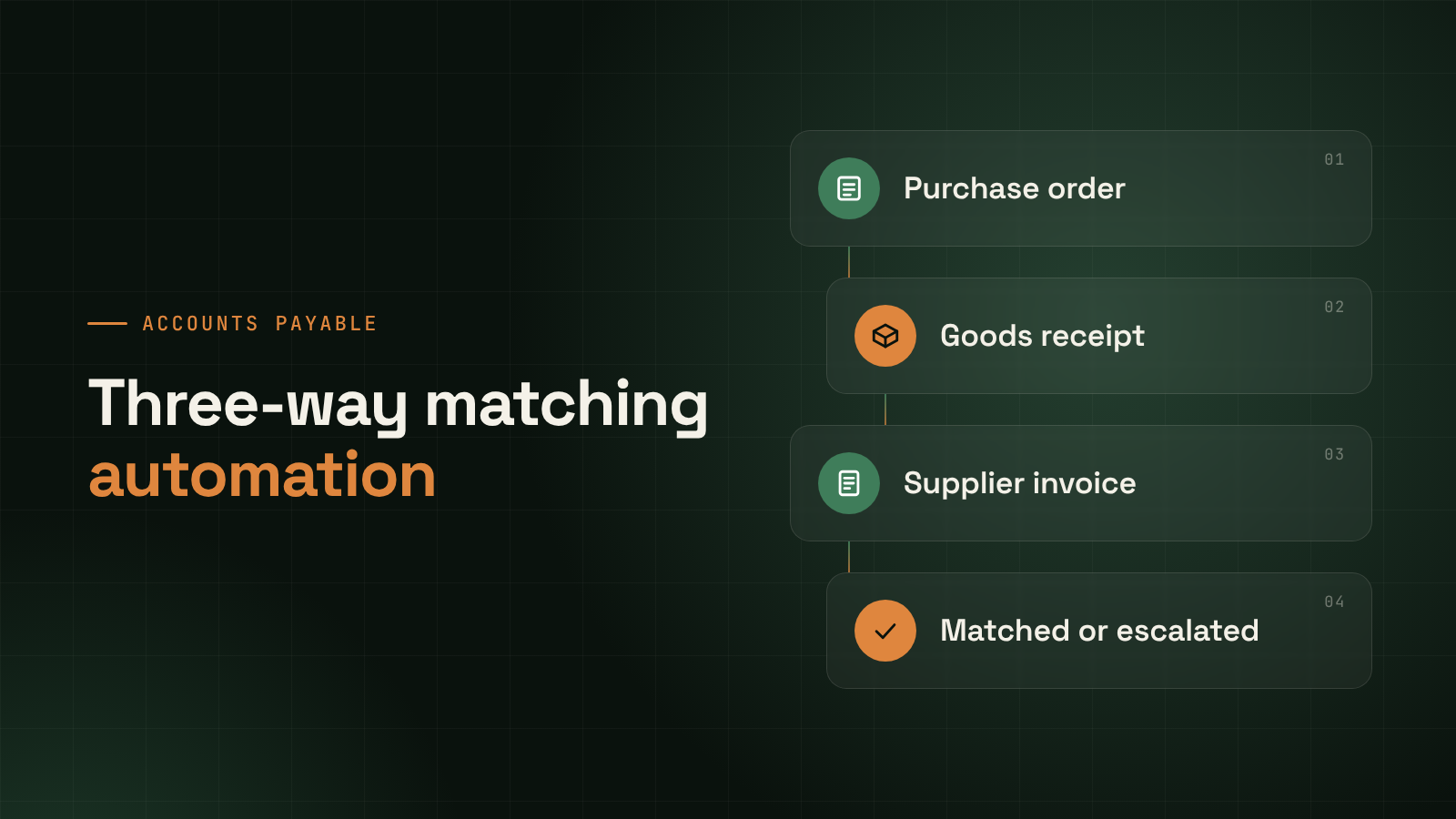
Three-way matching compares three documents: what you ordered, what you received and what the supplier billed. Automating it means software performs the comparison on every invoice, applies your tolerances, posts the clean ones and routes the rest to the right owner, so people spend time on judgment rather than lookups.
The purpose is protection. Paying only for goods ordered and received stops duplicate billing, over-billing and payment for material that never arrived. Two-way matching, which compares only the order and the invoice, is faster and weaker.
What actually breaks a match?
Six causes account for most failures, and only one of them is a genuine disagreement about price or quantity. The rest are timing, data and format problems that look like disputes from the inside. Sorting them is the first job, because they need different people.
| What breaks | What you see | Usual underlying cause | Who should resolve it |
|---|---|---|---|
| Receipt not posted | Invoice present, no goods receipt | The material is physically in stores, the entry is not made yet | Stores or site team |
| Partial delivery | Receipt quantity below invoice quantity | Several deliveries against one order line, billed together | Stores, then buyer |
| Unit of measure | Same goods, different units | Order in kilograms, invoice in metric tons, receipt in bags | Master data owner |
| Rate variance | Invoice rate differs from order rate | A price revision agreed by phone and never amended on the order | Buyer |
| Charges not on the order | Freight or packing on the invoice only | Terms agreed verbally, or applied late | Buyer, then finance |
| Wrong or missing reference | Invoice cannot be tied to an order | Supplier left off the PO number, or quoted an old one | AP, with the supplier |
Two further causes are control matters rather than matching matters. A duplicate invoice sent by email and again by courier will match the same receipt twice if nothing stops it, and an invoice with no order at all is a purchasing-governance problem that matching can only expose. Procurement automation addresses the second at source.
For the receipt-timing problem in detail, see GRN invoice matching.
Why do so few invoices cause so much of the work?
Because clean invoices and exceptions are different kinds of work. A clean invoice is a lookup that software does in seconds. An exception is an investigation that involves another person. Even if exceptions are a minority, they absorb most of the elapsed time, because each one waits on someone who is not in finance.
You will hear this put as a ratio, with most invoices easy and a smaller group eating the effort. Treat that as a rule of thumb, not a measured fact, and never quote a split in a business case. Your own depends on your receipts, orders and vendor master. Measure it for one month, by cause.
The question then changes: which causes can be removed, which can an agent resolve, and which need a human?
How does an AI agent differ from a rules engine?
A rules engine applies fixed comparisons: quantity within tolerance, rate within tolerance, order number present. An AI agent does the same comparisons but also deals with the inputs that make rules fail, such as free-text descriptions, split deliveries and unit differences, and it states why a match failed in words a buyer can act on.
A rules engine is predictable and auditable, which is a strength. Its weakness is that every irregular input becomes an exception.
| Question | Rules engine | AI agent |
|---|---|---|
| Matches on exact order number and line | Yes | Yes |
| Handles a supplier’s item description that differs from your item master | Rarely, without a maintained lookup table | Proposes the likely item and shows its reasoning |
| Handles one invoice covering several receipts | Only if configured for it | Aggregates the receipts and shows the arithmetic |
| Converts between units | Only through a maintained conversion table | Uses the table, and flags when the table looks wrong |
| Explains a failure | A code | A sentence naming the document, line and difference |
| Changes the tolerance policy | No, a person does | No, a person does |
| Approves a variance | No | No |
The last two rows matter most. An agent does not widen a tolerance for convenience or approve a price difference. Those are your policy and your authority.
How do you design the control, not just the automation?
Decide four things in writing before configuring anything: tolerances by category, an owner for every exception type, who may override and up to what value, and what evidence is kept. Most failed implementations automate a process nobody had agreed, and discover the disagreement during testing.
Tolerances by category. One global percentage is too tight for commodities that move in price and too loose for fixed-price items. Set quantity and rate tolerances by material group or supplier class, and decide whether tolerance is a percentage, an absolute amount or whichever is lower.
A named owner per exception. An exception queue where everything lands with AP is concentration, not automation. Receipt problems belong to stores, rate problems to the buyer, master data problems to whoever owns the master.
Override authority. Specify who can approve a variance, up to what value, and what happens during leave. Keep the person who matches separate from the person who approves, so no one marks their own work.
Evidence. Every decision, automated or human, should record what was compared, the result, and who acted. That is the audit trail, and it is the point at which the automation earns trust with your auditors.
Bound what the agent may do too, as in AI agent governance controls.
Does the agent post into SAP, and who releases payment?
Clean matches post into your ERP through supported interfaces with your authorization checks in force, as covered in can AI post invoices into SAP. Exceptions go to the owner for that cause. Payment release is a separate control and stays with your finance team: matching decides whether an invoice is fit to book, not when to pay.
How do you know the control is working?
Track four measures, and look at value as well as count. A match rate that counts invoices equally can look excellent while a handful of large, old exceptions carry most of the risk.
- Clean-match rate by count and by value. The share of invoices, and the share of invoice value, that post without a human touch.
- Exception age by cause. How long each type waits, since receipt-posting delays and rate disputes age differently.
- Rework rate. Invoices that were matched, then reversed or corrected.
- Booking latency. Time from invoice arrival to booking, which is what your aging report and cut-off depend on.
What this doesn’t do
- It does not fix your receipt discipline. If stores post receipts weekly, matching cannot run daily.
- It does not set your tolerances. That is a finance, procurement and stores decision, and the agent applies what you agree.
- It does not approve variances or release payments. Those stay with the people who hold the authority today.
- It does not clean your vendor master. A duplicate or incorrect supplier record breaks matching before any logic runs.
- It does not remove exceptions. It makes them fewer, specific and routed.
Frequently asked questions
What is the difference between two-way and three-way matching?
Two-way matching compares the purchase order with the invoice. Three-way adds the goods receipt, so you confirm that the goods arrived as well as that they were ordered. Two-way suits services and low-value spend. Three-way is the safer control for stock, raw material and project goods.
Can three-way matching be fully automated?
The comparison can be, and clean matches can post without a person. Exceptions cannot be fully removed, because a short receipt or a price difference needs someone with the authority to decide. A realistic design automates the comparison and routes only the exceptions.
Why do invoices fail three-way matching so often?
Mostly because of timing and data, not disputes. Receipts are posted after the invoice arrives, units differ between documents, order numbers are missing from the invoice, and prices change without the order being amended. Sorting failures by cause shows which are fixable at source.
What tolerance should we set for matching?
There is no universal figure, and you should be wary of anyone who quotes one. Tolerance depends on the material, price volatility and the cost of review. Set it by category, agree it between finance, procurement and stores, and review it after a few cycles of real data.
Does an AI agent replace our matching rules?
No. It works inside the rules you define. What it adds is the ability to handle inputs that rules struggle with, such as differing descriptions and split deliveries, and to explain failures clearly. The tolerance policy and the approval authority remain yours.
How do we handle invoices with no purchase order?
Decide the policy first: reject, route to a named approver, or allow below a value limit. Matching cannot create an order that was never raised, but it makes every such invoice visible.
Where to go next
To see how the accounts payable agent runs the match inside your SAP, with exceptions routed to the right owner, start with accounts payable automation.
Related reading:
- GRN invoice matching, on why receipts arrive late and which mismatches repeat.
- How AI invoice processing works, on the technical stages from capture to escalation.
- How to automate accounts payable, on sequencing the program.