Table of Contents
Key takeaways
- Yes. An agent can retrieve a price from a contract, a price list, a service rate card or a cost build-up and put it on a draft quotation. It retrieves a price, it never invents one.
- The harder question is whether your prices live in a system at all, or in spreadsheets, old email threads and one person’s memory.
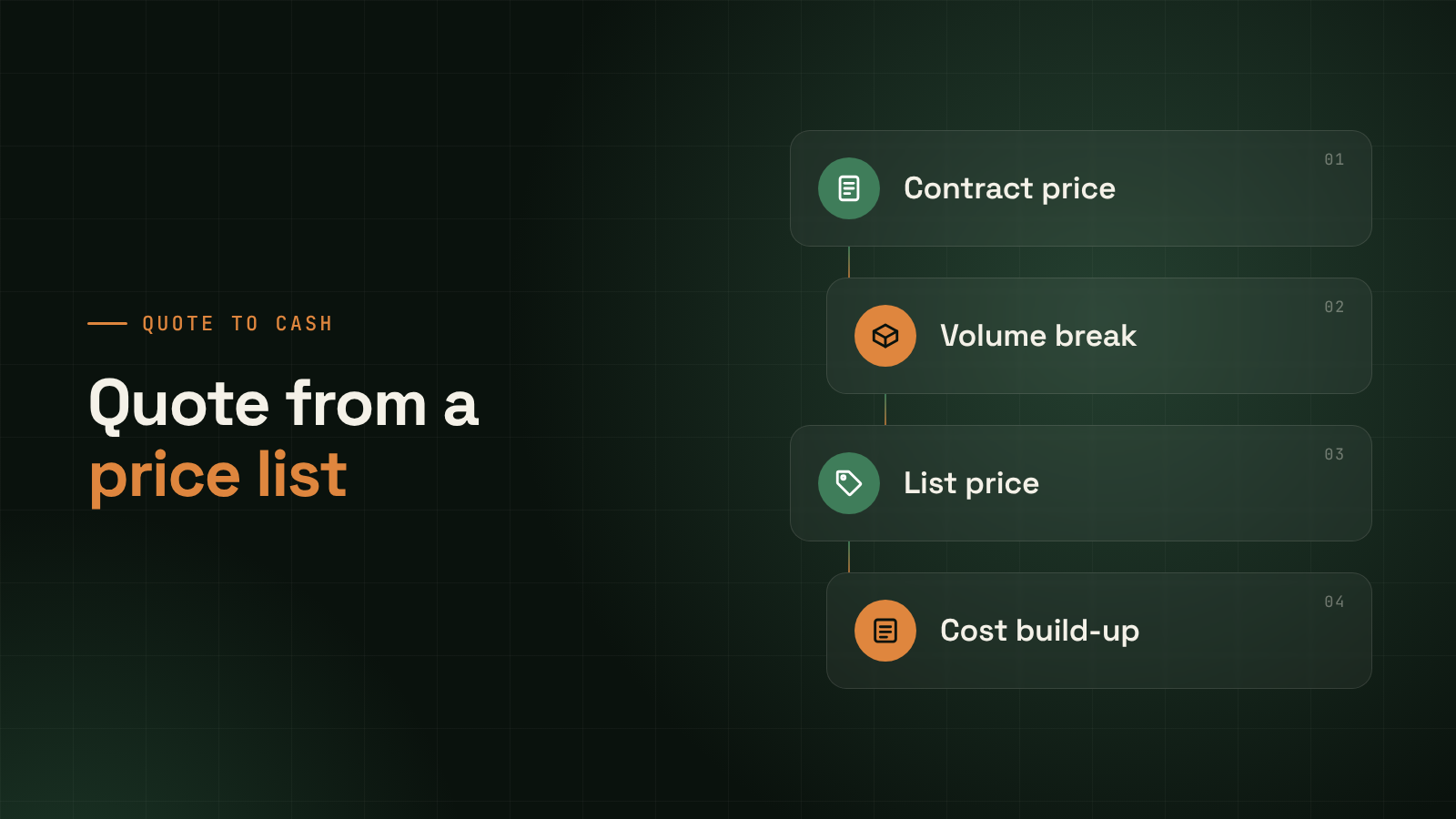
- Reliability comes from a written retrieval order: contract price, then any volume break, then the list price for that customer group and currency, then a cost build-up.
- A line with no retrievable price, a discount beyond policy, or a price that silently excludes freight should become a named exception, not an estimate.
- Across a border, three things decide whether a number means anything: the currency, the delivery term, and whether transport and duty sit inside or outside the price.
Imagine you run commercial operations at a 400-person industrial services company selling into four countries. A customer asks for pricing on twelve lines, nine stock items and three installation days. The ERP price list was last refreshed fourteen months ago. Two contract customers are priced in a spreadsheet on a shared drive. The day rate sits in a PDF someone circulated in March, and the freight number comes from a colleague who is on leave until Monday.
Quoting from a rate card or price list means retrieving an already agreed price for a given customer, item and quantity from a source of record and putting it on a quotation, rather than deciding a price from scratch. That is work an AI agent does well, and it is also where quoting projects quietly fail, because the price was never in a system to begin with. What follows is where a quoted price comes from, the order it should be retrieved in, what happens when there is only a cost, and what the agent must refuse to do. The quote automation and CPQ page shows the working shape of it.
Can AI quote from a rate card or price list?
Yes. Where a price exists in a structured, reachable place, an agent can find the right one for that customer, item, quantity and currency, write it onto a draft quotation, and record which source it used. It applies your pricing rules. It does not form an opinion about what the customer should pay.
One clarification, because the phrase is used three ways. A rate card in advertising is a published media price list, and a freelancer’s rate card is a personal day rate. Here it means what it means in a business-to-business seller’s office: an agreed schedule of prices for products or billable services, by customer, region or contract.
Where does a quoted price actually come from?
From one of six places, and most mid-market companies use all six at once without having written that down. The agent’s job is to know which one applies to this line, for this customer, at this quantity, in this currency, then say which one it used.
| Price source | Where it usually lives | What breaks |
|---|---|---|
| Standard price list by customer group and currency | The ERP | It goes stale, and a list nobody refreshed is quoted with full confidence |
| Contract or special price for one customer | The ERP if you are lucky, a spreadsheet or signed PDF if not | Expiry dates nobody tracks, so an expired price keeps going out |
| Volume or quantity break | The price list, where the structure supports breaks | Thresholds applied inconsistently by person and by branch |
| Service rate card: day rates, call-out, mobilization | A document, rarely the ERP | Rates differ by skill, shift and country and sit nowhere queryable |
| Cost build-up for made-to-order or project work | A costing sheet, usually per estimator | Each estimator builds it differently, so margin varies by who answered |
| Spot price backed by a supplier quotation | An inbox | The supplier price expires before your quotation does |
The first three are retrieval problems, and an agent handles them. The last three are part retrieval and part judgment, and that split decides how much of your quoting can be automated honestly.
What order should the agent retrieve a price in?
A written one, applied identically every time: contract or special price for that customer, then any volume break the quantity earns, then the standard list price for that customer group and currency, then a cost build-up for lines with no list price. Anything the order does not resolve stops and asks.
The value is not the sequence. It is that the sequence behaves the same at 9am on a Monday and at 6pm on a quarter end, whoever picked up the email. The quiet damage in manual quoting is rarely one wrong price. It is the same item going out at three prices to three comparable customers, which nobody sees until the margin report lands.
One more rule keeps it usable: the agent records the source on each line, so a reviewer sees “contract price, agreement ending March 31” rather than a bare number.
What happens when there is no price, only a cost?
Then the line is not a retrieval problem, and the agent should not pretend otherwise. Made-to-order items, engineered work and project scopes are priced from a build-up: materials, labor hours, bought-in items, freight, contingency and margin. Some inputs are lookups. At least one is a judgment.
The workable split is that the agent assembles everything retrievable and routes the line to the person who owns the judgment. It can pull current material costs, apply the standard labor rate for that skill and region, add the freight basis, and present a build-up with one field empty and a question attached. An agent that guesses the missing number is a different product, and the difference shows the first time a contingency is quietly set to zero.
Services work the same way. A day rate exists, but whether the job needs two engineers for three days or three for two is scoping. Holding the rate card saves hours. Deciding the scope is a liability.
How does the agent handle freight, duty and landed cost?
By treating them as named components with an owner, not as a rounding allowance. A quoted price that silently excluded transport becomes an order that included it, and the gap surfaces months later as margin leakage nobody can trace to a decision.
Start with the delivery term, because it decides who pays for what. The International Chamber of Commerce describes the Incoterms rules as “a set of standards used in international and domestic contracts for the delivery of goods,” working by “clarifying the tasks, costs and risks involved in the delivery of goods from sellers to buyers,” with the current edition in force from January 1, 2020 (ICC, checked November 23, 2026). A price with no delivery term attached has not really been stated.
Past the border, your price becomes the starting point for duty. The World Trade Organization’s Agreement on Implementation of Article VII of GATT 1994 states that “The customs value of imported goods shall be the transaction value, that is the price actually paid or payable for the goods when sold for export to the country of importation adjusted in accordance with the provisions of Article 8” (WTO, checked November 23, 2026). Whether transport and insurance sit inside that value is not universal. Article 8.2 says that “In framing its legislation, each Member shall provide for the inclusion in or the exclusion from the customs value, in whole or in part” of the cost of transport to the place of importation, the associated loading and handling charges, and the cost of insurance. The same price can land differently in two countries, by design.
The table is a cross-region view of what has to be settled before a number is stated. Only the two quotations above are cited rules. These rows name the regime and the operational question, and were not verified at primary sources for this article.
| Market | Indirect tax regime the quoted price feeds into | What to settle before quoting |
|---|---|---|
| United States | State and local sales tax, no national value added tax | Taxability in the ship-to state, and whether exemption or resale documentation is on file |
| European Union | Value added tax (VAT) | The customer’s VAT status and the ship-to member state |
| United Kingdom | VAT | VAT status, and whether the supply is domestic or an export |
| India | Goods and services tax (GST) | The customer’s GST registration number (GSTIN) and the place of supply on the account |
| Gulf states | VAT, with national e-invoicing programs | Tax registration, and whether the sale is domestic or cross-border |
Currency belongs in the same conversation. A customer asking in a currency your price lists do not hold is an exception, not a conversion. An agent that silently converts at today’s rate has invented a price.
What about discounts, and who approves them?
The agent drafts at policy price and routes anything beyond policy to a named person. A discount is a commercial decision with a margin consequence, and an agent that grants one alone forces every quotation it produces to be re-checked by hand.
What it can do is make that decision fast. It shows the requested discount, the resulting margin against the floor, what this customer was given last time, and who holds authority at that level, so the approver answers a question instead of starting an investigation. Where that authority model comes from is set out in AI agent governance, approvals and audit trails.
With no written discount rule, every request routes to a person and the automation looks broken while behaving as designed. Writing the rule is the fix, with or without an agent.
How do you tell whether your prices are ready for this?
Take last month’s quotations and ask one question per line: could someone who joined last week have found that price without asking a colleague? Where the answer is no, you have found the work. The common symptoms are few and recognizable.
| Symptom | What it usually means | What to do first |
|---|---|---|
| Sales quotes prices that differ from the ERP | The real price list lives in a spreadsheet | Move the live list into the system of record before automating |
| Nobody can say when a customer’s special price expires | Contract prices are held as documents, not dated records | Load contract prices with start and end dates |
| Service rates are quoted from a circulated PDF | There is no queryable rate card | Build a rate card by role, shift and region, even as a simple table |
| The same item went out at three prices last quarter | No retrieval order exists, so each person improvises | Write the order down, then test it against those three quotations |
| Freight is “added later” | Freight has no owner on the quotation | Fix the delivery term and the source of the number, per customer type |
None of those fixes needs software, and all five cap how well an agent can perform until they are done.
What does the agent write back, and where?
A draft quotation in the system you already run, created through its documented interface so the system’s own pricing, tax determination, numbering and validation still apply. In SAP Business One that is the sales quotation document, in SAP S/4HANA and SAP ECC the sales quotation object, and in a CRM-led desk the quote record on the opportunity.
A price calculated outside the ERP and pasted into a template bypasses every control the ERP holds, including the price list hierarchy. The same discipline one step later is covered in can AI read customer purchase order PDFs.
What this doesn’t do
- It does not set prices. It retrieves them from contracts, price lists, rate cards and cost build-ups. A line with no retrievable price becomes a named exception.
- It does not grant discounts. Anything outside written policy is drafted at policy price and routed to the approver with the margin impact shown.
- It does not scope engineered or project work. It can assemble a build-up and leave the judgment fields open. Effort, contingency and risk stay with an estimator.
- It does not convert currencies in the background. A request in a currency with no price list behind it raises an exception.
- It does not clean your pricing data, or send the quotation. Stale lists get applied faster, and send authority stays with a named person until you decide otherwise in writing.
Frequently asked questions
How does the agent know our pricing and discount rules?
It reads them from the systems and documents that hold them: price lists and special prices in the ERP, contract records, rate cards, and a written discount policy. Nothing is inferred from past quotations alone. Where a rule is written down nowhere, the agent cannot apply it, and that gap is better found before a project than during one.
Can it quote from a price list that lives in a spreadsheet?
Technically yes, and it is still the wrong answer. A spreadsheet has no owner, no audit trail and no expiry handling, so you automate the quoting and keep the pricing risk. Load the list into the system of record first, then point the agent at it.
Is AI-generated pricing accurate?
The question is slightly off target. The agent retrieves a price rather than generating one, so its accuracy is your source data plus the correctness of the retrieval order. If the price list is right, the output is right and repeatable. If the list is fourteen months old, the agent quotes fourteen-month-old prices faster than a person would.
Does this work with SAP S/4HANA, SAP ECC and SAP Business One, across multiple entities and currencies?
Yes, with configuration per entity. Each holds sales quotation documents and price list structures and exposes a documented interface, so quotations are written through the system’s own validation rather than around it. Separate company databases carry their own item masters, price lists and tax determination, so pricing rules are maintained per entity, and a currency with no price list behind it should raise an exception.
What happens when a customer asks for something we have never quoted?
It becomes an exception with a reason attached, not a guess. The agent reports that no contract price, list price or rate card entry covers that item for that customer, and routes it to whoever owns new pricing. For resale items it can attach the supplier quotation it found, with that quotation’s own expiry date.
Will it replace our pricing or inside sales team?
It changes what the day is spent on rather than how many people there are. The lookups, the retyping and the chasing of a freight number go. Deciding what a strategic account should pay, scoping a project and holding a difficult conversation about a discount do not.
Where to go next
To see how the quoting agent retrieves prices from your contracts, price lists and rate cards and drafts a quotation in the system you already run, start with quote automation and CPQ, or read how it works. Three related reads:
- Can AI read customer inquiries and reply with a quote covers the step before pricing, where a customer’s wording becomes your item codes and quantities.
- What is the lead-to-quote process maps the seven steps from inbound request to sent quotation, and where the elapsed days go.
- Quote-to-cash automation picks up after the quotation is sent, and explains why handoffs cost more time than steps.