Table of Contents
Key takeaways
- Lead-to-quote is everything between a buying signal arriving and a priced quotation reaching the customer. It ends where quote-to-cash begins.
- Most of the elapsed time is not document creation. It is working out what the customer means, finding the right price, and waiting for an input from someone else.
- The process has an owner problem: marketing owns the lead, sales owns the relationship, and nobody owns the hours in between.
- Before a price can be stated, four things have to be settled: currency, tax treatment, delivery terms and payment terms. All four are lookups, not opinions.
- An agent can take over resolution, retrieval and drafting. Pricing judgment, discount approval and sending stay with a named person.
Imagine you run sales operations at a 300-person pump manufacturer selling into four countries. A distributor emails asking for pricing on eleven line items. Three days later it is still sitting with a regional salesperson who is waiting on a freight cost, and nobody can tell you how many other requests are in the same state, because they live in individual mailboxes. The quarter ends in two weeks.
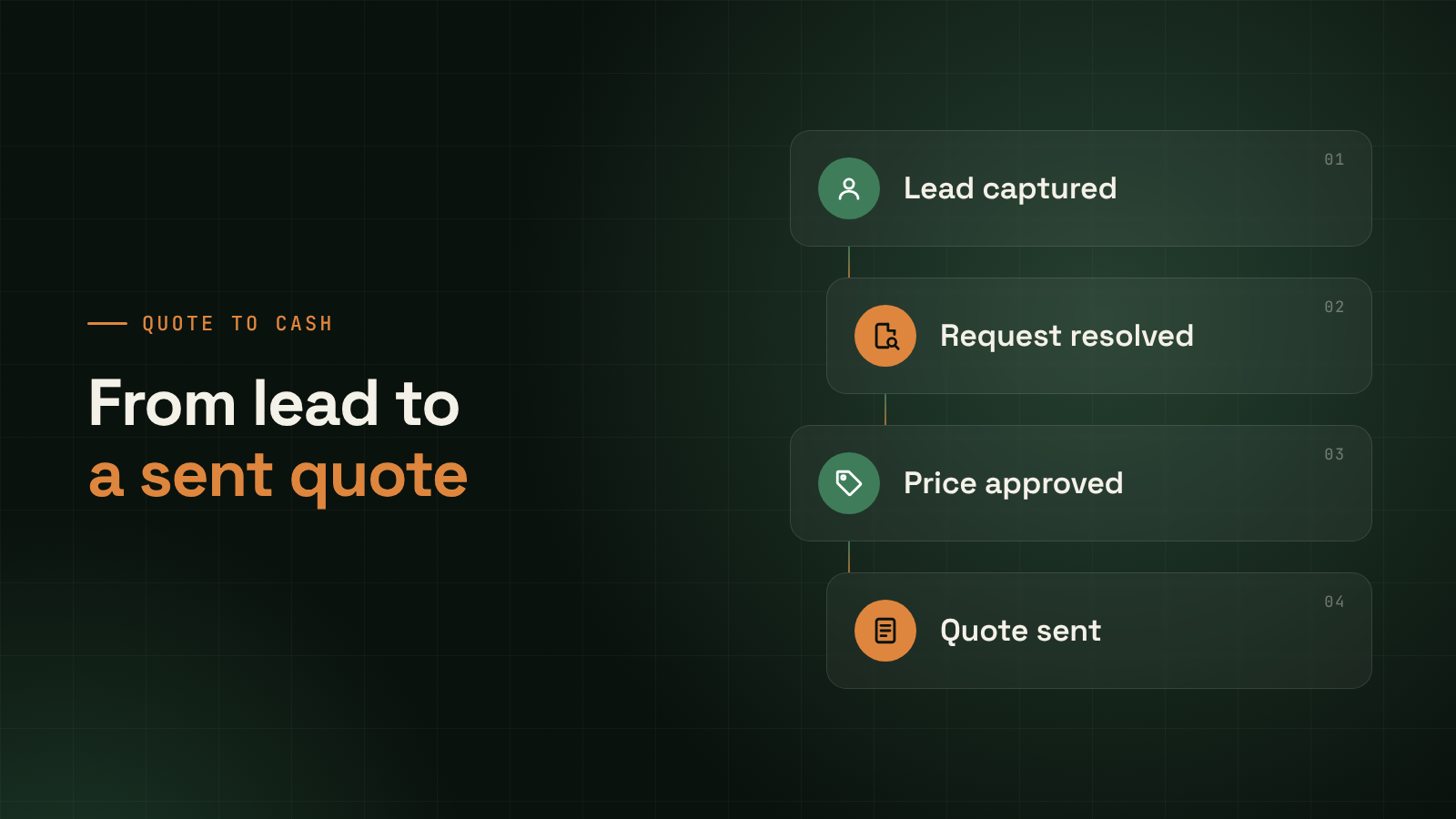
The lead-to-quote process is the sequence of steps a business runs between a buying signal arriving and a priced, sendable quotation reaching the customer. It covers capture, qualification, requirement resolution, pricing, internal approval, document creation and sending. It is the part of selling that happens before anything is ordered, and in most mid-market companies it is the least documented process in the business. Understanding it matters because this is where quotations are delayed, priced inconsistently or quietly never sent. The quote automation and CPQ page shows what a supported version of it looks like.
What is the lead-to-quote process?
It is the stretch of the commercial cycle that starts when an inbound lead or customer request arrives and ends when a quotation has been issued. Nothing in it is a financial transaction. No stock moves, no revenue is recognized, and nothing posts to the ledger. What it produces is a priced offer and a record of what was offered.
That last point is why the process is worth defining rather than leaving to habit. A quotation is a commitment with a number on it. If three salespeople quote the same item three ways, the damage shows up months later in margin, not this week in a report.
Two words are worth separating. A lead is a potential buyer who may not have asked for anything specific. An inquiry, written as “enquiry” in much of the world, is a specific request for pricing. Both feed the same process, but a lead needs qualification first and an inquiry needs resolution first.
What are the steps, and who owns each one?
Seven steps, in a fixed order, though companies name them differently. The useful question is not what to call them but who owns each one and what it waits on. Ownership gaps, not step count, are what make a quotation take nine days.
| Step | What has to happen | Who usually owns it | Where it stalls |
|---|---|---|---|
| 1. Capture | The lead or inquiry is logged against a customer or prospect record, whatever channel it arrived on | Marketing, inside sales or a shared mailbox | Requests that live in one person’s inbox and are invisible to everyone else |
| 2. Qualification | Is this a real buyer, in a market you serve, for something you sell | Sales | Qualification by gut, with no written rule, so nothing is consistently dropped or escalated |
| 3. Resolution | The customer’s wording becomes your item codes, quantities and units of measure | Inside sales or technical sales | Vague descriptions, customer part numbers, and items that may be configured rather than catalog |
| 4. Pricing | A price is retrieved from a contract, price list or cost build-up | Sales, with finance or product costing | Waiting on a cost, a freight number or a supplier quotation |
| 5. Approval | Any discount or term outside policy is authorized | Sales manager or commercial head | No written discount rule, so every exception is a conversation |
| 6. Document | The quotation is created in the ERP or CRM with terms, validity and tax treatment | Inside sales | Retyping the same data into a template that lives outside the system of record |
| 7. Send and follow up | The quotation reaches the customer, and someone follows up before it lapses | Sales | No list of open quotations with dates, so follow-up depends on memory |
Steps 3 and 4 hold most of the work. Step 7 holds most of the lost revenue.
How is lead-to-quote different from quote-to-cash and CPQ?
They are adjacent stretches of one commercial cycle, and the confusion is costly because teams buy software for one stretch while the problem sits in another. Lead-to-quote ends at a sent quotation. Quote-to-cash starts there. CPQ is a tool category that operates inside the quoting step, not a description of the whole process.
| Term | Where it starts | Where it ends | What it is |
|---|---|---|---|
| Lead-to-quote | An inbound lead or customer inquiry | A quotation sent to the customer | A process |
| Quote-to-cash | An accepted or issued quotation | Cash received and applied | A process |
| Lead-to-cash | The first buying signal | Cash received | The two above, joined end to end |
| Order-to-cash | A customer order | Cash received | A process, the back half of quote-to-cash |
| CPQ (configure, price, quote) | An opportunity with a product selection | A generated quote document | A software category |
| RFQ response | A formal request for quotation, often from a procurement portal | A submitted bid | A sell-side subset of lead-to-quote |
The practical consequence: a company looking for help with its quote to cash process often has a lead-to-quote problem, because quotations are slow or inconsistent long before any order exists. Where the handoffs in the later stages cost the time, quote-to-cash automation covers that half.
Where do the days actually go?
Not into writing the document. In most teams the quotation itself takes minutes once every input is in hand. The elapsed days are waiting time: waiting for a person to read the request, waiting for a cost or a freight rate, waiting for an approval, and waiting for someone to remember to send it.
Three patterns account for most of it. Batching, where requests are handled when a salesperson next opens the mailbox. Serial dependency, where nobody prices a line until the costing comes back, even for the eight lines that do not need it. And invisible queues, where no shared list of open requests exists, so one that falls through the gap is noticed only when the customer buys elsewhere. None of the three is solved by a better document template.
What has to be settled before a price can be stated?
Four things: the currency and price list behind it, the indirect tax treatment, the delivery terms, and the payment terms. Each is a lookup against the customer master or a contract, not a judgment call, which is exactly why they are automatable. A quotation issued without them is not really a price.
Delivery terms matter more than they look. The International Chamber of Commerce describes the Incoterms rules as “a set of standards used in international and domestic contracts for the delivery of goods,” which clarify “the tasks, costs and risks involved in the delivery of goods from sellers to buyers,” with Incoterms 2020 the most recent edition (ICC, checked November 20, 2026). A price that does not name a delivery term leaves the cost of getting the goods there unassigned.
The table below separates what is verified from what is an operating requirement. Only the two European rows state a rule checked at its source today. The rest name the regime and the thing to pin down before quoting, because those were not verified at primary sources for this article.
| Region | Indirect tax regime the quotation feeds into | Payment terms position | What to settle before quoting |
|---|---|---|---|
| European Union | VAT. The European Commission states that under the VAT in the Digital Age package, adopted on March 11, 2025, “Digital Reporting Requirements will affect cross-border B2B transactions from 1 July 2030” (checked November 20, 2026) | The Commission’s late payment page states that under Directive 2011/7/EU “enterprises have to pay their invoices within 60 days, unless they expressly agree otherwise and provided it is not grossly unfair” (checked November 20, 2026) | The customer’s VAT status and ship-to member state |
| United Kingdom | VAT | Set by contract | VAT status, and whether the supply is domestic or an export |
| United States | State and local sales tax, no national VAT | Set by contract | Whether the sale is taxable in the ship-to state, and whether exemption or resale documentation is on file |
| India | Goods and services tax (GST), a destination-based indirect tax | Set by contract | The customer’s GST registration number (GSTIN) and the place of supply on the account |
| Gulf states | VAT, with e-invoicing programs run by national tax authorities | Set by contract | Tax registration, and whether the sale is domestic or cross-border |
| Asia-Pacific, other | VAT or goods and services tax, varying by country | Set by contract | Registration status, place of supply, and the currency the price list holds |
The pattern is the same everywhere. Decisions taken casually at the quotation stage are inherited by the order and then by the invoice, and in a growing number of countries that invoice is reported to a tax authority rather than emailed.
Which steps can an AI agent take over?
The lookup-heavy ones. An agent reads the incoming request whatever form it arrived in, resolves each line against your item master, retrieves the right price for that customer and currency, assembles the terms, and drafts the quotation in your ERP or CRM for a person to check. It also keeps the list of open quotations and their dates.
What it does not take is the commercial judgment. Whether to shave three points to win a strategic account, whether to quote a customer who is on credit hold, whether a request is really an engineering question: those are human decisions, and an agent that made them quietly would be a liability rather than a tool. The reading and resolution half is covered in can AI read customer inquiries and reply with a quote, and the authority question is settled the way every agent action should be, by classifying actions by consequence, as AI agent governance, approvals and audit trails sets out.
How do you tell whether your lead-to-quote process is working?
Four numbers, none of which most mid-market teams can produce today. How many requests arrived last month, and how many became quotations. How long each took from arrival to sending. How many open quotations have passed their validity date with no follow-up. And how often the same item was quoted at different prices to comparable customers.
If those numbers are unavailable rather than bad, that is the finding. A process you cannot measure runs on individual memory, and it will keep doing so after any software purchase.
What should you fix before automating it?
Three things, in this order. The item master first: duplicate codes, dead items and inconsistent units do not stop an agent, which is the risk, because it reproduces the confusion faster. A written discount rule second, because without one every exception routes to a person and the automation looks broken while behaving correctly. A single place where requests land third, so the queue is visible before anyone tries to shorten it. None of the three needs software, and all three are worth doing whether or not you ever automate the process.
What this doesn’t do
- It does not set prices. An agent retrieves a price from a contract, price list or cost build-up. A line with no retrievable price becomes a named exception, not an estimate.
- It does not send quotations by default. Send authority and any discount beyond policy stay with a named person, and starting any other way is a mistake.
- It does not qualify leads for you. Qualification rules are a commercial decision. An agent can apply a written rule; it cannot invent the rule.
- It does not estimate engineered work. Requests that need a drawing reviewed or a cost built by a specialist are routed, not quoted.
- It does not fix your master data or decide tax treatment. Resolution quality is capped by data quality, and tax determination stays with the rules configured in your ERP.
Frequently asked questions
What does lead-to-quote mean in simple terms?
It means everything a company does between a buyer showing interest and that buyer receiving a price. Capture the request, check it is worth quoting, work out exactly what was asked for, price it, approve anything outside policy, create the quotation and send it. Nothing has been ordered yet.
Is lead-to-quote the same as quote-to-cash?
No. They are consecutive. Lead-to-quote ends when the quotation is sent; quote-to-cash starts from the quotation and ends when the money arrives and is applied. Together they are sometimes called lead-to-cash. Buying software for one when your problem is in the other is a common and expensive mistake.
How long should a quotation take?
There is no credible published benchmark for mid-market B2B quoting that survives a source check, so treat any number you are shown with suspicion. The practical answer is to measure your own arrival-to-sent time for a month, then look at how much of it is waiting rather than working. The waiting is the part you can remove.
Do we need a CRM to run a lead-to-quote process?
No, but you need one shared place where requests land and open quotations are visible. That can be a CRM, the quotation module of your ERP, or a shared queue. What does not work is individual mailboxes, because the requests that go missing there are invisible by definition.
Does this work with SAP S/4HANA, SAP ECC and SAP Business One, and across multiple entities and currencies?
Yes, with configuration per entity. Each of those systems has a sales quotation document and a documented interface for creating one, so quotations are written through the system’s own validation and numbering rather than around it. Separate company databases hold their own item masters, price lists and tax determination, so pricing rules and cross references are maintained per entity, and a currency with no price list behind it should raise an exception rather than trigger a silent conversion.
Can the agent send the quotation to the customer itself?
Not by default. The normal design is that the agent drafts and notifies the owner, who checks and sends. Some teams later allow automatic sending for repeat catalog items at list price, with everything else routed to a person. That choice should be a written rule, not a setting someone flips.
Where to go next
To see how the quoting agent reads an inbound request, resolves it against your item master and drafts a quotation in the system you already run, start with quote automation and CPQ, or read how it works. Three related reads:
- Can AI read customer inquiries and reply with a quote covers the resolution and drafting steps in detail, including where the price comes from.
- Quote-to-cash automation picks up where this process ends, and explains why handoffs cost more time than the steps themselves.
- Can AI read customer purchase order PDFs covers what happens when the customer accepts and sends an order against your quotation.