Table of Contents
Key takeaways
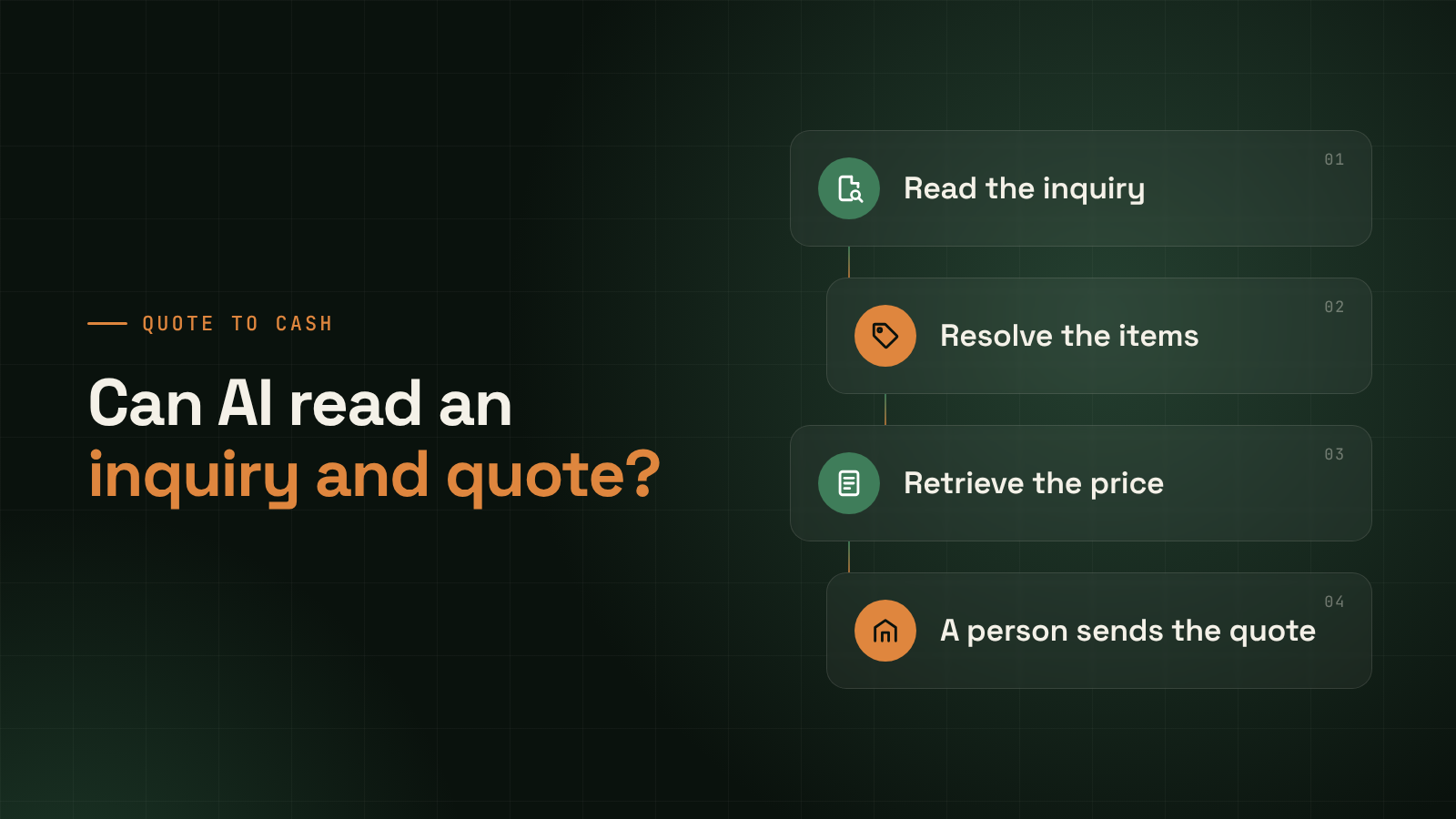
- An agent can read an inbound inquiry, resolve the lines against your item master, retrieve prices and draft a quotation. Sending it stays a human decision.
- Reading the message is the easy part. Turning “2 inch stainless ball valve, 40 pieces, delivered Rotterdam” into your item codes, units and price list is the work.
- CPQ and quoting tools start after this step. They assume a deal record and a chosen product, so a person has already read the email.
- The agent retrieves a price, it never invents one. No price, a discount beyond policy, or a request that is really a specification should produce a named exception.
- Two conditions decide whether it works: an item master clean enough to resolve customer wording, and a written discount rule.
Imagine you run inside sales at a 250-person valve distributor with branches in three countries. Thirty inquiries landed overnight. One is a tidy spreadsheet, one a photograph of a handwritten list, and most a paragraph of email asking your best price on items described the way the customer thinks of them. By Thursday the oldest are two days old and one of those customers has bought elsewhere.
Inquiry-to-quote automation is the practice of having an AI agent read an inbound customer inquiry, resolve what was asked for against your item master and price list, and draft a quotation for a person to check and send. If you searched for whether AI can read customer inquiries and reply with a quote, the spelling differs by region and the question is identical. What follows is what the agent reads, how a description becomes something priceable, what it writes into your ERP, and where it stops. The quote automation and CPQ page shows the working shape of it.
Can AI read a customer inquiry and reply with a quote?
Yes, with one qualification. An agent can read the inquiry, resolve each line against your item master, pull prices from the right price list or rate card, and draft a complete quotation in your ERP or CRM. Sending it to the customer is a separate decision, and in most deployments a named person makes it.
That is not timidity. A quotation is a commitment with a price on it, and a wrong one is either a loss you honor or a conversation you did not want. The design that works is an agent doing the ninety minutes of lookup and drafting, and a salesperson spending two minutes checking it.
Why do quoting tools start after this step?
Because CPQ and quoting software assume an opportunity record already exists, with a customer, a product selection and a configuration attached. Someone has already read the message, decided what it is and chosen the lines, and that deciding is what takes the time. Very little of the delay is the document, which is a template. The hours go into working out what the customer means, checking whether you sell it, finding the last price that account was given, and waiting for a cost. A tool that starts at “create quote” leaves all of it in place.
What does the agent actually read?
Whatever the customer sent. Inquiries arrive as email text, PDF requests for quotation, spreadsheets in the customer’s own layout, web form submissions and chat fragments. The agent reads each and extracts the same five things: who is asking, what they want, how many, where it goes, and by when.
| What arrives | What it typically contains | What has to be resolved before a price exists |
|---|---|---|
| Email body text | A loose description, a quantity, sometimes a delivery place | Which of your items it means, in which unit of measure |
| PDF request for quotation | A structured form on the customer’s template | Line by line mapping to your item codes, plus the stated terms |
| Spreadsheet attachment | The customer’s own columns and part numbering | Column meaning, then customer part number to your item code |
| Web or portal form | Structured but shallow fields | Whatever the form did not ask, usually delivery terms and quantity breaks |
| Chat message | Fragments across several messages, sometimes a photo | The complete request, assembled from pieces |
| Drawing or specification sheet | A specification, not a part number | Whether this is a catalog item, a configured item or an engineering question |
The last row decides project scope. A specification that needs an engineer to cost it is an estimating problem, not a quoting problem, and an honest deployment routes it to a person.
How does a description become something you can price?
By resolution, the same hard problem that sits inside order automation. The agent matches the customer’s wording against your item master, your customer-specific cross references and your past quotations to that account, then returns a candidate with a confidence level. Low confidence produces a question, not a line.
Three things make it work. A cross reference the agent builds per customer, so the second inquiry from that account is easier than the first. Unit handling, because customers ask in pieces, meters, boxes and kilograms while your price list holds one of those. And a rule that an unresolved line never becomes a priced line. The same problem one step later is covered in can AI read customer purchase order PDFs, and the point in OCR versus AI invoice capture holds here too: template matching works on layouts you have seen and fails on the long tail.
Where does the price come from?
From your systems, in a defined order: a contract or customer-specific price list first, then the standard list for that customer group and currency, then a cost build-up for made-to-order lines. The agent retrieves a price, it does not calculate one from nothing.
| Situation | Wrong behavior | Correct behavior |
|---|---|---|
| No price exists for the item or customer | Apply the nearest price found | Raise a named exception and quote nothing for that line |
| A discount beyond policy is requested | Grant it inside the draft | Draft at policy price and route the request to the named approver |
| Freight, duty or packing is not in the price list | Leave it out silently or guess | State what is excluded, or hold the line for a cost input |
The third row is where quotations quietly lose money. A price that excluded freight becomes an order that included it, and nobody notices until the margin report.
What does the agent write, and where?
A draft quotation in the system you already run, created through its documented interface so the system’s own validation still applies. In SAP Business One that is the sales quotation document, in SAP S/4HANA the sales quotation object, and in a CRM-led desk the quote record on the opportunity.
One detail from SAP Business One’s documentation explains a common gap. The sales quotation carries a “Valid Until” date, which SAP describes as “the date until which the sales quotation is valid,” defaulting to 30 days after the posting date, and adds that “The field is informative only” (SAP Business One documentation, checked November 19, 2026). A quotation whose status is Open is one where, in SAP’s wording, “You can draw the document completely or partially to a document of a higher level.” The ERP knows which quotations are still live and when each lapses. Nothing in it chases them.
What changes when the customer is in another country?
Three things have to be settled before a price can be stated: the currency and the price list behind it, the indirect tax treatment, and the delivery terms. None is a decision the agent should make alone, and all are lookups it can perform.
| Region | Indirect tax regime the quote feeds into | What to pin down before quoting |
|---|---|---|
| United States | State and local sales tax, no national VAT | Whether the sale is taxable in the ship-to state, and whether exemption or resale documentation is on file |
| European Union | VAT | The customer’s VAT status and ship-to member state |
| United Kingdom | VAT | The customer’s VAT status and whether the supply is domestic or an export |
| India | Goods and services tax (GST) | The customer’s GST registration number (GSTIN) and the place of supply held on the account |
| Gulf states | VAT, with Saudi Arabia’s e-invoicing program run by ZATCA | The customer’s tax registration and whether the sale is domestic or cross-border |
Only one claim in that table is a checked statutory fact rather than an operational requirement. The European Commission describes VAT in the Digital Age (ViDA) as a package to modernize and improve the EU VAT system, adopted on March 11, 2025 and rolled out progressively until January 2035, and states that “Digital Reporting Requirements will affect cross-border B2B transactions from July 1, 2030” (European Commission, checked November 19, 2026). The tax code chosen on a quotation flows through the order into the invoice, and in a growing number of countries that invoice is reported to a tax authority rather than emailed.
Delivery terms need the same discipline. The International Chamber of Commerce describes the Incoterms rules as “a set of standards used in international and domestic contracts for the delivery of goods,” which clarify “the tasks, costs and risks involved in the delivery of goods from sellers to buyers,” with Incoterms 2020 the current edition (ICC, checked November 19, 2026). A quotation that names a price without naming a delivery term has not really stated a price.
What decides whether this works for you?
You can test for the common failures in an afternoon without buying anything. Take last month’s inquiries and ask: could a careful new joiner resolve each line from the item master alone, is there a written discount rule, is every price retrievable from a system rather than a person, and how many of those inquiries were really engineering requests?
If the first answer is no, fix the item master first. Duplicate codes, dead items and inconsistent units do not stop an agent, which is the danger: it reproduces the confusion quickly and confidently. If the second is no, every discount request routes to a human queue, which is correct behavior and will feel like a failure until somebody writes the rule.
Where it does work, three things change in the first quarter. Inquiries that waited for an afternoon get a draft in minutes. The same customer stops getting different prices depending on who answered. And the quotations nobody followed up become a list with dates on it, which usually moves more revenue than the speed does.
What this doesn’t do
- It does not send the quotation. Send authority, discount approval beyond policy and any commercial concession stay with a named person.
- It does not set prices. It retrieves from your price lists, contracts and cost build-ups, and a line with no retrievable price becomes an exception, not an estimate.
- It does not estimate engineered work. Where a request needs a drawing reviewed or a cost built by a specialist, it routes rather than quotes.
- It does not replace your CRM or CPQ. It fills the step before them, creating the record they assume already exists.
- It does not clean your item master, or decide tax treatment. Resolution quality is capped by data quality, and tax determination stays with the rules configured in your ERP.
Frequently asked questions
Can AI really read an inquiry that arrives as a photograph or a chat message?
Yes, and that is the normal case rather than the hard one. An agent reads email text, PDFs, spreadsheets, form submissions and chat fragments, including photographed documents, and assembles them into one request. The difficulty is not reading the characters. It is deciding which of your items the customer means.
Does the quote go to the customer automatically?
Not by default, and configuring it that way at the start is a mistake. The agent drafts the quotation and notifies the owner, who checks and sends. Some teams later allow automatic sending for repeat catalog items at list price, with everything else routed to a person.
How is this different from CPQ software?
CPQ configures, prices and generates a document once a deal record and a product selection exist. This step creates those inputs from an unstructured inbound message, so the two are complements rather than alternatives. If you already run CPQ, the agent feeds it.
Which ERPs and CRMs does this work with?
Any system that exposes a documented interface for quotation records. SAP Business One uses its Service Layer, SAP S/4HANA and SAP ECC expose their own sales document interfaces, and mainstream CRMs provide quote objects through their APIs. Writing through that interface keeps the system’s validation and numbering in play.
Can it handle multiple companies, currencies and languages?
Yes, with configuration per entity. Separate company databases hold their own item masters, price lists, tax determination and numbering, so cross references and pricing rules are maintained per entity. Inquiries in a second language are readable, and a currency with no price list behind it raises an exception rather than triggering a silent conversion.
What happens to customer data in our mailbox?
The agent reads the inbox it is given access to, under the same controls as any other integration, and what it retains should be limited to the record it creates. Where rules such as the EU General Data Protection Regulation apply, settle the lawful basis, the retention period and who can see the records before connecting the mailbox.
How long before it is useful, and will it replace the inside sales team?
Usefulness depends more on your master data than on the software: a clean item master and a written discount policy usually mean drafts within weeks. It changes what the team does rather than how many of them there are. The lookups, the retyping and the chasing of costs go. The customer conversations and the judgment on price stay.
Where to go next
To see how the quoting agent reads an inbound inquiry, resolves it against your item master and drafts a quotation in the system you already run, start with quote automation and CPQ, or read how it works. Three related reads:
- Quote-to-cash automation shows where the cycle time sits between inquiry and cash, and why handoffs cost more than steps.
- Can AI read customer purchase order PDFs covers the same resolution problem one step later, when the customer accepts and sends an order.
- AI agent governance, approvals and audit trails classifies agent actions by consequence, which is how send authority and discount limits get settled.